
The U.S. military launched strikes against three Iranian crude oil carriers following missile attacks on two American Navy warships. These actions took place near the Strait of Hormuz, a vital shipping lane for global oil supplies. The Islamic Revolutionary Guard Corps (IRGC) fired ballistic missiles at U.S. Navy vessels but did not hit them.
The strikes targeted tankers believed to be part of a network supporting Iran’s military proxies and funding operations in the region, according to NPR. One of the vessels struck was the M/T Downy, an oil carrier linked to the IRGC, located off Kharg Island, according to a report from ntd.com.
The U.S. military said it permanently disabled two tankers and destroyed a third one that was unladen. The strikes occurred in the Gulf of Oman, near key Iranian oil export infrastructure. One tanker was hit near Jask, east of the Strait of Hormuz, and another was struck off Kharg Island.
The U.S. Central Command said that the actions were a response to recent missile attacks on American naval vessels. Admiral Brad Cooper, who leads U.S. Central Command, confirmed the strikes were taken in response to threats from Iran.
The U.S. government has been working to apply economic pressure on Iran since the conflict began. Iranian officials have responded with attacks on military sites in neighboring countries like Kuwait and the UAE.
The conflict has led to a drop in shipping traffic through the Strait of Hormuz. Iran’s new leadership has shown willingness to continue its confrontational stance despite years of international sanctions.
The U.S. has increased efforts to guide ships through the strait as Iran asserts greater control over maritime routes. The situation has resumed after a month of relative calm in the region.
U.S. forces have targeted civilian areas, including a reported strike that hit a wedding. The U.S. military made its decision after Iran launched missiles near Kharg Island, which hosts a major oil export terminal.
A statement shared what it called video footage of the strikes. The U.S. military said it had taken out three Iranian tankers in response to threats made by the IRGC, CNN reported.
The strikes are part of broader U.S. efforts to counter Iran’s influence and protect regional allies. Iran has been using the Strait of Hormuz as a strategic point to assert control over international shipping.
The U.S. military emphasized that its actions were aimed at deterring further attacks on American forces. This escalation follows a pattern of mutual retaliation between the U.S. and Iran since early 2026.
The conflict has raised concerns about global oil supply disruptions and regional stability. International shipping through the Strait of Hormuz remains low due to ongoing tensions.
The U.S. has been working with regional partners to ensure safe passage for commercial vessels. Iran’s response to the strikes is expected to continue as it seeks to maintain leverage in the region.
The government has not yet announced any additional military actions beyond the recent strikes. The incident marks a significant moment in the ongoing conflict between the U.S. and Iran near critical oil infrastructure.
IMAGE:
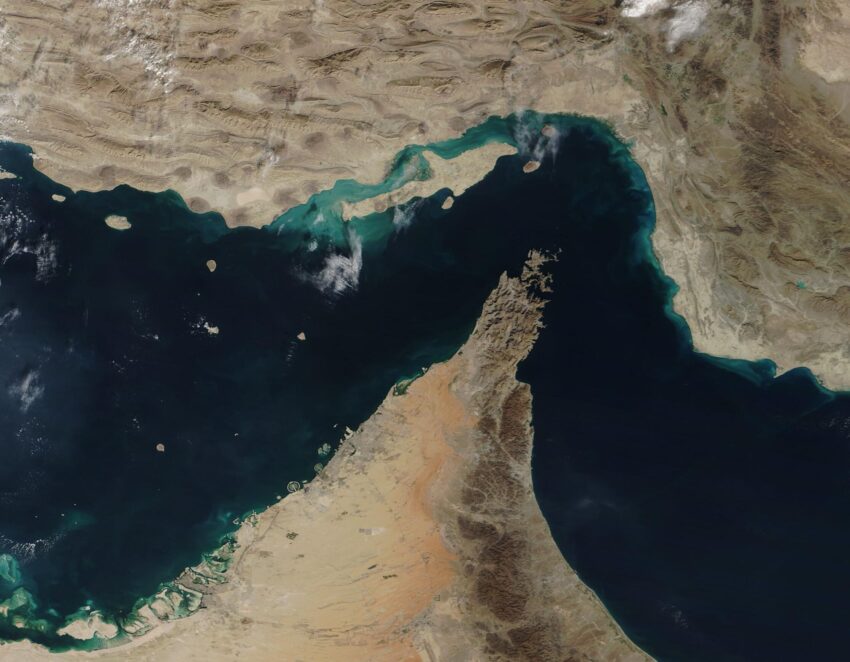
The narrow Strait of Hormuz lies between the Persian Gulf and the Gulf of Oman, separating Iran (north) from the Arabian Peninsula (south). Only about 21 miles (34 km) wide at the narrowest point and roughly 96 miles (155 km) long, about thirty percent of the world’s seaborne oil and nearly one-quarter of the liquified natural gas (LNG) supply passes through this strait — all on shipping lanes that measure only two-mile wide. It has been estimated that 21 million barrels of oil, with a value of 1.2 billion US dollars (USD), pass through the strait every day.
On December 2, 2020, the Moderate Resolution Imaging Spectroradiometer (MODIS) on board NASA’s Terra satellite acquired a true-color image of the Strait of Hormuz.
The arid landscape of Iran sits in the north, with Qeshm Island, the largest in the Persian Gulf, just off the Iranian coast. The tiny Strait of Khuran separates the island and the mainland and bounds a wetland of international importance, recognized by Ramsar. These wetlands provide critical habitat to two globally threatened species: the Dalmatian Pelican and the Green sea turtle. In the south, the rocky and rugged Musandam Peninsula juts into the Strait of Hormuz. The tip of the peninsula is filled by the Musandam Governate, an exclave of Oman. To the south, the land on the peninsula belongs to the United Arab Emirates.. Photo: MODIS Land Rapid Response Team, NASA GSFC / Wikimedia, Public domain