
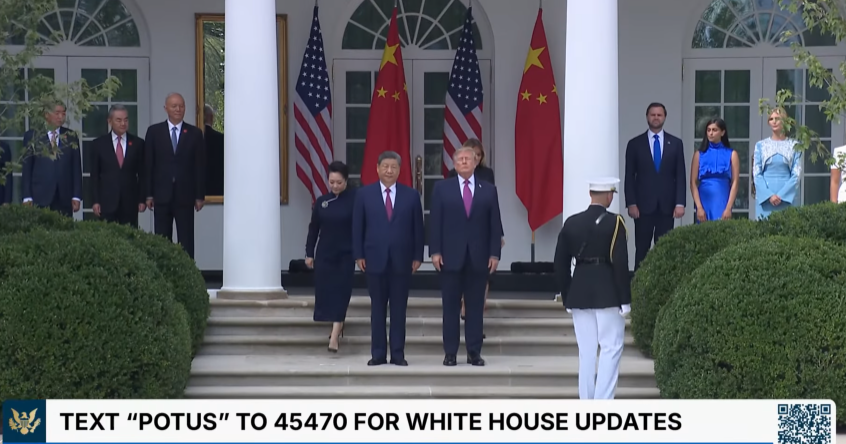
President Donald Trump welcomed Chinese President Xi Jinping to the White House for a formal state visit that included a military review, arrival ceremony, and a state dinner. The event marked a high-level diplomatic exchange following Trump’s earlier trip to Beijing in May, where he described the visit as an “amazing period of time.” Xi Jinping was greeted personally by Trump at Joint Base Andrews, a rare gesture for an American president to extend to a visiting foreign leader.
Prominent American business leaders attended the state dinner, including Elon Musk, Jensen Huang, Tim Cook, and Lisa Su, according to Channel News Asia. Other guests included Jeff Bezos, Sam Altman, Satya Nadella and Sundar Pichai. The Chinese delegation was made up largely of senior government officials rather than business executives. It included Cai Qi, Wang Yi, Vice Premier He Lifeng and other senior officials.
Despite the diplomatic tone, tensions remained over Taiwan. Xi urged Trump to oppose Taiwan independence and to handle the issue with “prudence.” The United States did not publicly announce a change in its Taiwan policy during the visit.
The two countries extended their trade truce to January, but key issues like tariffs and rare-earth supplies were left for further negotiations. Reuters reported that the extension delayed rather than resolved major disputes between the nations. Treasury Secretary Scott Bessent said the two-month extension would give the countries more time to work on economic issues.
Trade and investment have been central parts of the administration’s talks with China. Still, major disputes remain. Chinese shipments of some rare-earth materials to the United States had fallen before the summit despite earlier commitments intended to stabilize supplies.
Artificial intelligence was another major subject during the talks. The U.S. intelligence community assesses China as the country’s most capable competitor in artificial intelligence and says Beijing aims to displace the United States as the global AI leader by 2030. Trump and Xi discussed AI during their White House meeting and agreed that talks between the two countries should continue.
China’s relationship with Russia has grown closer since Russia’s invasion of Ukraine, but Beijing still prioritizes its own national interests. China is also viewed as a major cyber threat to the U.S., along with Russia and North Korea, according to intelligence assessments.
Trump has sought Chinese influence over Russia, particularly in relation to Ukraine, though it remains unclear whether any progress was made during the visit. Trump and Xi discussed Ukraine as well as the Middle East and the Korean Peninsula.
The state dinner was held Thursday evening in the East Room of the White House. The menu combined American ingredients with Chinese influences. Trump and Xi exchanged toasts during the dinner.
The two leaders and their wives held a separate tea in the Red Room on Friday morning. They later traveled to the National Archives, where they viewed records connected to the history of relations between the United States and China.
The visit also took place during a dispute over White House press access. Trump had banned CNN from White House events, leading major television networks to stop participating in the White House television pool for several days. CNN and other reporters regained access after a federal judge ordered the administration to restore their credentials. Television pool coverage resumed Friday in time to show Trump greeting Xi before the tea meeting.
In contrast to the 2015 visit under President Barack Obama, Chinese business leaders were notably absent from this week’s state dinner. Analysts noted that the absence of major Chinese executives limited their opportunity to directly advocate for market access and reciprocal trade policies. The 2015 visit had included prominent figures like Jack Ma and Pony Ma in a bilateral CEO roundtable with Xi in Seattle.
American corporate executives had a much larger presence at this year’s dinner. Musk, Huang, Su and Cook were seated at the head table with Trump, Xi and their wives. Other leaders from technology, banking and industry were also invited.
For Beijing, business delegations have previously been used to show that improved political relations could create commercial opportunities for Chinese firms. This year’s imbalance between the American and Chinese business presence came as the countries continue to disagree over technology restrictions, tariffs and market access.
The state visit followed Trump’s trip to China in May. During that visit, Trump praised Xi and invited him to Washington for the September state visit. The two leaders exchanged state visits within a period of less than six months.
The September summit produced some agreements but left major disagreements unresolved. The trade truce will continue for two more months while negotiations proceed. Taiwan remains a sensitive issue, and the countries continue to compete over artificial intelligence, advanced technology and access to critical minerals.
IMAGE: Author The White House CC0