
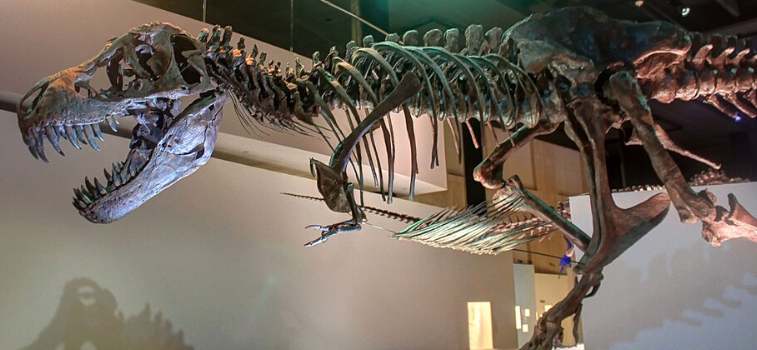
Scientists have long debated whether dinosaurs were warm-blooded or cold-blooded, but new research now shows that Tyrannosaurus rex had a body temperature similar to humans. Once thought of as slow-moving reptiles, many dinosaurs are now believed to have been active and warm-blooded creatures. This latest study was conducted by researchers from UCLA in collaboration with the Natural History Museum of Los Angeles County. The findings were published September 16 in the journal Science Advances.
The researchers analyzed enamel from three T. rex teeth from the Late Cretaceous Hell Creek Formation. The team used isotopic signatures in the tooth enamel to measure how hot the dinosaur’s body had been. Their findings show that Thomas the T. rex had a body temperature around 97 degrees Fahrenheit, according to a report from popsci.com. The study calculated a temperature of 36.3 degrees Celsius or about 97.3 degrees Fahrenheit with an uncertainty of about 4.5 degrees Fahrenheit.
This result places T. rex in the same category as warm-blooded animals like humans and birds. It is the first thermodynamically and relatively direct measure of a T. rex’s body temperature. The method was developed by UCLA years ago and previously used to study other large prehistoric animals like megalodon. The method is known as clumped-isotope thermometry and measures how rare forms of carbon and oxygen bond together in tooth enamel.
The research team needed only a few milligrams of tooth enamel to make their measurements. The Natural History Museum provided small portions of two teeth from Thomas the T. rex, which is one of the most complete T. rex skeletons ever found. Using a dental drill, they removed tiny pieces of fossilized enamel and dissolved them in acid to extract carbon dioxide gas. Thomas was found in Montana and has nearly 65% of its skeleton preserved.
Then they used a mass spectrometer to analyze the gas and determine the temperature at which the enamel formed. The process revealed that T. rex had a body temperature close to that of modern humans. This finding supports earlier theories about the dinosaur’s active lifestyle and metabolism. Crocodilian teeth from the same Hell Creek deposits produced a temperature of about 86 degrees Fahrenheit. Researchers said the difference helped show that geological changes had not simply altered all of the fossils to produce similar readings.
It also helps explain how T. rex was able to live in a wide range of climates from Texas to Alberta. Warm-blooded animals can maintain their body temperature even when the environment changes. This ability would have allowed T. rex to move into colder regions and hunt more efficiently. Computer modeling used by the researchers found that much of ancient North America including colder northern regions could have provided suitable habitat for T. rex.
The study adds to growing evidence that many dinosaurs were warm-blooded rather than cold-blooded, Yahoo News reported. It also shows how scientific methods have advanced to allow researchers to learn more about extinct animals. The research followed more than a decade of work to improve the technique enough that only tiny amounts of valuable fossil material were needed. UCLA researcher Aradhna Tripati said the project grew out of about 15 years of discussions and method development.
This study gives scientists a clearer picture of how T. rex lived and moved through its environment. The findings support the idea that T. rex maintained a body temperature above its environment and had a physiology consistent with endothermy. A warmer body would have required substantial energy and may have helped the predator remain active for longer periods. The researchers did not directly measure T. rex’s metabolic rate so its metabolism cannot be assumed to have worked exactly like that of a modern human or other mammal.
The study was published in the journal Science Advances. This is a major step forward in understanding how dinosaurs functioned and evolved.
The study provides direct evidence that T. rex maintained a warm body temperature and was not dependent on environmental heat in the same way as modern cold-blooded reptiles. The research shows how much we’ve learned about the lives of dinosaurs in recent decades.
IMAGE: Yinan Chen CC0