
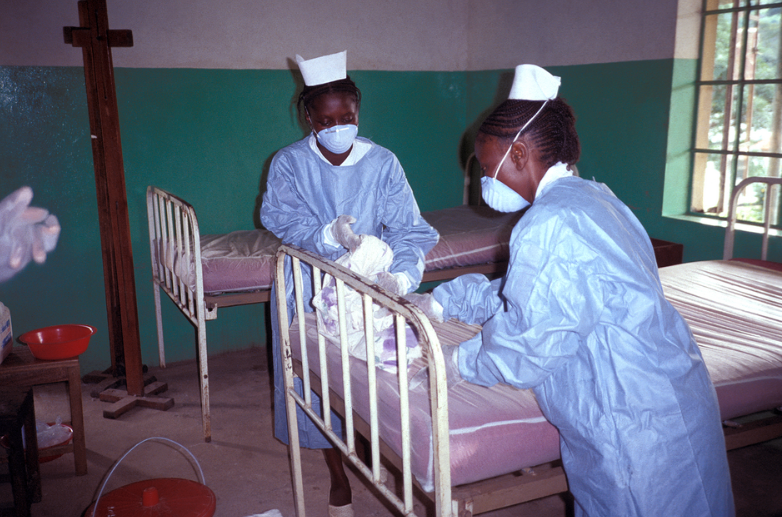
Healthcare workers in the Democratic Republic of the Congo are battling the country’s largest and deadliest Ebola outbreak on record, with cases now spreading across seven provinces. The outbreak has claimed more than 3,300 lives and infected 7,022 people since May, according to government figures released Friday. Reuters reported that the epidemic is now second only to the 2014-2016 West Africa Ebola outbreak in global size and death toll.
Dr. Rupa Narra, a pediatrician working with Doctors Without Borders in Butembo, described the conditions in the Ebola treatment unit where she works, according to NPR. She shared a before and after photo from her shift showing how difficult it is to care for patients in protective gear that limits her time with each one to about an hour. The unit in Butembo has 30 beds, all currently full, and the situation is growing worse as more patients arrive.
Narra said her unit lost eight children under five in recent days, highlighting the high mortality rate among young patients. The outbreak is caused by the Bundibugyo strain of Ebola, which has no approved vaccine or antiviral treatment. Adults diagnosed with this strain have a 30% death rate within two weeks, while children and newborns face even higher risks. NPR reported that children have accounted for about one in four confirmed cases but roughly one in three deaths during the outbreak.
Narra and her team provide supportive care such as IV fluids, oxygen, and blood transfusions to help patients fight the virus. She also trains other medical staff on how to care for pediatric and newborn cases in the Ebola unit.
Narra said she had to change her mindset about saving children, as the work is emotionally difficult and physically limiting. The treatment unit has 15 beds for patients waiting on test results and 15 for confirmed cases, but recent demand has forced them to use quarantine beds for confirmed patients.
She recalled a case where a young mother died shortly after giving birth, leaving her newborn alone and at risk of infection. A woman who had previously survived Ebola came to care for the baby, but the child eventually succumbed to the virus. The baby survived for 10 days while the Ebola survivor remained with her.
Narra has worked in emergencies before, including responding to the West Africa Ebola outbreak of 2014 and the early days of the COVID-19 pandemic. She said this outbreak feels different and more overwhelming than anything she’s seen before.
The outbreak is concentrated in the eastern part of the country near the borders with Rwanda and Uganda, where conflict has displaced families and disrupted healthcare services. The region’s health system is already under strain from treating malnutrition, malaria, and measles in children.
Insecurity, strikes by healthcare workers, and reduced aid have made it harder to contain the spread of the disease, according to a report from The Associated Press. A new case was confirmed in Sud-Ubangi province, making it the seventh affected area in the country. This is the first time the outbreak has reached western Congo, raising concerns about further spread into neighboring countries. Sud-Ubangi is far from the outbreak’s original eastern center and borders the Central African Republic and the Republic of Congo.
The man who tested positive in Sud-Ubangi had traveled from South Kivu through Rwanda and Uganda before reaching Ituri province. Local officials said the patient had a fever and was vomiting blood. He later traveled through Tshopo and Mongala before reaching Sud-Ubangi.
Jean-Jacques Mbungani, a former health minister and local lawmaker, warned that the situation could worsen as the outbreak spreads. The Bundibugyo strain of Ebola is rare and has no licensed vaccine or specific approved treatment, unlike Ebola caused by the Zaire species.
Moderna has entered a phase 1 clinical trial of a possible vaccine against the Bundibugyo strain. The outbreak is occurring amid a complex mix of health challenges and conflict that makes containment extremely difficult. Moderna began its first-in-human trial in Canada in August to test the safety and immune response produced by its mRNA-1469 candidate.
There was a significant delay in confirming the outbreak, which may have contributed to increased transmission. The presence of malaria and influenza-like illnesses has also made early detection harder for healthcare workers. WHO reported that a detection gap early in the outbreak allowed transmission to continue before the virus was identified.
Four healthcare workers died within a four-day span at one hospital due to lapses in infection control protocols. Unsafe burial practices have also contributed to more deaths in the community.
Ongoing conflict in Ituri province restricts access for surveillance teams and limits lab sample transport. The region’s role as a hub for trade and migration increases the risk of regional spread.
The virus has already crossed into Uganda, which declared its outbreak over in July, while South Sudan remains among the neighboring countries at risk of cross-border spread. The World Health Organization has said the outbreak remains out of control and is on track to surpass the 2014-2016 West Africa outbreak in severity. Uganda recorded 20 confirmed cases linked to the outbreak before declaring it over.
Despite some decline in cases in Ituri, new infections have risen sharply in nearby provinces like North Kivu and Haut-Uele. Vaccination efforts are underway in several provinces, but the spread of the disease continues to challenge public health responses. Congo has also used the Ervebo vaccine for some frontline workers. That vaccine was developed for Zaire ebolavirus and is not a licensed Bundibugyo vaccine. Clinical trials for Bundibugyo vaccine candidates are now underway.
IMAGES: Nurses in Ebola isolation ward, Kikwit 1995 Ethleen Lloyd (CDC) CC0