
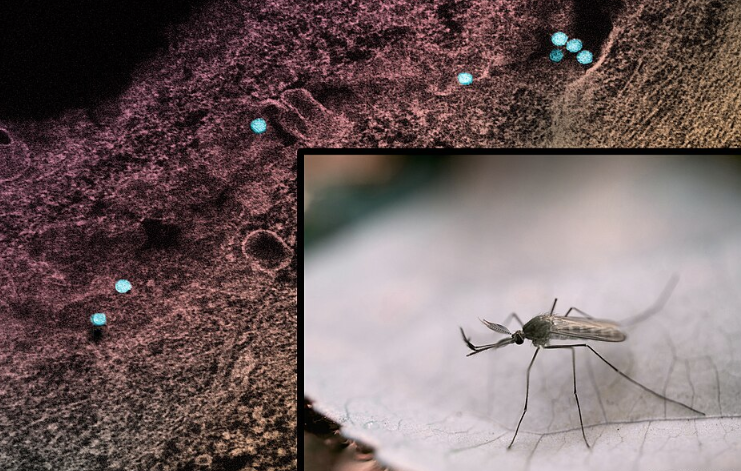
A woman in her 30s in Massachusetts has tested positive for the West Nile virus, marking the eighth reported case of the disease in the state this year. Public health officials said that she was exposed to the virus in an area where others had also been exposed this year. In addition to this case, three men were reported to have been exposed in Suffolk County — one in his 50s and two in their 70s. Three more men were found to be infected in Middlesex County — a man in his 60s, another in his 80s, and one in his 90s. Another man in his 60s was exposed to the virus in Worcester County.
The state has found West Nile virus in 327 mosquito samples across Massachusetts, with positive samples found in every county except Nantucket. Health officials update risk levels for West Nile and other viruses on a daily basis.
Massachusetts officials said seven of the eight human cases involved exposure in Middlesex or Suffolk counties. West Nile risk is currently considered high in Boston, Brookline, Cambridge, Chelsea, Everett, Malden, Newton, Revere, Somerville, Watertown and Winthrop. Most of the rest of Massachusetts is considered at moderate risk.
In New York City, the number of confirmed cases this year has already surpassed the 18 cases from all of 2025, according to a report from Gothamist. West Nile virus is mainly spread through bites from infected mosquitoes and does not normally spread directly from one person to another. According to the Centers for Disease Control and Prevention, most individuals who contract the virus show no symptoms at all. Some people may experience mild flu-like symptoms such as fever and body aches.
Of the 23 confirmed cases in New York City this year, 18 were classified as having neuroinvasive disease, which is a more serious form of the illness. Health officials noted that many young and healthy individuals may not even realize they’ve been infected or have had mild symptoms. These people are less likely to get tested and therefore don’t appear in official records. People who are tested are often those with more serious symptoms and some require hospitalization.
The high proportion of serious cases among confirmed patients does not mean most people infected with West Nile develop severe disease. The CDC says about 80 percent of infected people develop no symptoms and less than 1 percent develop severe illness involving the central nervous system.
City health departments monitor both reported cases and the presence of the virus in mosquito pools throughout all five boroughs. This year, more than 1,600 mosquito pools have tested positive for West Nile virus — a record number according to health officials. Warmer temperatures are known to speed up the mosquito life cycle and increase viral replication in mosquitoes. This can lead to a faster spread of infection from mosquitoes to humans.
The 23 confirmed human cases have already exceeded the 18 reported during all of 2025. However, 2025 was a relatively low year. New York City reported 36 cases in 2024, 32 in 2023 and 46 in 2022.
New York City has increased mosquito surveillance and control efforts this year. The Health Department has conducted targeted spraying in neighborhoods where surveillance showed an increased risk of transmission.
Health experts warn that people aged 65 and older are three times more likely to develop neurological complications if infected. The CDC also says people with conditions such as cancer, diabetes, high blood pressure or kidney disease and people with weakened immune systems face a higher risk of serious illness.
To reduce the risk of mosquito breeding, residents are advised to empty standing water from containers like buckets and flower pots at least once a week. They should also keep swimming pools, hot tubs, and ponds clean, covered, or drained when not in use.
Health officials also recommend using insect repellent and wearing clothing that covers the arms and legs when mosquitoes are active. There is currently no specific medicine that treats West Nile virus infection. Severe cases may require hospitalization and supportive treatment.
IMAGE: A male Culex mosquito and a transmission electron micrograph Source Own work Author Visualspecialist CC1