
Tributes have flooded in following the death of Dolly Parton, the iconic country singer-songwriter who died at age 80 in Nashville. Taylor Swift shared a heartfelt message honoring Parton’s legacy, describing her as someone who gave the world a gift that kept on giving. Swift noted how Parton encouraged people to be themselves and shared life lessons in a way that was both honest and often funny. She praised Parton for balancing mystery with transparency, calling her a person of grace and grit. Swift also expressed gratitude for the music Parton created and the books she provided to children through her Imagination Library program.
Despite her enormous success, Parton was also widely admired for her humility. She often spoke about her achievements with humor rather than self-importance and regularly redirected attention toward the people who helped her along the way. Even after becoming one of the most recognizable entertainers in the world, she remained closely connected to her East Tennessee roots and rarely presented herself as being above her audience. Parton had a gift for making extraordinary accomplishments seem almost ordinary, often joking about her appearance, fame and fortune while emphasizing gratitude, hard work and kindness. That combination of confidence and humility helped make her approachable in a way few celebrities ever achieve, and it became an important part of why so many people felt a personal connection to her.
Parton’s influence extended beyond music into film and culture, where she was remembered for her vibrant screen presence, according to The Hollywood Reporter. In the 1980 workplace comedy 9 to 5, Dolly Parton played a character who dodged unwanted advances from a boss and brought comic energy to scenes. The movie became a major hit, grossing over $103 million and paving the way for future female-led comedies. Parton’s theme song from the film reached number one on multiple charts, cementing her place in pop culture history. Her death was especially felt by members of the LGBTQ+ community, who saw her as a beacon of inclusivity and acceptance. She was known for her welcoming spirit and was a frequent visitor to Dollywood, a theme park near the Great Smoky Mountains. A fan recalled seeing Parton perform at Radio City Music Hall in 2005, surrounded by fellow fans who embraced her style and persona. Parton’s charm was not just in her singing but also in how she brought warmth to every role she played on screen. In The Best Little Whorehouse in Texas, she portrayed a madam with heart, making even a brothel feel like a place of care. She also starred in Steel Magnolias, where her character Truvy Jones stood out as a strong and kind-hearted woman. Even in less successful films like Rhinestone, Parton managed to contribute memorable hits that showcased her talents. Her ability to bring joy and authenticity to roles made her a beloved figure in Hollywood and beyond.
Parton’s legacy continues to inspire fans around the world, with many remembering her as a generous, talented, and kind-hearted woman. She was admired not only for her music but also for her impact on children, communities, and popular culture, according to a report from Variety. Her influence remains strong in the entertainment world, with many calling her a true icon of American culture.
Parton’s reach was perhaps most remarkable because it stretched far beyond the boundaries of country music. Over a career spanning nearly seven decades, she became one of the best-selling female recording artists in history, selling more than 100 million records and winning 11 Grammy Awards, including a Lifetime Achievement Award. Songs such as “Jolene,” “Coat of Many Colors” and “I Will Always Love You” became standards that were embraced by audiences far removed from Nashville. Whitney Houston’s recording of “I Will Always Love You” introduced Parton’s songwriting to another generation, while artists ranging from Beyoncé to The White Stripes later recorded their own versions of her work.
Parton was also an unusually prolific songwriter. She is estimated to have written roughly 3,000 songs over the course of her life, recording only a portion of them herself. Twenty-five of her songs reached No. 1 on Billboard’s country charts. Her accomplishments led to induction into the Songwriters Hall of Fame and, in 2022, the Rock and Roll Hall of Fame. Despite the awards, fame and commercial success, Parton repeatedly emphasized that she wanted to be remembered first as a songwriter.
Her philanthropy became nearly as recognizable as her music. The Imagination Library, which Parton founded in 1995, grew from a program serving children in her native East Tennessee into an international literacy effort that has distributed hundreds of millions of books to young children. Her family has encouraged people looking for a way to honor her memory to support the program. Parton also provided scholarships to students in Tennessee and contributed $1 million to Vanderbilt University Medical Center in 2020 for coronavirus research that helped support development of the Moderna COVID-19 vaccine.
Her connection to Tennessee remained central throughout her life. Parton was born January 19, 1946, and grew up as one of 12 children in a one-room cabin in the Great Smoky Mountains of East Tennessee. She began performing on local radio as a child and appeared at the Grand Ole Opry when she was just 13. After graduating from high school, she moved to Nashville and eventually joined Porter Wagoner’s television program, a partnership that helped introduce her to a national country music audience. Her decision to leave Wagoner and pursue a solo career inspired her to write “I Will Always Love You.”
Parton also built one of the most recognizable entertainment businesses in Tennessee through Dollywood. Rather than distancing herself from the region after becoming famous, she repeatedly invested in the area where she grew up. The theme park became both a major tourist destination and part of a larger collection of businesses that provided jobs and helped attract visitors to the Great Smoky Mountains region.
Her personal life remained comparatively private. Parton married Carl Dean in 1966 after meeting him shortly after she arrived in Nashville. Dean largely avoided the entertainment spotlight during their nearly six decades of marriage. He died in March 2025 at age 82. Parton spoke afterward about the emotional difficulty of losing the man who had been beside her for most of her adult life.
As news of her death spread, musicians, actors and public figures from several generations joined fans in remembering her. Reba McEntire praised the enormous amount of love Parton gave to others, while Miley Cyrus, Parton’s goddaughter, expressed heartbreak over the loss. George Strait, Dionne Warwick, Kacey Musgraves, Jamie Lee Curtis and others also paid tribute. The range of people mourning Parton reflected something that had long distinguished her career: she was able to connect with audiences who might otherwise have had very little in common.
That broad appeal may ultimately be one of the most enduring parts of Parton’s legacy. She could be glamorous without appearing distant, successful without abandoning her roots, and humorous without making others the target of the joke. For generations of listeners, she represented far more than country music. She became a songwriter, entertainer, businesswoman and philanthropist whose work reached into homes, movie theaters, classrooms and communities around the world.
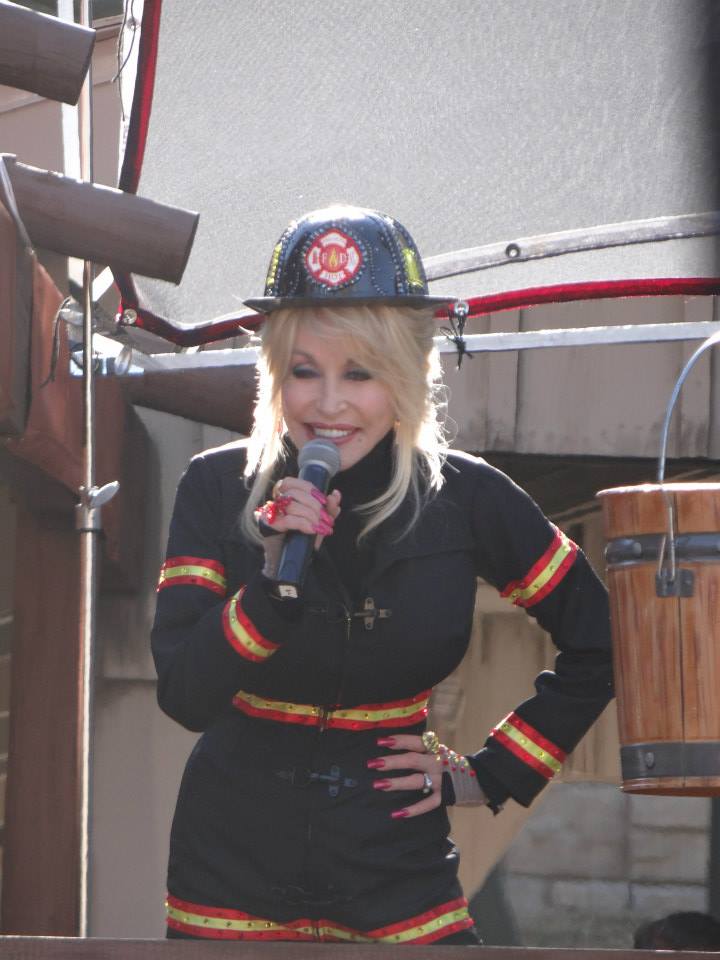
IMAGE: Dolly Parton, vestida con ropa de bombero, en Dollywood, presentando nuevas atracciones. Tiene un micrófono en sus manos.. Photo: Kris Harris King / Wikimedia, taken 2014-03-23, CC BY-SA 3.0