
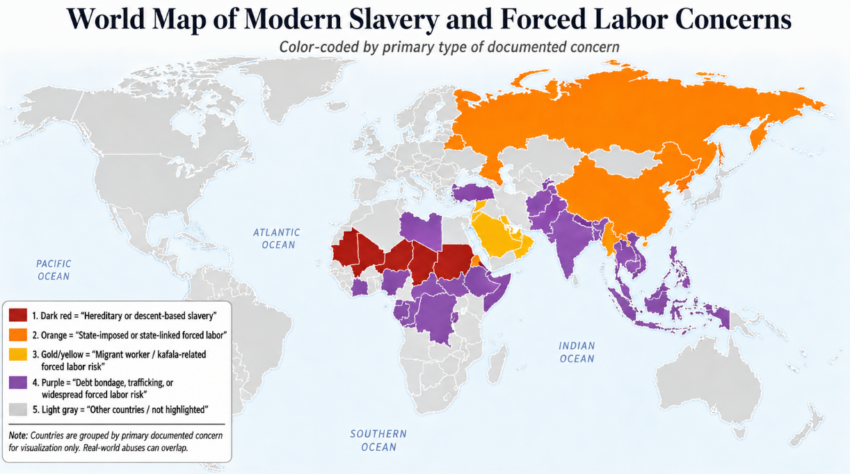
Slavery is illegal in nearly every country, yet millions of people remain trapped in situations they cannot freely leave. Modern slavery does not always resemble the slave markets and plantations found in history books. It often operates through debt, threats, confiscated passports, fraudulent job offers, forced marriage, violence, or fear of arrest and deportation.
The latest global estimate from the International Labour Organization, Walk Free, and the International Organization for Migration found that 49.6 million people were living in modern slavery on an average day in 2021. About 27.6 million were in forced labor, while 22 million were living in forced marriages. That means nearly one person in every 150 worldwide was affected.
Forced labor is work performed under threat or penalty when the worker has not freely consented. Someone may accept a job but later become trapped through withheld wages, recruitment debt, confinement, threats against relatives, or seized identity documents. The key question is whether that person can refuse the work or leave without serious consequences.
Most forced labor is not imposed directly by governments. The ILO estimates that 86 percent occurs in the private economy. The global total includes 17.3 million people exploited in private-sector work outside commercial sexual exploitation, 6.3 million subjected to forced commercial sexual exploitation, and 3.9 million in labor imposed by state authorities. More than 3.3 million victims were children.
Modern slavery appears in agriculture, construction, mining, manufacturing, fishing, domestic service, hospitality, and commercial sexual exploitation. It may be hidden in a private home, on a fishing vessel, inside a factory, or within an informal work crew. The U.S. Department of Labor’s 2024 list identified 204 goods from 82 countries and areas believed to involve child labor or forced labor. Frequently listed products include sugarcane, cotton, coffee, cattle, rice, fish, garments, bricks, footwear, gold, coal, and diamonds.
Debt bondage is a common method of control. Recruiters may charge workers large fees for transportation, paperwork, or promised employment. Employers can then add housing and food charges while withholding wages. The debt grows faster than it can be repaid, leaving the worker dependent and afraid to escape.
Migrant workers face particular danger because their legal status, housing, income, and ability to remain in a country may depend on one employer. Some are threatened with deportation or falsely told that leaving a job is a crime. Domestic workers can be especially isolated because they work inside private homes where inspectors and labor organizations have little access. Forced labor also occurs in wealthy countries, often affecting trafficked migrants and people outside formal employment protections.
Some practices more closely resemble historical slavery. Descent-based slavery remains a documented concern in parts of the Sahel, where status and labor obligations may pass through families. State-imposed forced labor is another distinct problem. Governments may misuse prison labor, military conscription, compulsory public projects, or assigned employment to force people to work.
North Korea is one of the clearest examples of institutionalized state forced labor. A 2024 United Nations report described compulsory labor through prisons, military service, state-assigned jobs, overseas work, and special labor mobilizations. It said some practices could amount to enslavement as a crime against humanity.
Forced marriage is also included in the leading international estimate of modern slavery. It occurs when a person is made to marry without free and informed consent and cannot realistically leave. Women and girls are affected most often, although men and boys can also be victims. The estimated number of people living in forced marriages rose by 6.6 million between 2016 and 2021.
Human trafficking and modern slavery overlap, but they are not identical. Trafficking involves recruiting, moving, transferring, or controlling people through coercion, deception, or abuse of vulnerability for exploitation. A person does not need to cross an international border to be trafficked. Modern slavery describes severe exploitation that the victim cannot refuse or leave.
The crime continues because it is highly profitable. The ILO estimated in 2024 that forced labor in the private economy generates about $236 billion in illegal profits each year. The money comes from stolen wages and income gained by exploiters. The total has risen sharply since the ILO’s previous estimate a decade earlier.
Poverty, discrimination, conflict, displacement, unsafe migration, weak labor protections, and corruption increase vulnerability. A medical bill, crop failure, war, or loss of housing can push someone toward a recruiter making false promises. Once isolated from family and legal help, a worker becomes easier to control. Economic shocks and climate-related displacement can create more opportunities for traffickers and abusive employers.
Ending modern slavery requires more than laws on paper. Governments need trained labor inspectors, accessible courts, safe migration systems, victim services, and penalties strong enough to remove the financial reward. Workers must be able to change employers, keep their passports, report abuse, organize, and recover unpaid wages without risking detention or deportation. The ILO also calls for stronger social protections and action against forced labor in business supply chains.
Businesses have a major role because long supply chains can conceal exploitation far from the company selling the final product. Audits may miss workers who are coached, threatened, or employed by subcontractors. Companies need to trace raw materials, examine recruitment fees, speak with workers privately, publish findings, correct abuses, and compensate victims. Cutting off a supplier without protecting workers can leave exploited people in a worse position.
Consumers cannot solve modern slavery through shopping choices alone. Product origins are often unclear, and forced-labor risks can enter a supply chain several stages before an item reaches a store. Public pressure can still encourage companies to disclose suppliers and governments to enforce import controls, labor laws, and accountability rules.
Modern slavery survives because vulnerable people can still be treated as a source of cheap labor and profit. It exists in authoritarian states, fragile countries, manufacturing centers, and wealthy democracies. Its forms differ, but the central abuse is the same: control over another person through coercion. Progress depends on identifying victims, protecting their freedom, prosecuting those responsible, and making exploitation more costly than fair employment.
Image Sourcing:
This color-coded world map provides a simplified editorial overview of documented modern-slavery and forced-labor concerns. Dark red represents countries associated primarily with hereditary or descent-based slavery. Orange identifies state-imposed or state-linked forced labor. Gold highlights migrant-worker and kafala-related risks. Purple represents countries with serious concerns involving debt bondage, trafficking, or widespread forced labor.
The categories show the primary documented concern selected for the visualization. Abuses often overlap, and conditions can differ greatly within each country. Inclusion does not mean every worker or industry in a country uses forced labor, and the map should not be treated as a legal judgment or a complete ranking.
The International Labour Organization, Walk Free, and the International Organization for Migration estimated that 49.6 million people were living in modern slavery on an average day in 2021, including 27.6 million in forced labor and 22 million in forced marriages.
Sources used: International Labour Organization, Global Estimates of Modern Slavery; Walk Free, Global Slavery Index 2023; U.S. Department of Labor, List of Goods Produced by Child Labor or Forced Labor; United Nations Office of the High Commissioner for Human Rights; Anti-Slavery International; International Labour Organization resources on domestic workers and the kafala system in Arab states; U.S. Department of State, 2025 Trafficking in Persons Report.
Related Article: https://www.digitalnewsreport.com/2026/07/modern-slavery-still-traps-nearly-50-million-people/21185