
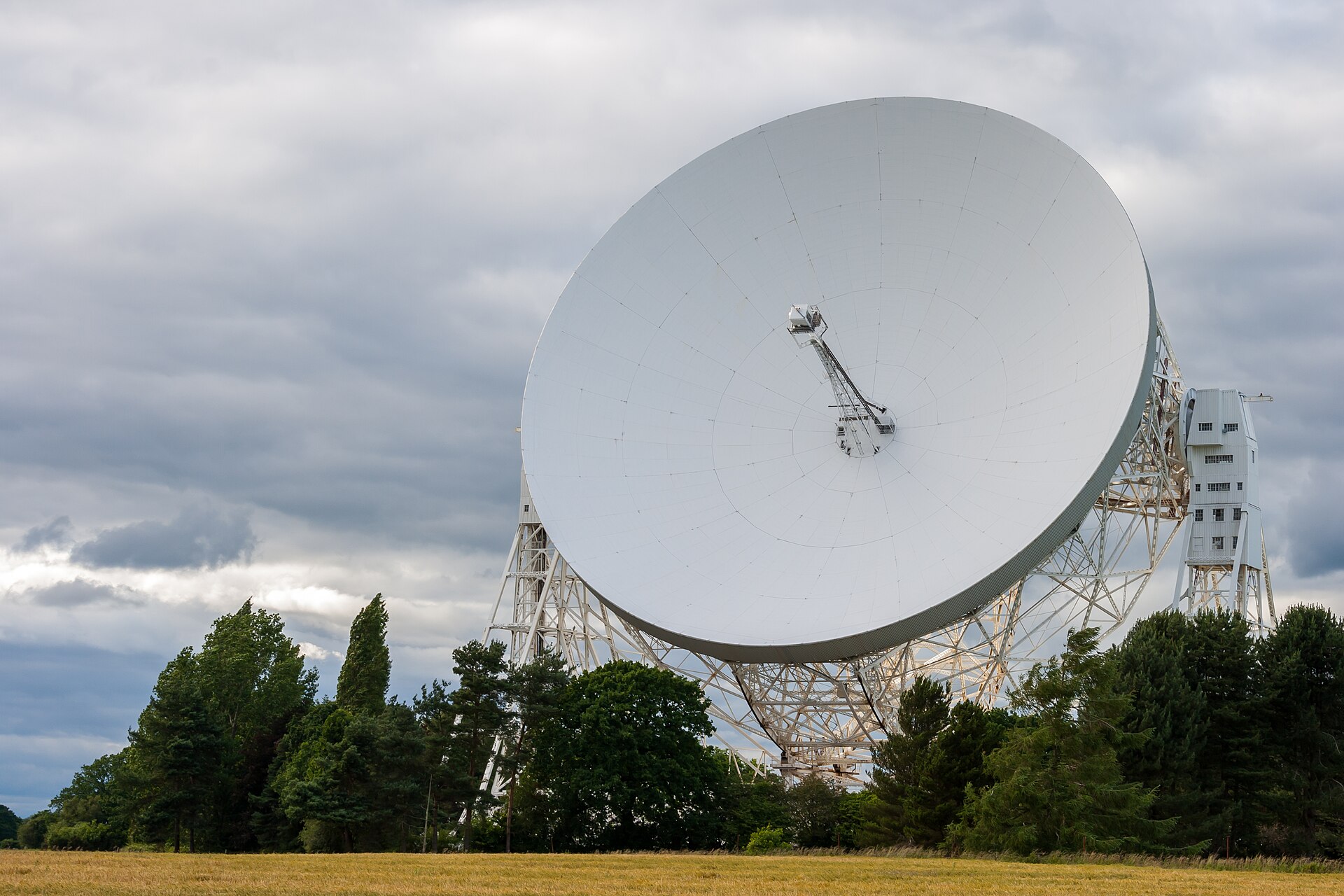
A major science facility in northwest England is under threat due to financial restrictions that could end its role in space research. The Lovell Telescope, a large radio dish that has been part of the British scientific landscape since 1957, is at risk of no longer functioning as an active research instrument. This telescope is not only the largest in the United Kingdom but also ranks among the world’s top three steerable radio telescopes.
It has helped scientists study cosmic phenomena like distant galaxies, black holes, and pulsars through the radio waves they emit. The telescope has played a key role in major space events, including tracking Sputnik when it launched in 1957 and receiving the first images from the moon’s surface in 1966. It also served as an early warning system during the Cold War, monitoring Soviet missile movements.
The telescope is part of a larger group of radio telescopes known as e-MERLIN, which spans across England and connects to the Jodrell Bank center. The funding for this network is set to end in 2028, and officials are now searching for new sources of support. If no new funding is found, the Lovell Telescope may stop contributing to scientific research by that time.
The telescope’s future has sparked concern among scientists and leaders who see it as a symbol of British scientific achievement. The Royal Astronomical Society President described the potential loss as a major blow to UK astronomy. Leaders from the University of Manchester, which operates e-MERLIN, say they are actively looking for other funding options.
They have not ruled out support from businesses, charities, or government sources. While the telescope itself is at risk, public access to Jodrell Bank’s educational center remains unaffected. The center continues to welcome school groups and visitors, offering a space for learning about the universe.
Scientists have expressed alarm over the decision to cut funding, warning that it could damage the UK’s scientific reputation. The Institute of Physics president urged the new government to reconsider its choices. He said that such funding decisions could hurt the country’s ability to lead in science and innovation.
The Lovell Telescope is also recognized as a UNESCO World Heritage Site, highlighting its global importance. Its long history includes helping to map the cosmos and advancing our understanding of space through decades of observation. The telescope’s upcoming 70th anniversary in the year 2024 brings attention to its legacy and the urgency of securing its future.
There is growing concern that without new support, it could become a monument to past scientific efforts rather than an active tool for discovery. The situation has drawn attention from national leaders who see the observatory as a vital part of the country’s scientific and cultural identity. They argue that saving Jodrell Bank is essential to maintaining a balanced national development plan.
The Observatory’s continued support is also seen as important for the local economy and education in the region. Despite current challenges, officials say Jodrell Bank remains a significant national asset. The clock is ticking for new funding to be secured before the end of 2028.
IMAGE: Mike Peel; Jodrell Bank Centre for Astrophysics, University of Manchester / Wikimedia Commons (CC BY-SA 4.0)