Skip to content
Digital News Report More Than News
Menu
  • Home
  • History
  • Business
  • Health
  • Science
  • Self Help
  • News
  • Audio
  • Videos
Menu

Home » History » Ancient » Ancient Rome » QUIZ – Julius Caesar Part 4: Consolidation of Power and Reforms (45–44 BC) – Page 03

QUIZ – Julius Caesar Part 4: Consolidation of Power and Reforms (45–44 BC) – Page 03

Posted on September 15, 2024 by Jim Peterson
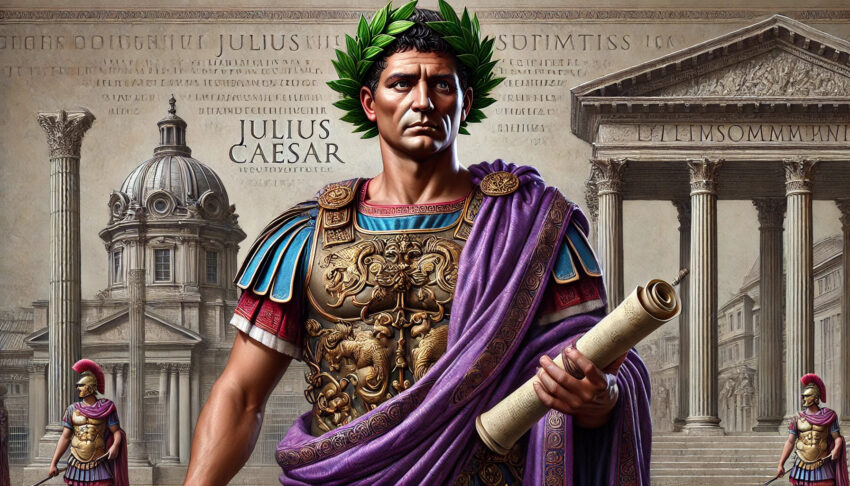
This image captures Julius Caesar standing confidently in traditional Roman attire. He is adorned with a laurel wreath on his head, symbolizing victory, while his richly colored toga with purple accents highlights his high status. Caesar's expression is both stern and thoughtful, reflecting his leadership and authority.
Spread the love

44 BC: Caesar Declared dictator perpetuo (dictator for life) by the Senate, further centralizing his authority.

In 44 BC, Julius Caesar reached the apex of his political career when the Roman Senate declared him *dictator perpetuo*, or dictator for life. This unprecedented title granted him supreme authority over the Roman Republic, effectively consolidating power and diminishing the influence of traditional republican institutions.

Caesar’s ascent to this position was the culmination of a series of military victories and political maneuvers. His successful campaigns in Gaul and decisive win in the civil war against Pompey had elevated his status among the Roman populace and the legions. The Senate’s decision to appoint him as dictator for life was both a recognition of his contributions to Rome and a reflection of his dominant position in Roman politics.

With his newfound authority, Caesar implemented a range of reforms aimed at stabilizing and improving Roman society. He restructured the debt system to alleviate the financial burdens of the lower classes and redistributed land to veterans and the poor. Caesar also expanded the Senate from 600 to 900 members, incorporating allies and representatives from the provinces, which helped to integrate Rome’s vast territories.

Additionally, Caesar enacted laws to regulate the distribution of grain and initiated extensive building projects, including the construction of temples, forums, and public spaces. These efforts were designed to revitalize Rome’s infrastructure and provide employment opportunities, thereby garnering public support.

However, the concentration of power in Caesar’s hands alarmed many senators who feared the erosion of the Republic’s democratic principles. His adoption of regal symbols, such as wearing a purple toga and placing his likeness on coins, fueled suspicions that he aimed to establish a monarchy.

The growing discontent culminated on the Ides of March—March 15, 44 BC—when a group of senators, including Brutus and Cassius, assassinated Caesar during a Senate meeting. They believed that eliminating Caesar would restore the Republic and preserve its traditions. Instead, his death plunged Rome into a series of civil wars, ultimately leading to the rise of his adopted heir, Octavian (later known as Augustus), and the establishment of the Roman Empire.

Caesar’s appointment as dictator perpetuo was a pivotal moment in Roman history. It signified the end of the Roman Republic and set the stage for the imperial era, fundamentally transforming Rome’s political landscape.

1. What title was granted to Julius Caesar by the Roman Senate in 44 BC?

A) King of Rome
B) Emperor of Rome
C) Dictator for life
D) Best General

2. What did Caesar's appointment as 'dictator perpetuo' effectively result in?

A) The restoration of the Republic
B) The minimization of Caesar's influence
C) The consolidation of political power and reduction of republican institutions' sway
D) The abolishment of the Senate

3. Which actions did Caesar take upon assuming his new role of authority?

A) Refrained from making any changes
B) Declared war on all of Rome's enemies
C) Implemented a range of reforms aimed at improving Roman society
D) Abandoned his military career

4. What repercussions did the concentration of power in Caesar's hands have?

A) It led to an increased support from the senators.
B) It alarmed senators who began to fear the erosion of democratic principles.
C) It resulted in Caesar's immediate banishment from Rome.
D) It gave Caesar full control of the Roman army.

5. What event signaled the end of Julius Caesar's reign?

A) Caesar's voluntary stepping down
B) A massive rebellion by the Roman people
C) Caesar's assassination on the Ides of March
D) Caesar's loss at the hands of his military rivals

6. Which figure rose to power following Caesar's death?

A) Brutus
B) Cassius
C) Pompey
D) Octavian

Previous Page Listen to our complete audio book Next Page
Watch Video

Leave a Reply Cancel reply

Your email address will not be published. Required fields are marked *

Recent Posts

  • Business Law: Burglary Quiz
  • Medical Quiz: Becker Muscular Dystrophy
  • Business Law: Burden of Proof Quiz
  • Medical Quiz: Basophilia
  • Business Law: Broker-Dealer Quiz
  • Ancient
  • Ancient Greece
  • Ancient Persia
  • Ancient Rome
  • Biology
  • Business
  • Business Law Terms
  • Cellular Biology
  • Classical Mechanics
  • Cultural
  • Finance
  • Health
  • History
  • Investment Strategies
  • Leadership
  • Leadership Skills
  • Medical Terms
  • Mesopotamia
  • Military
  • Napoleonic Wars
  • Nutrition
  • Personal Development
  • Physics
  • Real Estate
  • Real Estate Appraisal
  • Real Estate Law
  • Real Estate Marketing
  • Residential Real Estate
  • Science
  • Sleep Health
  • Urban Planning
  • Vitamins and Supplements
  • Wellness
©2025 Digital News Report Practice Tests | Design: Newspaperly WordPress Theme