Skip to content
Digital News Report More Than News
Menu
  • Home
  • History
  • Business
  • Health
  • Science
  • Self Help
  • News
  • Audio
  • Videos
Menu

Home » History » Ancient » Ancient Rome » The First Interwar Period – Page 03

The First Interwar Period – Page 03

Posted on July 12, 2024July 12, 2024 by Jim Peterson
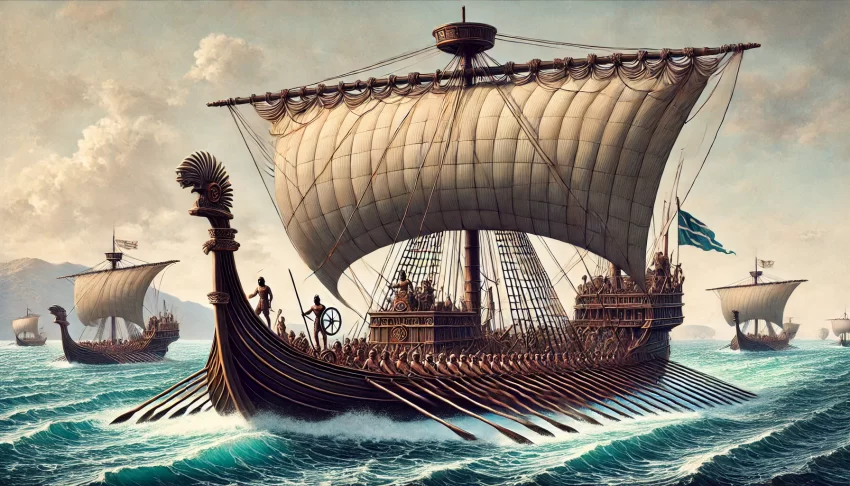
Here is a detailed and historically accurate depiction of an ancient Carthaginian trireme in wide format, showcasing its three tiers of oars, bronze-sheathed ram, and simple square sails. The trireme is shown cutting through the water, with the open sea and a distant coastline in the background, highlighting its speed and agility.
Spread the love

Expansion and Colonization Efforts

During the First Interwar Period, both Rome and Carthage embarked on ambitious expansion and colonization efforts as a means to consolidate power and secure economic resources. These initiatives were driven by the desire to recover from the First Punic War’s devastation and to position themselves advantageously for future conflicts.

Rome, having secured Sicily as its first province outside the Italian peninsula, turned its attention to further territorial expansion. The annexation of Sardinia and Corsica in 238 BCE was a strategic move to control important maritime routes and to curtail Carthaginian influence in the western Mediterranean. These islands provided Rome with crucial resources, such as grain and metals, which were essential for the growing republic. Additionally, Rome’s focus on expanding its influence in Northern Italy led to conflicts with the Gauls, resulting in the conquest of the Po Valley. This region’s fertile lands and strategic location facilitated Rome’s agricultural and military capabilities, further strengthening its position.

Meanwhile, Carthage, under the leadership of Hamilcar Barca, initiated a vigorous expansion campaign in Spain. The rich mineral deposits in the Iberian Peninsula, particularly silver, were vital for Carthage’s economic recovery and military financing. Hamilcar’s campaigns not only established Carthaginian control over large parts of southern and eastern Spain but also laid the groundwork for the future exploits of his son, Hannibal. The establishment of new colonies and fortresses in Spain allowed Carthage to build a robust power base independent of its African territories. This expansion was not merely for economic gain; it was also a strategic necessity to counterbalance Rome’s growing dominance.

Both powers recognized the importance of integrating their new territories into their respective economic and political systems. In Rome, the expansion efforts were accompanied by the establishment of Roman colonies (coloniae) in conquered areas. These colonies served as military outposts, centers of Roman culture, and means to control newly acquired lands. The settlers, often Roman citizens and veterans, helped to Romanize the local populations and secure loyalty to the republic.

Carthage, too, implemented measures to integrate its new Spanish territories. The Carthaginian approach involved establishing trade networks and alliances with local tribes, as well as encouraging intermarriage to solidify these relationships. These efforts were crucial in maintaining control over the vast and diverse Iberian Peninsula.

The expansion and colonization efforts during the First Interwar Period significantly altered the geopolitical landscape of the western Mediterranean. Rome and Carthage’s strategic moves not only aimed at immediate recovery and consolidation but also set the stage for their continued rivalry. These actions would eventually culminate in the Second Punic War, a conflict that would further define the destiny of both powers and the broader region.

1. What were the reasons for the expansion and colonization efforts by Rome and Carthage during the First Interwar Period?

A) To recover from the First Punic War and to prepare for future conflicts.
B) To control maritime routes and curtail each other's influence.
C) To secure economic resources and consolidate power.
D) All of the above.

2. Which region did Rome conquer that helped it strengthen agricultural and military capabilities?

A) The Po Valley
B) Sardinia and Corsica
C) Sicily
D) Iberian Peninsula

3. Under whose leadership did Carthage launch its expansion campaign in Spain?

A) Hannibal
B) Caesar
C) Hamilcar Barca
D) Scipio Africanus

4. Why was the Iberian Peninsula important for Carthage?

A) Its maritime routes
B) The presence of large local populations
C) Its fertile lands
D) Its rich mineral deposits

5. How did Rome ensure loyalty in its conquered territories?

A) By imposing harsh control mechanisms.
B) Through the establishment of Roman colonies and integration of settlers.
C) By using military force.
D) Through diplomatic negotiations.

6. How did the expansion and colonization efforts during the First Interwar Period alter the geopolitical landscape?

A) By causing a shift in power dynamics between Carthage and Rome.
B) By introducing Roman and Carthaginian culture to new areas.
C) Both powers increased their dominance, setting the stage for their continued rivalry.
D) Both A and C.

Previous Page Listen to our complete audio book Next Page
Watch Video

Leave a Reply Cancel reply

Your email address will not be published. Required fields are marked *

Recent Posts

  • Business Law: Burglary Quiz
  • Medical Quiz: Becker Muscular Dystrophy
  • Business Law: Burden of Proof Quiz
  • Medical Quiz: Basophilia
  • Business Law: Broker-Dealer Quiz
  • Ancient
  • Ancient Greece
  • Ancient Persia
  • Ancient Rome
  • Biology
  • Business
  • Business Law Terms
  • Cellular Biology
  • Classical Mechanics
  • Cultural
  • Finance
  • Health
  • History
  • Investment Strategies
  • Leadership
  • Leadership Skills
  • Medical Terms
  • Mesopotamia
  • Military
  • Napoleonic Wars
  • Nutrition
  • Personal Development
  • Physics
  • Real Estate
  • Real Estate Appraisal
  • Real Estate Law
  • Real Estate Marketing
  • Residential Real Estate
  • Science
  • Sleep Health
  • Urban Planning
  • Vitamins and Supplements
  • Wellness
©2026 Digital News Report Practice Tests | Design: Newspaperly WordPress Theme