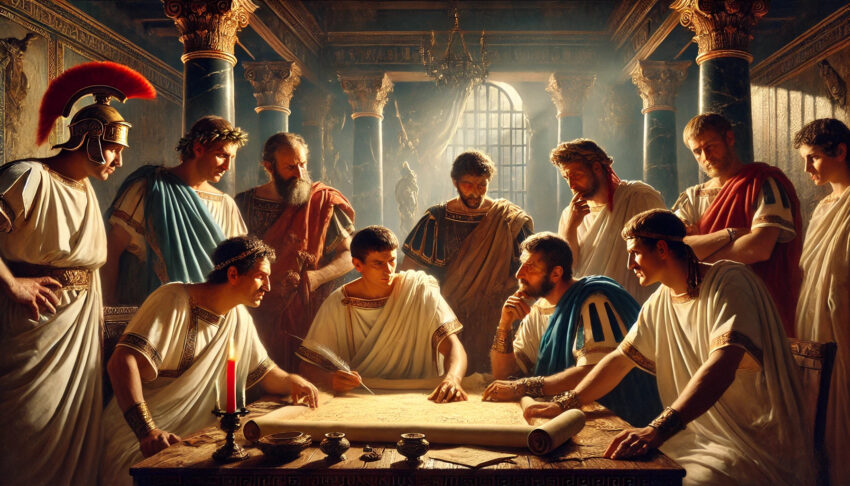
Details of the plot and secret meetings
The plot to assassinate Julius Caesar was meticulously planned and executed through a series of secret meetings and careful coordination among the conspirators. Ancient historians provide detailed accounts of these clandestine activities, revealing the depth of their commitment and the complexity of their undertaking.
Initial Discussions: According to Plutarch, the initial discussions about the assassination began among a small group of senators who were increasingly alarmed by Caesar’s growing power. Cassius is often credited with being one of the first to propose the idea, motivated by his deep-seated fear of Caesar’s potential to become a tyrant. Plutarch’s ‘Life of Brutus’ describes how Cassius approached Brutus, playing on his sense of duty to the Republic to persuade him to join the conspiracy.
Recruitment of Conspirators: The recruitment process was carried out with great secrecy. Suetonius in ‘The Twelve Caesars’ notes that the conspirators sought out individuals who were known to be discontented with Caesar’s rule. They needed men of influence and courage, capable of both planning and executing such a daring act. Among those recruited were Decimus Junius Brutus Albinus, Gaius Trebonius, and Servilius Casca. Appian, in his ‘Roman History,’ provides a detailed list of the conspirators, emphasizing their diverse backgrounds and motives.
Secret Meetings: The conspirators held a series of secret meetings to finalize their plans. These gatherings often took place at the homes of key members, such as Cassius and Brutus, where they could discuss their strategies away from prying eyes. Plutarch mentions that they sometimes met in small groups to avoid drawing attention, using trusted messengers to communicate plans to those not present.
Selection of the Date: Choosing the date for the assassination was critical. They decided on the Ides of March, a date with religious significance in the Roman calendar. According to Suetonius, the timing was chosen because it coincided with a Senate meeting, ensuring that Caesar would be present and relatively unguarded. The conspirators believed that striking at a Senate session would symbolize their act as one of restoring Republican order.
Final Preparations: In the days leading up to the assassination, the conspirators took great care to maintain secrecy. Plutarch recounts how they coordinated their final steps, distributing roles and ensuring that each participant knew their part. They also took measures to isolate Caesar from his supporters, particularly Mark Antony. According to Appian, Gaius Trebonius was tasked with detaining Antony outside the Senate chamber to prevent him from intervening.
The Assassination: On the day of the Ides of March, the conspirators gathered at the Senate, each carrying a dagger concealed in their toga. Plutarch’s ‘Life of Caesar’ details the tension of the moment, as Caesar entered the Senate house unaware of the impending attack. The first blow was struck by Casca, followed by the others in quick succession, with Brutus delivering one of the final stabs.
In conclusion, the conspiracy to assassinate Julius Caesar was a carefully orchestrated plot, marked by secret meetings, strategic planning, and a clear division of roles among the conspirators. Ancient historians like Plutarch, Suetonius, and Appian provide vivid accounts of these events, highlighting the conspirators’ dedication to their cause and the meticulous nature of their preparations.
 |
 |
 |