
A powerful storm brought damaging winds, heavy rainfall, and major coastal flooding across the Midwest and East Coast, disrupting holiday travel and forcing the first postponement of the Macy’s Thanksgiving Day Parade.
Hundreds of thousands of utility customers remained without electricity on Friday, November 27, 2026, after powerful Thanksgiving storms swept across the Midwest and East Coast. Heavy rainfall, damaging winds, and coastal flooding affected communities from Missouri to Massachusetts, disrupting holiday travel and forcing emergency crews to rescue stranded motorists. The severe weather also prompted the first postponement of the Macy’s Thanksgiving Day Parade in its 100-year history.
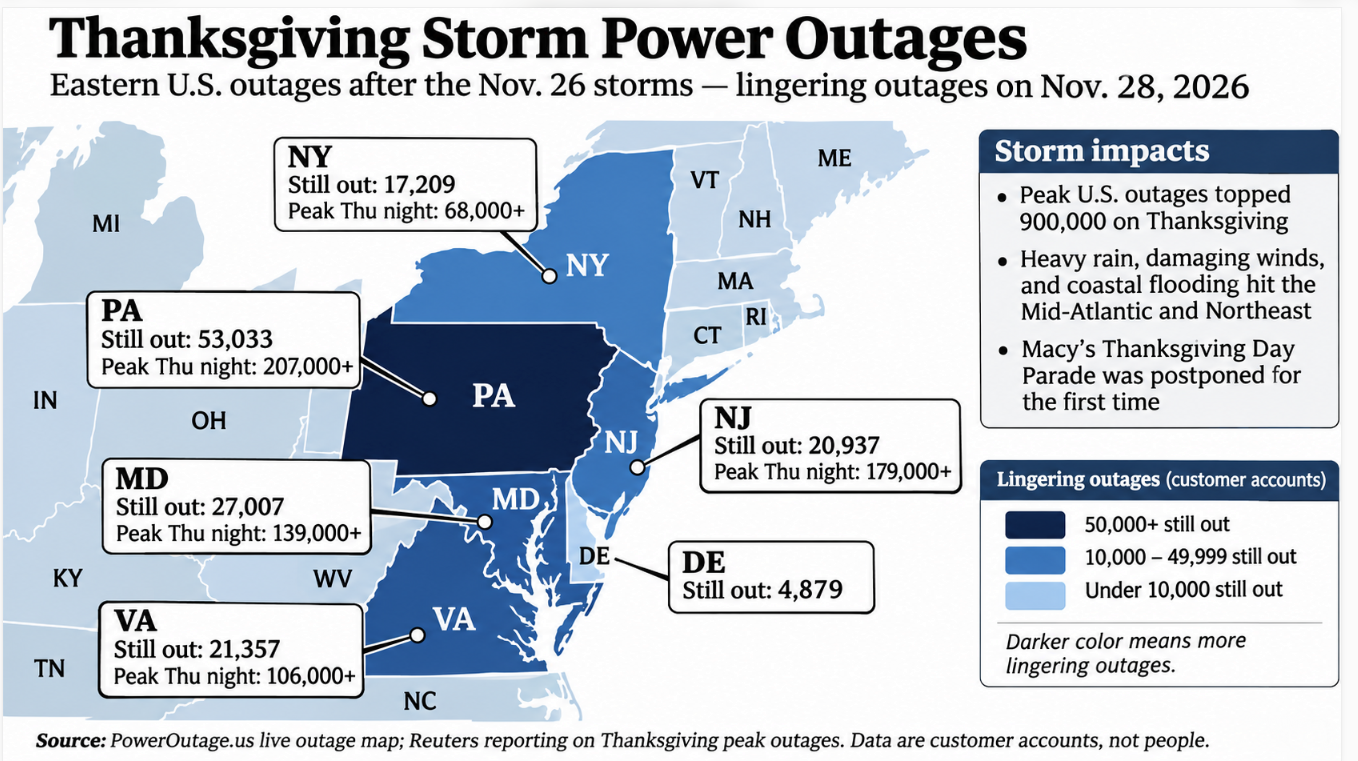
Power outages peaked at more than 900,000 customers on Thanksgiving Day before declining to approximately 736,000 by 3:30 a.m. Eastern Time on Friday. By Friday afternoon, fewer than 400,000 customers remained without electricity, according to utility tracking service PowerOutage.us. Although weather conditions improved across much of the affected region, some coastal communities continued to face flooding during high tides.
Widespread Power Outages Disrupt Thanksgiving
Strong winds brought down trees and damaged electrical infrastructure across several states, with Pennsylvania and New Jersey among the areas experiencing substantial disruptions. Utility companies deployed repair crews to restore damaged electrical connections and remove fallen trees obstructing access to power lines. Wind gusts approached 70 miles per hour in some areas.
The widespread outages disrupted holiday gatherings and created difficulties for households dependent on electricity for heating, cooking, and medical equipment. Restoration efforts continued throughout Friday, although flooded roads and fallen debris complicated access to some damaged infrastructure.
In Maryland, electrical disruptions also affected water treatment and distribution operations serving Montgomery and Prince George’s counties. Approximately two million water customers were temporarily asked to conserve water. Authorities lifted the conservation request on Friday after conditions improved.
Virginia Experiences Major Coastal Flooding
Coastal communities in Virginia experienced extensive flooding as strong winds pushed seawater into rivers, bays, and low-lying neighborhoods. Areas surrounding the Chesapeake Bay and Potomac River were particularly vulnerable to rising water levels. Emergency personnel responded to flooded roads and vehicles throughout the region.
In Norfolk, emergency crews rescued 39 people and two dogs from floodwaters, with no injuries reported in those rescues. Water covered portions of major streets, leaving vehicles stranded and preventing normal traffic from moving through affected neighborhoods.
The Weather Channel reported that the tidal monitoring station at Sewells Point recorded its highest storm tide since Hurricane Isabel in September 2003. Estimated peak flooding approached five feet above normally dry ground in some areas. Communities along Virginia’s Eastern Shore also experienced unusually high water levels.
Strong winds forced the temporary closure of the Chesapeake Bay Bridge-Tunnel, an important transportation connection between southeastern Virginia and the Eastern Shore. Farther north, tidal flooding affected parts of Alexandria, including its historic waterfront district.
New Jersey and Delaware Face Extensive Flood Damage
Along the New Jersey coastline, seawater flooded residential streets, commercial districts, and transportation routes. Atlantic City and Ocean City recorded their highest storm tides since Superstorm Sandy in 2012, although water levels remained below those experienced during Sandy. Emergency officials warned residents in vulnerable neighborhoods to prepare for dangerous flooding.
An emergency shelter opened at the Atlantic City Convention Center on Thanksgiving morning. Floodwaters began receding in parts of the city by Friday, allowing residents and emergency crews to begin assessing the damage.
Delaware also experienced significant coastal flooding. In Lewes, the storm produced the third-highest recorded storm tide, behind the January 2016 winter storm and the Ash Wednesday storm of 1962.
New York Postpones Historic Thanksgiving Parade
New York City experienced heavy rainfall, coastal flooding, and damaging winds during the storm. According to New York City Emergency Management, rainfall reached 2.54 inches during the storm, while wind gusts reached 66 miles per hour. Falling trees, damaged property, and collapsed scaffolding were reported across the city.
Ahead of the storm, Mayor Zohran Mamdani and city emergency management officials issued a travel advisory urging residents to avoid unnecessary journeys during dangerous weather conditions. Organizers also announced on November 25 that the 100th Macy’s Thanksgiving Day Parade would be moved from Thursday to Saturday.
The decision marked the first weather-related postponement in the parade’s history. Organizers scheduled the rescheduled event to begin at 8:30 a.m. Eastern Time on November 28, following an improvement in weather conditions.
Holiday Travel Disruptions Continue
The storms affected one of the busiest travel periods of the year, disrupting airline operations, highway travel, and some railway services. The Associated Press reported more than 2,200 flight delays and 400 cancellations involving US destinations on Thanksgiving Day. By Friday morning, more than 1,100 additional flights had been delayed, with at least 116 cancellations reported.
Heavy, wet snow also affected portions of Missouri, Illinois, and surrounding states. In North Carolina, seawater breached coastal dunes and covered sections of Highway 12, an important transportation route serving communities along the Outer Banks.
Although the worst weather had passed by Friday, emergency management officials continued warning residents against entering flooded roads. Moving water can sweep vehicles away, while standing floodwater may conceal damaged pavement, debris, or electrical hazards.
Utility crews and local authorities continued clearing debris and repairing infrastructure throughout Friday. Coastal residents were advised to monitor local flood warnings as recovery efforts continued into the Thanksgiving weekend.
IMAGE: DNR Art and Research Team