
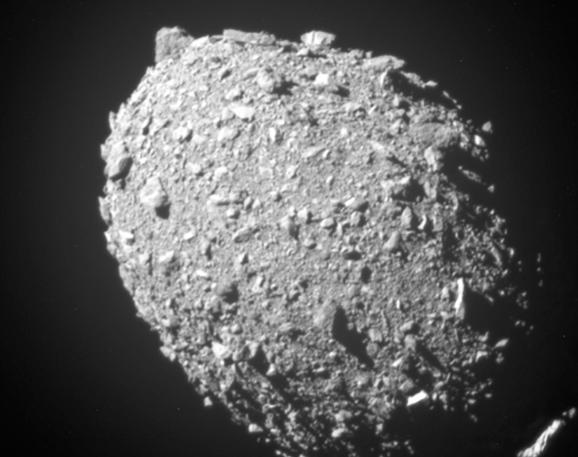
New images released by the European Space Agency reveal how NASA’s 2022 asteroid deflection experiment dramatically reshaped Dimorphos, leaving a massive crater and causing the asteroid to tumble in space.
The European Space Agency (ESA) released detailed images of the asteroid Dimorphos on Wednesday, November 25, 2026, revealing the extensive damage caused by NASA’s DART spacecraft in 2022. The photographs show a stadium-sized impact crater covering nearly an entire side of the asteroid, providing new evidence about the effectiveness of deliberately redirecting objects in space.
ESA’s Hera spacecraft reached the Didymos asteroid system in early November following a journey of more than two years. Scientists will spend approximately six months investigating the two asteroids and measuring the physical consequences of the historic collision.
The findings could help space agencies design future missions to redirect potentially hazardous asteroids before they reach Earth.
A Stadium-Sized Crater
The new photographs reveal that DART’s collision flattened the previously rounded face of Dimorphos. Scientists had debated whether the impact would produce a distinct crater or reshape the asteroid more extensively.
Patrick Michel, Hera’s principal investigator and a research director at France’s National Centre for Scientific Research, explained that the observations revealed a combination of these outcomes.
The impacted side underwent substantial changes, while much of the remaining surface appears similar to photographs captured before the collision. Large rocks visible in earlier images remain recognizable in areas away from the crater.
The German Aerospace Center also identified an unusual elongated structure near the crater’s center. Further observations will help scientists determine how this feature formed and what it reveals about the asteroid’s composition.
One photograph released Wednesday was captured on November 7 from approximately 29 kilometers away. Hera’s cameras will obtain increasingly detailed images as the spacecraft approaches the asteroids.
NASA’s Historic Asteroid Deflection Experiment
NASA launched its Double Asteroid Redirection Test, known as DART, in November 2021. The spacecraft deliberately collided with Dimorphos on September 26, 2022, at approximately 22,000 kilometers per hour.
Dimorphos measures approximately 151 meters across and travels around a much larger asteroid named Didymos, which has a diameter of about 730 meters.
Neither asteroid poses a known threat to Earth. Scientists selected the pair because their orbital relationship provided an opportunity to measure the effects of a controlled collision.
Before the experiment, Dimorphos completed an orbit around Didymos in approximately 11 hours and 55 minutes. Observations following the impact showed that its orbital period had decreased by about 33 minutes.
A NASA study published in 2024 refined the measurement to approximately 33 minutes and 15 seconds.
The experiment demonstrated that a spacecraft could alter an asteroid’s motion through a deliberate collision. However, researchers still needed detailed information about how the target responded physically.
Hundreds of Boulders Surround the Asteroids
Hera’s observations also revealed unexpected complications within the asteroid system. Hundreds of rocks, some measuring several meters across, are moving through the surrounding space.
ESA mission scientist Michael Kueppers explained that the spacecraft’s observations also show Dimorphos rotating irregularly following the collision.
Scientists will need to study the distribution and movement of the surrounding material as Hera travels closer to the asteroids. Determining how much debris originated from the DART impact remains an important research question.
The rocks could complicate the navigation of Hera and its smaller companion spacecraft. Mission planners must consider these objects when selecting safe routes for closer observations.
The asteroid system is currently approximately 193.5 million kilometers from Earth. Operating spacecraft at that distance requires carefully coordinated navigation and scientific measurements.
Two Miniature Spacecraft Will Assist Hera
Hera carries two small satellites known as CubeSats, named Juventas and Milani. They are scheduled for deployment beginning in January 2027.
Juventas will use radar to investigate the interior of Dimorphos. Scientists hope its measurements will reveal how the asteroid’s rocks are arranged beneath the surface and whether significant gaps exist within its structure.
The satellite will eventually attempt to land on Dimorphos, where instruments will measure the asteroid’s extremely weak gravitational field.
Milani will examine surface materials and investigate the dust surrounding the asteroid system. Its observations should help researchers understand the composition of the asteroids and the material moving around them.
Together, the three spacecraft will collect different types of measurements that scientists can combine to develop a more complete understanding of the collision.
Why Measuring Asteroid Mass Matters
One of Hera’s primary objectives is determining the mass of Dimorphos more accurately.
An asteroid’s response to a collision depends on several factors, including its mass, internal structure, composition, and the amount of material thrown into space.
When DART struck Dimorphos, the escaping debris carried momentum away from the asteroid. This process contributed to the overall change in its motion, beyond the direct effect of the spacecraft striking its surface.
Without precise measurements of the asteroid’s mass and the collision’s consequences, scientists cannot fully determine how efficiently DART transferred momentum to its target.
Hera’s measurements will help researchers improve computer models used to predict how different asteroids might respond to similar interventions.
Those calculations could eventually guide decisions about spacecraft size, impact velocity, and the amount of advance warning required to redirect a hazardous asteroid.
Building a Planetary Defense Strategy
ESA presented its new findings at the Museum für Naturkunde in Berlin, Germany. The event took place in the museum’s dinosaur hall, providing a reminder of the consequences of major asteroid impacts.
Approximately 66 million years ago, an asteroid collision contributed to a mass extinction that eliminated the non-avian dinosaurs.
NASA’s DART experiment and ESA’s Hera investigation represent complementary approaches to preparing for potential asteroid threats. One mission demonstrated that a collision could change an asteroid’s orbit, while the other is investigating the physical processes behind that change.
The technique is not a universal solution for every asteroid. Larger objects, different compositions, and shorter warning periods could require alternative strategies.
Hera will continue moving closer to Didymos and Dimorphos over the coming months. Its upcoming measurements and the planned deployment of Juventas and Milani will provide scientists with additional evidence needed to assess asteroid deflection as a practical planetary defense technique.
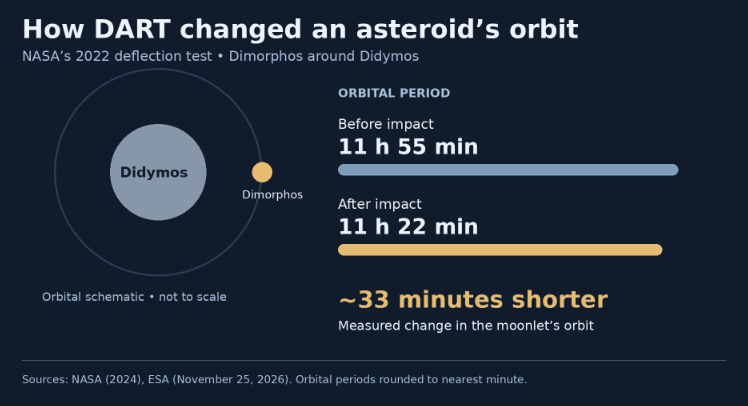
IMAGE: DNR Art Department