
NASA’s longest-running space mission is expected to reach a distance of 16.094 billion miles on November 18, 2026, making radio signals take a full day to travel between Earth and the spacecraft.
NASA’s Voyager 1 spacecraft is approaching a historic milestone nearly 50 years after leaving Earth. On Wednesday, November 18, 2026, it is expected to become the first human-made object to reach a distance of one light-day from Earth, approximately 16.094 billion miles. At that distance, a radio signal traveling at the speed of light will take exactly 24 hours to reach the spacecraft, making even routine communication an extraordinary engineering challenge.
The milestone comes as Voyager 1 continues its journey through interstellar space, far beyond the region dominated by the Sun’s solar wind. The spacecraft is still transmitting scientific and engineering information despite its age, limited electrical power and occasional technical problems. NASA engineers at the Jet Propulsion Laboratory in Southern California continue working to extend the mission for as long as its equipment remains operational.
Voyager 1 Approaches a Record Distance
NASA calculates that Voyager 1 will reach the one-light-day mark at 5:16:07 a.m. Eastern Time on November 18. That corresponds to 2:16:07 a.m. Pacific Time and a distance of approximately 25.902 billion kilometers from Earth. No spacecraft has previously traveled far enough from our planet for light to require an entire day to reach it.
A light-day is a measurement of distance rather than elapsed mission time. Light travels approximately 186,000 miles per second, covering more than 16 billion miles in 24 hours. Although Voyager 1 moves at nearly 38,000 miles per hour, its speed is extremely slow compared with light.
The milestone will not trigger any physical change aboard Voyager 1. Its instruments will continue operating normally, and the spacecraft will not encounter a new boundary simply because its distance reaches one light-day. The achievement instead provides a striking measurement of how far human technology has traveled.
Communication delays make operating the spacecraft increasingly difficult. Once Voyager 1 reaches the milestone, a command transmitted from Earth will require 24 hours to arrive. If the spacecraft sends an immediate response, another 24 hours will pass before engineers receive it.
Journey Began Nearly Five Decades Ago
Voyager 1 launched on September 5, 1977, from Cape Canaveral, Florida, during President Jimmy Carter’s administration. Its original mission was to explore Jupiter and Saturn, using close planetary encounters to gather scientific information unavailable from Earth. The spacecraft was designed for a much shorter mission than the nearly five decades it has now completed.
Voyager 1 reached Jupiter in March 1979 and returned detailed images of the planet, its clouds, rings and moons. Its observations helped scientists better understand Jupiter’s atmosphere and the complex environments surrounding its satellites. The spacecraft also discovered previously unknown features that changed researchers’ understanding of the outer solar system.
The spacecraft continued to Saturn, making its closest approach in November 1980. Its instruments examined the planet’s rings, atmosphere and moons, including Titan. The encounter revealed important information about Titan’s thick atmosphere and contributed to later scientific interest in that distant world.
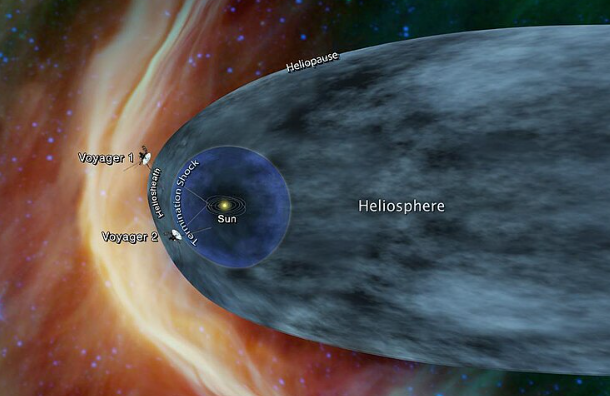
Following its Saturn encounter, Voyager 1 traveled away from the main plane of the planets. Unlike its twin, Voyager 2, it did not continue toward Uranus and Neptune. Its new trajectory eventually carried it beyond the Sun’s protective bubble of charged particles and magnetic fields.
First Spacecraft to Enter Interstellar Space
On August 25, 2012, Voyager 1 crossed the heliopause, the boundary separating the solar wind from the surrounding interstellar environment. The event made it the first spacecraft to enter interstellar space. Scientists confirmed the crossing through measurements of charged particles and plasma conditions.
Interstellar space is not completely empty. It contains particles, magnetic fields and radiation that scientists can study using instruments aboard the spacecraft. Voyager 1 provides direct measurements from a region that cannot be examined in the same way by telescopes near Earth.
Its remaining scientific equipment includes instruments designed to measure cosmic rays, low-energy charged particles, magnetic fields and plasma waves. Those measurements help researchers understand how material originating beyond the solar system interacts with the Sun’s influence. The information continues to support scientific studies decades after the spacecraft completed its original planetary encounters.
Crossing the heliopause did not mean Voyager 1 had passed beyond every part of the solar system. The distant Oort Cloud, a theoretical reservoir of icy objects gravitationally associated with the Sun, extends much farther into space. Voyager 1 is therefore in interstellar space while still traveling through the broader region influenced by the Sun’s gravity.
Engineers Resolve Recent Communications Problem
Keeping Voyager 1 operating requires constant attention from engineers at NASA’s Jet Propulsion Laboratory. The spacecraft uses technology developed in the 1970s, and its aging systems occasionally behave in unexpected ways. Troubleshooting is especially difficult because commands and responses now require almost two days for a complete exchange.
NASA temporarily lost contact with Voyager 1 during scheduled communications attempts on October 18 and 19. The spacecraft’s radio signal reappeared on October 20, allowing the mission team to resume contact. Engineers continued investigating the cause after communication was restored.
The investigation found that one group of thrusters had gone offline and backup thrusters had activated automatically. Such changes can occur when the spacecraft’s fault-protection system detects a potential problem. NASA had not established the underlying cause of the interruption when it issued its October 29 update.
The recent incident illustrates the challenges of maintaining equipment that has operated far beyond its planned lifetime. Even a minor malfunction can require days of careful investigation because the spacecraft is so distant. Engineers must also avoid unnecessary commands that could create additional problems.
Power Conservation Helps Extend the Mission
Voyager 1 receives its electricity from radioisotope thermoelectric generators rather than solar panels. These generators convert heat produced by the natural decay of plutonium-238 into electrical energy. The system has allowed the spacecraft to continue operating far beyond the distance where sunlight could provide practical power.
However, the generators produce less electricity as time passes. NASA estimates that each Voyager spacecraft loses approximately four watts of available power annually. Engineers have gradually shut down instruments and other equipment to preserve energy for essential operations.
In September 2026, the Voyager team completed a complicated power-saving procedure involving three devices aboard Voyager 1. Engineers replaced their functions with lower-power alternatives while maintaining the spacecraft’s necessary heating arrangements. The adjustment reduced electricity consumption and helped preserve power for the remaining scientific instruments.
NASA said the successful procedure could prevent another instrument shutdown that otherwise might have become necessary as early as summer 2027. Similar changes had already been completed on Voyager 2. The effort demonstrates how engineers continue finding ways to extend missions using equipment built almost half a century ago.
Golden Record Carries a Message From Earth
Voyager 1 carries a gold-plated copper phonograph record intended as a message to any intelligent civilization that might someday encounter the spacecraft. A similar record travels aboard Voyager 2. The recordings were prepared before the spacecraft launched in 1977.
Astronomer Carl Sagan led the committee responsible for selecting the contents. The collection includes spoken greetings in 55 languages, music from different cultures and recordings of natural sounds. It also contains 115 images representing life, science and human civilization on Earth.
The record includes messages from President Jimmy Carter and United Nations Secretary-General Kurt Waldheim. Instructions engraved on its protective cover explain how the recordings can be played and provide information about the spacecraft’s origins. Its purpose is to preserve a representation of Earth for an unknown future audience.
Voyager 1 is not expected to encounter another star anytime soon. NASA estimates that in approximately 40,000 years, it will pass within about 1.7 light-years of a star in the constellation Ursa Minor. The Golden Record could remain aboard the spacecraft long after its electronic systems stop functioning.
NASA Plans Worldwide Milestone Celebration
NASA is inviting people around the world to recognize Voyager 1’s achievement on Tuesday, November 17, the evening before the spacecraft reaches one light-day. The agency’s campaign, called “Shine Bright for Voyager’s Light-Day,” encourages participants to direct lights toward the sky. People can use flashlights, smartphones or other lights to send a symbolic greeting.
NASA has also developed a tool that flashes the letters VGR in Morse code, representing Voyager’s call sign. The activity is intended as a celebration rather than an actual communication method capable of reaching the spacecraft. Voyager 1 continues receiving its commands through NASA’s Deep Space Network.
The spacecraft’s twin, Voyager 2, is also operating in interstellar space after crossing the heliopause in November 2018. It followed a different route past the outer planets, visiting Uranus and Neptune before continuing outward. NASA expects Voyager 2 to reach a distance of one light-day from Earth in November 2035.
For Voyager 1, the November 18 milestone will mark another achievement in a mission that has already exceeded its original goals by decades. The spacecraft continues traveling outward while engineers conserve its remaining power and investigate occasional equipment problems. Its next challenge is simply to keep operating and returning scientific data from a region no other human-made spacecraft has reached.
IMAGE: Source https://photojournal.jpl.nasa.gov/jpeg/PIA22566.jpg Author NASA/JPL-Caltech CC0