
The spacecraft completes 14 orbits of Earth before being captured by mechanical arms at its Texas launch tower, but a failed booster recovery prevents a planned double catch.
SpaceX successfully caught its Starship spacecraft at its launch tower in South Texas on Saturday, November 14, 2026, after the vehicle completed 14 orbits of Earth. The spacecraft descended through the atmosphere, turned upright and was captured by two enormous mechanical arms at the Starbase launch facility. It was the first time SpaceX had recovered a Starship upper stage returning from orbit, marking an important advance toward developing a fully reusable rocket.
The achievement followed Friday’s launch of Starship Flight 15, which carried 26 Starlink satellites into space during a mission lasting more than 22 hours. SpaceX had hoped to recover both sections of the rocket, but its Super Heavy booster failed to return to the launch tower. The booster was destroyed over the Gulf of Mexico, leaving the successful spacecraft catch as the mission’s defining accomplishment.
Starship Returns to Earth After 14 Orbits
Starship lifted off from Starbase on Friday, November 13, at approximately 4:47 p.m. Central time. The 407-foot rocket rose above the Texas coast before its Super Heavy booster separated from the upper spacecraft. Starship continued into low Earth orbit, beginning a mission designed to test satellite deployment, heat-shield performance and a controlled return to the launch site.
The spacecraft remained in orbit for approximately 22 and a half hours while engineers monitored its systems. Unlike previous orbital testing, the mission included plans to bring the upper stage back to the tower from which it launched. Flight controllers had several opportunities to direct the spacecraft toward an ocean landing if they determined that returning to Texas was unsafe.
After completing its final orbit, Starship fired an engine to begin its descent toward Earth. The spacecraft traveled through the atmosphere protected by thousands of heat-resistant tiles. Its flight-control surfaces helped manage the descent as it approached the Texas coast.
The spacecraft remained largely horizontal during the final portion of its descent, using aerodynamic forces to control its speed and position. Near the launch tower, three Raptor engines ignited and brought the vehicle into an upright position. The maneuver allowed Starship to slow its descent and move toward the waiting recovery system.
Mechazilla Tower Makes Historic Catch
The launch tower’s recovery system, nicknamed Mechazilla, uses two large mechanical arms commonly called chopsticks. Rather than landing on traditional legs, Starship approached the tower with small structural supports designed to rest on the arms. The spacecraft’s engines controlled its final movement as the arms prepared to accept its weight.
The final approach required precise positioning because the supporting structures offered a relatively small contact area. Starship moved slowly toward the tower before settling onto the mechanical arms. The successful catch demonstrated that the spacecraft could return from orbital speed and complete a controlled recovery without landing on the ground.
SpaceX had already demonstrated the tower’s ability to catch Super Heavy boosters during earlier test flights. However, recovering Starship presented additional challenges because the upper stage had traveled around Earth before returning through the atmosphere. Engineers also needed confidence that its heat shield and engines had survived the mission in sufficiently good condition.
The recovery provided SpaceX with an intact spacecraft that can now undergo detailed inspections. Engineers can examine heat-shield tiles, structural components and propulsion equipment after the demanding orbital flight. Those inspections will help determine how much refurbishment would be necessary before a recovered Starship could fly again.
Super Heavy Booster Lost During Recovery Attempt
Although the upper-stage catch succeeded, the mission did not achieve SpaceX’s original goal of recovering both rocket stages. The Super Heavy booster was supposed to return to Starbase shortly after separating from the spacecraft. Instead, its automated systems determined that it could not safely complete the planned approach.
Initial reports suggested a problem involving the booster’s guidance and navigation system. SpaceX later clarified that the guidance system had functioned as intended by recognizing that the vehicle was outside the acceptable position for recovery. The system automatically canceled the catch attempt and redirected the booster toward a designated offshore area.
During Saturday’s mission coverage, SpaceX said preliminary information indicated that a low-fuel-mass alarm had caused the booster’s return burn to end earlier than planned. Engineers had not established the underlying cause of the warning. The investigation will examine why the booster could not complete the maneuver needed to reach the tower.
The booster subsequently activated its flight termination system and exploded near the surface of the Gulf of Mexico. The offshore diversion kept the vehicle away from the launch infrastructure and surrounding communities. Its loss prevented SpaceX from completing the first recovery of both stages during a single Starship mission.
Starlink Satellites Successfully Reach Orbit
The mission also accomplished an important commercial objective by deploying 26 next-generation Starlink V3 satellites. The spacecraft released the satellites during the orbital portion of Friday’s flight. They are intended to expand the capacity of SpaceX’s satellite internet network.
The Starlink V3 satellites are designed to provide substantially greater communications capacity than earlier versions. SpaceX says each satellite can add approximately one terabit of capacity to the network. The company expects larger spacecraft and more powerful launch vehicles to support its plans for expanding satellite internet service.
Three satellites carried cameras intended to examine Starship’s heat shield while the spacecraft remained in orbit. These observations gave engineers additional information about the condition of the protective tiles before the return attempt. SpaceX also used ground observations and onboard measurements to assess whether the spacecraft was ready to descend.
The successful deployment demonstrated that Starship could perform a useful orbital mission while also testing recovery technology. It was the second Starship flight to reach orbit, following Flight 14 in September. Completing both satellite deployment and spacecraft recovery made Flight 15 a significant test of the system’s intended capabilities.
Recovery Brings Reusable Rocket Goal Closer
SpaceX has spent years developing technologies that allow rocket components to return to Earth and fly again. Its Falcon 9 rockets already reuse first-stage boosters, helping the company conduct frequent launches. However, Falcon 9’s upper stages are generally discarded after completing their missions.
Starship is designed to recover both the Super Heavy booster and the upper spacecraft. SpaceX hopes this approach will reduce the equipment and preparation required for repeated launches. The company also wants its recovery towers to support a much faster launch schedule than conventional rocket operations.
Saturday’s catch represents progress, but it does not establish that Starship has achieved full operational reusability. The recovered vehicle has not yet been launched again, and engineers must determine whether its components can withstand repeated flights. The failed booster recovery also showed that significant reliability challenges remain.
SpaceX has discussed plans to increase Starship launch frequency to weekly flights and eventually conduct multiple launches each week. Achieving those goals will require dependable recovery systems, efficient inspections and regulatory approval. The company must also demonstrate that reused upper stages can safely complete additional missions.
NASA Watches Progress Toward Moon Missions
Starship’s development has important implications for NASA’s Artemis program, which aims to return astronauts to the Moon. SpaceX is developing a modified Starship spacecraft intended to transport crews between lunar orbit and the Moon’s surface. NASA is also working with Blue Origin on another human lunar landing system.
The agency is targeting crewed lunar landings in 2028, although the schedule depends on additional testing and development. SpaceX must demonstrate capabilities beyond those shown during Flight 15, including transferring large quantities of propellant between spacecraft in orbit. Its lunar lander will also need systems capable of supporting astronauts safely during demanding missions.
The successful orbital recovery provides valuable engineering information, particularly about propulsion, atmospheric reentry and vehicle durability. However, it does not demonstrate that the lunar version of Starship is ready to carry people. NASA’s human-spaceflight requirements include extensive testing before astronauts can rely on a new landing system.
Elon Musk has also described Starship as central to his long-term plans for transporting people and cargo to Mars. Such missions would require additional advances in life-support technology, propellant management and spacecraft reliability. Those goals remain separate from the immediate task of demonstrating routine recovery and reuse.
SpaceX Prepares for Further Testing
SpaceX’s next work will focus on inspecting the recovered upper stage and investigating the failure of the Super Heavy booster. Engineers will review data from the boostback burn, guidance system and flight termination sequence. They will also assess how the spacecraft’s heat shield performed during its return from orbit.
The successful catch gives the company its first opportunity to study a Starship upper stage recovered intact after an orbital mission. That information could help determine whether future spacecraft can be refurbished and relaunched with limited repairs. Repeated use of the same vehicle remains an important milestone that SpaceX has not yet demonstrated.
Flight 15 ended with a successful satellite deployment, the first orbital Starship tower catch and an unresolved booster recovery failure. The results show substantial progress while identifying work still needed before the rocket becomes fully reusable. SpaceX’s next major test will be whether it can repeat the recovery and eventually launch a previously flown Starship spacecraft.
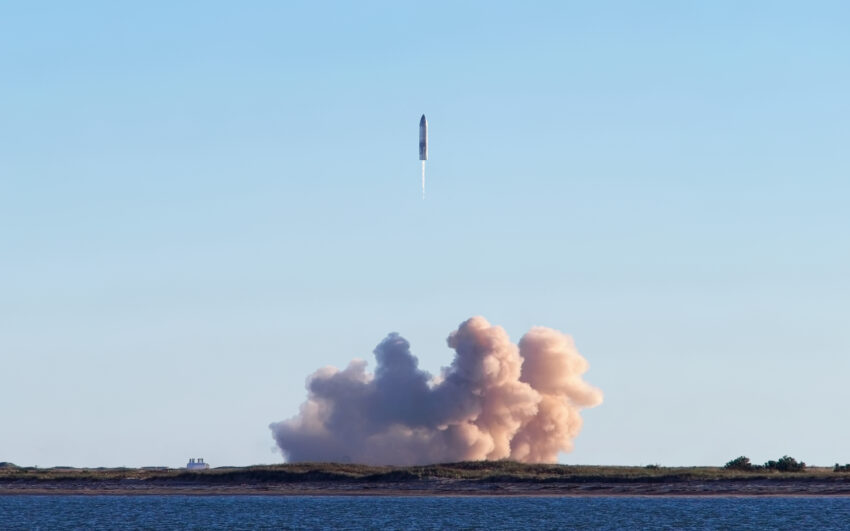
IMAGE: SpaceX Starship SN8 launching from South Texas on December 9, 2020. Photo: Forest Katsch / Wikimedia Commons / CC BY-SA 4.0. Source: https://commons.wikimedia.org/wiki/File:SpaceX_Starship_SN8_launch_as_viewed_from_South_Padre_Island.jpg License: https://creativecommons.org/licenses/by-sa/4.0/