
A river cruise ship capsized after a tanker struck it near the Port of New Orleans on November 13, 2026. All passengers and crew survived, while investigators examined a possible steering failure.
A large tanker struck a docked river cruise ship on the Mississippi River in New Orleans on Friday, November 13, 2026, causing the passenger vessel to capsize and triggering a major rescue operation. Thirty-two people were hospitalized, including 30 passengers and two harbor police officers involved in the rescue. Officials confirmed that everyone aboard both ships was accounted for and no deaths or critical injuries were reported.
The collision occurred at approximately 12:30 p.m. near the Port of New Orleans, where the American Heritage riverboat had docked about two hours earlier. The tanker, identified as the Atlantic Asphalt, struck the passenger vessel along its side. The impact caused significant structural damage, and the riverboat gradually rolled onto its side as water entered the ship.
Emergency crews rushed to the waterfront as passengers scrambled to escape. Some climbed over railings and onto exposed sections of the vessel, while others entered the river wearing life jackets. Nearby boats joined firefighters, police and Coast Guard personnel in pulling people from the water.
Passengers Escape as Riverboat Capsizes
The American Heritage was preparing to disembark passengers when the collision occurred. The vessel had been operating a Mississippi River cruise and was tied to the dock when the much larger tanker approached. The impact damaged the passenger ship and left people aboard struggling to reach safety.
Videos recorded near the waterfront showed the tanker striking the riverboat before the smaller vessel began leaning toward the water. People could be seen gathering along railings as the ship continued tilting. Eventually, much of the American Heritage disappeared beneath the river’s surface, leaving part of its structure exposed.
One passenger, Tamara Carrasco, a retired elementary school teacher from Atlanta, described seeing the tanker approaching while she was in the dining room. She attempted to move away from the danger but was knocked to the floor when the vessels collided. Returning toward the dining area, she saw broken windows and water rushing inside.
Another witness, Jamie Holford, described the force of the impact and the frantic evacuation that followed. He told CBS News that he watched people hurry off the vessel as it began rolling over. Some passengers climbed over railings as the boat settled farther into the river.
The Mississippi River’s powerful current made the evacuation especially dangerous. Rescue workers had to reach people in the water while navigating around the damaged ship and nearby vessels. Despite those conditions, authorities reported that everyone aboard the riverboat survived.
Thirty-Two Hospitalized After Major Rescue
New Orleans Mayor Helena Moreno confirmed that 30 cruise passengers were taken to local hospitals following the collision. Two harbor police officers who entered the water during rescue operations were also hospitalized. Officials described the injuries as noncritical, and no one aboard the tanker was reported injured.
Moreno praised the coordination between professional emergency responders and private boat operators who helped rescue stranded passengers. The effort involved the Coast Guard, New Orleans Fire Department, emergency medical personnel, harbor police and other agencies. Civilian vessels already operating nearby also assisted in transporting people to safety.
The mayor called the successful evacuation a “miracle on the Mississippi” during a news conference Friday afternoon. Louisiana Governor Jeff Landry also praised the emergency response, emphasizing the dangers posed by the river’s currents. Authorities confirmed that the search-and-rescue operation had ended after all passengers and crew were accounted for.
The precise number of people aboard the American Heritage varied in initial reports. Port officials identified approximately 129 passengers, while other accounts placed the total number of passengers and crew closer to 200. Those figures were not necessarily contradictory because the lower number did not include all crew members.
Many passengers lost personal belongings during the emergency, including identification documents, medications, telephones and car keys. City officials worked with the cruise operator to arrange temporary accommodations and other assistance. Some survivors were brought to the port administration building after being evacuated from the waterfront.
Coast Guard Investigates Possible Steering Failure
Investigators are examining whether the Atlantic Asphalt experienced a steering problem shortly before striking the American Heritage. Coast Guard Capt. Melanie Burnham said preliminary information suggested that the tanker might have lost steering control. However, she emphasized that the cause had not been established.
Investigators must determine what happened as the tanker approached the docked cruise ship and whether mechanical, operational or navigational factors contributed to the collision. The investigation will examine the vessels’ movements and the circumstances leading up to the impact. Officials have not announced a final determination of responsibility.
The National Transportation Safety Board announced that it was sending investigators to New Orleans, with a team expected to arrive Saturday. The Coast Guard was also conducting its own investigation into the marine casualty. Both agencies will examine evidence to establish the sequence of events and identify potential safety failures.
The Atlantic Asphalt is a tanker designed to transport asphalt and bitumen, materials commonly used in road construction and roofing. Built in 2017, the vessel is approximately 160 meters long and sails under the flag of the Marshall Islands. Maritime records identify Nave Shipping as its commercial operator, with technical management handled by Thome Ship Management.
The American Heritage is a much smaller passenger vessel operated by American Cruise Lines. Built in 2015, the paddlewheel-style riverboat has a capacity of approximately 150 passengers and operates cruises along the Mississippi River. Its design resembles traditional American riverboats, although it is a modern passenger ship.
Mississippi River Closed During Emergency Response
The Coast Guard temporarily closed a section of the Mississippi River between mile markers 93 and 96 following the collision. The restriction prevented commercial and recreational vessels from entering the emergency response area. Officials said the closure was necessary to protect rescue crews and other mariners while operations continued.
The disruption also affected transportation across the river. New Orleans’ cross-river ferry service was suspended, and a nearby riverfront festival was canceled for the day. Authorities worked to determine when normal marine traffic could safely resume.
The Mississippi River is one of the nation’s busiest commercial waterways, carrying cargo vessels, tankers, barges and passenger boats through the Port of New Orleans. Ships navigating the area must contend with powerful currents, sharp bends and other river traffic. The collision occurred near a section of the waterfront where commercial shipping operates close to passenger facilities.
The damaged American Heritage remained partially submerged after the evacuation. Coast Guard officials said they would assess conditions before allowing normal traffic through the affected stretch of river. The extent of the ship’s structural damage and plans for recovery had not been fully established Friday evening.
Cruise Operator Responds as Investigation Begins
American Cruise Lines confirmed that guests and crew had been evacuated from the American Heritage. The company expressed concern for those involved and thanked emergency personnel for their rescue efforts. It also began helping affected passengers with arrangements following the interrupted cruise.
The collision brought renewed attention to the risks involved when large commercial vessels and passenger ships operate in the same waterways. Maritime investigators will need to establish why the tanker approached the docked riverboat and whether the reported steering problems played a role. The available evidence does not yet establish that a mechanical failure caused the accident.
For passengers, the evacuation ended without any reported deaths despite the extensive damage to the riverboat. The outcome depended on the rapid response of emergency agencies, nearby boat crews and the ship’s own personnel.
The Coast Guard and National Transportation Safety Board are expected to continue examining the circumstances surrounding the collision. Their findings will help determine what caused the tanker to strike the American Heritage and whether changes to equipment, procedures or navigation practices are needed to prevent another similar accident.
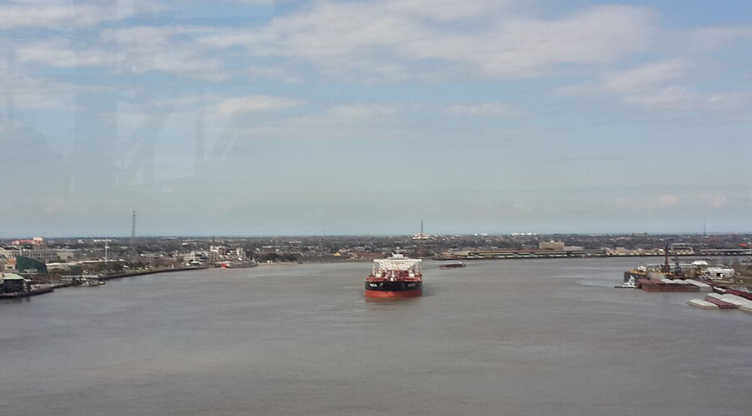
IMAGE: Source Own work Author Yair Haklai CC4