
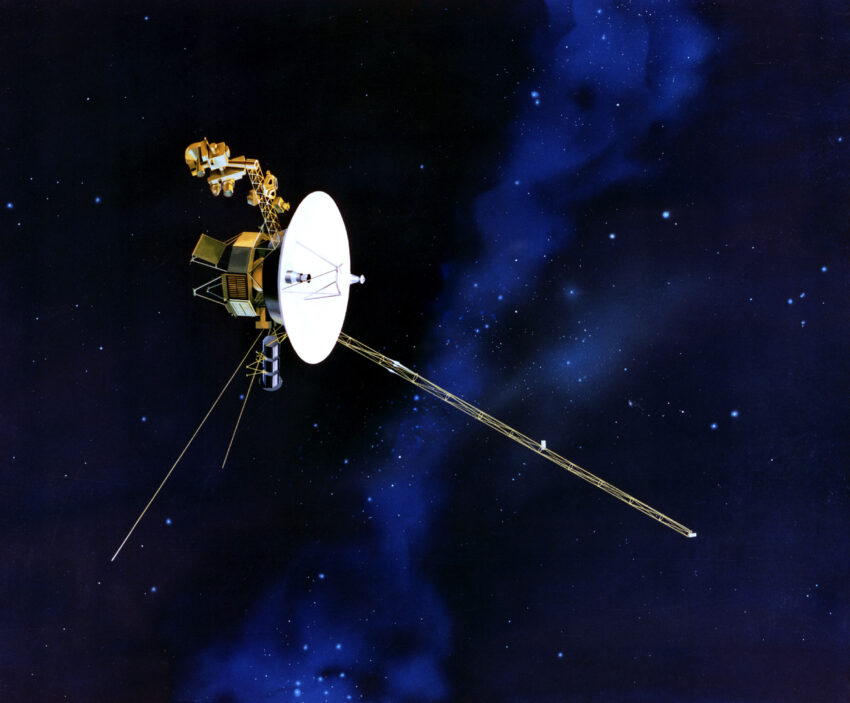
Voyager 1 will become the first human-made object to reach a distance of one light-day from Earth on November 18, 2026, as NASA works to extend the scientific missions of both Voyager spacecraft.
NASA’s Voyager 1 spacecraft is approaching a historic milestone nearly 50 years after leaving Earth. On November 18, 2026, the probe will become the first human-made object to reach a distance of one light-day from Earth, marking another achievement for the longest-running deep-space exploration mission.
The spacecraft will be approximately 16.094 billion miles (25.902 billion kilometers) from Earth when it reaches the milestone at 5:16:07 a.m. Eastern time. At that distance, a radio signal traveling at the speed of light will take 24 hours to reach Voyager 1, with another 24 hours required for a response to return.
NASA continues to operate Voyager 1 and its twin, Voyager 2, despite the challenges of aging equipment and declining electrical power. Both spacecraft are traveling through interstellar space, making scientific measurements from a region no other spacecraft has explored directly.
Voyager 1 Approaches an Unprecedented Distance
Voyager 1 launched on September 5, 1977, beginning a journey that would eventually carry it beyond the Sun’s protective magnetic environment. Its original mission focused on studying the outer planets, but the spacecraft continued traveling long after completing its planetary encounters.
The probe passed Jupiter in 1979 and Saturn in 1980, returning detailed observations that transformed scientists’ understanding of both planets and their moons. Its instruments discovered new features in the planets’ atmospheres, rings and surrounding environments.
Voyager 1 entered interstellar space in August 2012 after crossing the heliopause, the boundary where the solar wind gives way to the surrounding interstellar environment. Voyager 2 reached that region in November 2018, becoming the second spacecraft to cross the boundary.
Although both probes are now in interstellar space, neither has traveled beyond the solar system in every scientific sense. The distant Oort Cloud, a vast region believed to contain icy objects gravitationally associated with the Sun, extends far beyond their current positions.
Voyager 1 is moving at approximately 38,000 miles per hour, yet its journey demonstrates the enormous distances involved in exploring space. At that speed, it will take thousands of years to approach another star.
NASA expects the spacecraft to pass within about 1.7 light-years of Gliese 445, a star in the constellation Ursa Minor, in approximately 40,000 years.
Engineers Find New Ways to Conserve Power
Keeping spacecraft operating for nearly half a century requires constant attention to their aging systems. Both Voyager probes receive electricity from radioisotope thermoelectric generators, which convert heat produced by decaying plutonium-238 into electrical energy.
Unlike solar-powered spacecraft, the Voyagers do not depend on sunlight to operate. Their nuclear power systems allow them to function at distances where solar panels would produce too little electricity to support their missions.
However, the generators gradually lose power, reducing the electricity available for instruments, communications and onboard equipment. NASA estimates that each Voyager loses approximately four watts of electrical output annually.
Engineers have responded by shutting down equipment that is no longer essential and carefully managing the remaining instruments. These decisions allow the spacecraft to continue collecting scientific information while conserving their limited energy supplies.
In September 2026, NASA completed an important power-saving operation aboard Voyager 1. Engineers simultaneously replaced three active devices with three lower-power alternatives that perform similar spacecraft functions.
The maneuver, nicknamed the “Big Bang” by mission engineers, followed a successful operation aboard Voyager 2 in July. The changes reduced electrical consumption while maintaining the heat distribution needed to protect spacecraft equipment.
According to NASA’s Jet Propulsion Laboratory, the modification should allow Voyager 1’s remaining scientific instruments to operate longer than previously expected. Without the changes, engineers would have needed to shut down another instrument as early as summer 2027.
The operation was particularly challenging because the equipment switches had to be coordinated carefully. At Voyager’s distance, engineers cannot receive immediate confirmation that a command has worked.
Brief Communications Failure Raises New Questions
The spacecraft’s age became another concern in October when NASA temporarily lost contact with Voyager 1. The agency’s Deep Space Network failed to detect the probe’s radio signal during scheduled communications attempts on October 18 and 19.
The signal reappeared on October 20, allowing engineers to resume communications. NASA reported that the spacecraft had switched from one group of thrusters to its backup system during the disruption.
The automatic response was consistent with Voyager’s fault-protection system, which can place the spacecraft in a safer operating condition when onboard computers detect a problem.
Engineers continued investigating the incident after communications resumed. The precise reason for the unexpected thruster switch had not been established in NASA’s October 29 update.
The temporary interruption illustrated how difficult it has become to maintain reliable contact with equipment launched in the 1970s. The spacecraft must perform many protective functions independently because commands from Earth require almost an entire day to arrive.
NASA communicates with the probes through the Deep Space Network, a worldwide system of large radio antennas located in California, Spain and Australia. The network allows mission controllers to communicate with distant spacecraft as Earth rotates.
Voyager Probes Continue Studying Interstellar Space
Despite their limited power supplies, the Voyagers continue returning valuable measurements about the environment beyond the heliosphere. Their instruments help researchers examine magnetic fields, plasma waves and energetic particles.
Voyager 1 currently operates its magnetometer and plasma wave subsystem. NASA shut down its low-energy charged particle experiment in April 2026 to preserve enough electrical power for other essential operations.
Voyager 2 continues operating instruments that measure magnetic fields, plasma waves and cosmic rays. The two spacecraft travel in different directions, allowing scientists to compare conditions across widely separated regions of interstellar space.
These measurements provide information unavailable from telescopes observing distant objects. The spacecraft directly sample their surrounding environments, helping scientists understand how the solar system interacts with the material between stars.
The probes also carry identical Golden Records containing sounds, images and musical selections representing life on Earth. The records were designed as messages for any civilization that might encounter the spacecraft in the distant future.
Even after their instruments and transmitters stop functioning, both Voyagers will continue traveling through space. Their journeys will extend far beyond the operational lives of the spacecraft.
NASA Plans Return to Moon as Deep-Space Research Continues
While the Voyager mission continues, NASA is also preparing for another major phase of human space exploration. The agency is working toward returning astronauts to the lunar surface in 2028 through its Artemis program.
Under the updated schedule, Artemis III is planned as a 2027 test mission in low Earth orbit. Artemis IV is intended to carry astronauts to the lunar surface in 2028, with exploration concentrated near the Moon’s South Pole.
NASA announced further details of the accelerated program in October, building on goals introduced through its Ignition initiative. The plans include developing technologies and equipment needed for a sustained human presence on the Moon.
The lunar program is separate from Voyager’s scientific mission, but both represent different parts of NASA’s broader exploration work. Artemis focuses on human operations near Earth, while Voyager studies conditions far beyond the planetary region.
Researchers are also improving their ability to study smaller objects entering Earth’s atmosphere. Scientists at MIT’s Haystack Observatory recently reported new findings from a bright meteor that exploded above Cape Cod Bay on May 30, 2026.
Radar measurements helped investigators reconstruct the object’s atmospheric passage and study its behavior. The research, which remained under peer review in early November, demonstrates how ground-based instruments can contribute to understanding objects arriving from space.
NASA Prepares to Mark Voyager’s Achievement
NASA has announced public activities surrounding Voyager 1’s approaching milestone. On November 17, the agency is encouraging people around the world to participate in a symbolic celebration called “Shine Bright for Voyager’s Light-Day.”
Participants can use flashlights or mobile devices to signal the letters VGR, the Voyager mission’s call sign, in Morse code. NASA also plans a public discussion about the mission on November 19.
The celebration will not involve sending an actual message that Voyager’s instruments are designed to detect. Instead, it recognizes the extraordinary distance traveled by a spacecraft built using technology developed nearly five decades ago.
NASA’s next challenge will be preserving the Voyagers’ remaining scientific capabilities as their power supplies continue declining. Engineers have extended the missions through careful planning and technical adjustments, but future instrument shutdowns will eventually become unavoidable.
For now, both spacecraft continue returning information from interstellar space. Voyager 1’s November 18 milestone will mark another chapter in a journey that began in 1977 and has already lasted far longer than its original planetary mission.
IMAGE: Artist’s concept of Voyager in flight. Photo: NASA/JPL / Wikimedia, taken 1990-01-01, Public domain