
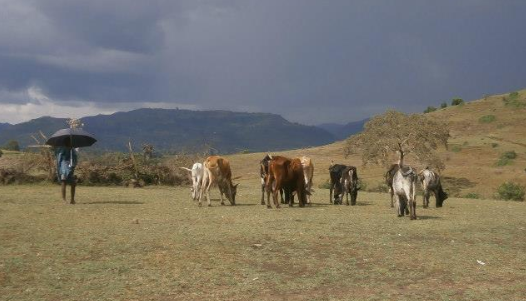
Researchers documented repeated sexual interactions and affectionate behavior between two animals of different species, raising new questions about the role of sex in animal relationships.
A bull and a male donkey living on an Ethiopian plateau have attracted scientific attention after researchers documented an unusual relationship involving repeated sexual contact and affectionate behavior. The animals, named Achille and Patroclo, regularly sought each other out despite having access to potential partners of their own species.
The findings were published November 2, 2026, in the scientific journal Current Biology. Researchers from the University of Pisa in Italy recorded 51 mounting events between the animals, including 34 instances involving penetration, during observations conducted in March.
What makes the case particularly unusual is not simply that both animals are male. The researchers found that their sexual interactions occurred alongside a consistent social relationship involving grooming, rubbing and remaining close to one another.
Researchers Discover the Relationship by Chance
The scientific team was working in the Ethiopian highlands to study gelada monkeys when members noticed the bull repeatedly mounting a male donkey in a nearby grazing area. The donkey did not appear to resist or attempt to escape, prompting the team to investigate further.
Led by behavioral scientist Elisabetta Palagi, the researchers began systematically recording interactions involving both animals. Their observations took place between March 6 and March 19, 2026.
Although the observation period covered approximately two weeks, the animals shared the same pasture on only four days. They belonged to different owners and were separated outside their shared grazing periods.
During the time they spent together, Achille and Patroclo repeatedly approached one another. They also engaged in nonsexual behaviors that scientists describe as affiliative, meaning interactions associated with positive social contact.
These included licking, rubbing their bodies together and touching one another with their muzzles. Such behaviors occurred both before and after sexual encounters, suggesting that their interactions extended beyond mounting.
The researchers considered this broader pattern important because it indicated a selective relationship rather than a series of unrelated sexual encounters.
Donkey Actively Participated in the Encounters
Patroclo’s behavior was particularly notable because he did not simply remain passive during Achille’s advances. He sometimes presented his hindquarters to the bull and initiated contact through gentle nipping.
The donkey also approached Achille and remained nearby after sexual activity. Neither animal consistently displayed behaviors that researchers would interpret as rejection or avoidance.
This differed from Achille’s interactions with another male donkey. When the bull attempted to mount that animal, the donkey responded by flattening its ears and displaying threatening or avoidance behavior.
Achille’s repeated interactions with Patroclo therefore appeared to involve a willingness to participate that was absent in those other encounters.
The study also documented situations in which Patroclo reacted negatively toward other bulls. These observations added to the evidence that the relationship involved more than an indiscriminate response to nearby animals.
Researchers emphasized that the two had access to male and female animals of their respective species. Their behavior could not easily be explained by a complete absence of other potential partners.
However, the team cautioned that observing repeated interactions does not establish the animals’ motivations or prove that their relationship resembled human romantic attachment.
Ancient Greek Names Reflect an Unusual Partnership
The names Achille and Patroclo reference Achilles and Patroclus, two figures from ancient Greek mythology whose relationship has been interpreted in different ways over centuries.
In Homer’s Iliad, the two warriors share a powerful emotional connection. Later interpretations have described them as devoted companions, close friends or lovers.
The comparison offers a memorable way to identify the animals, but the researchers do not claim that the bull and donkey experience relationships in the same way humans do.
Animal behavior specialists distinguish between observable actions and assumptions about internal emotional experiences. Grooming, proximity and sexual contact can be documented directly, while romantic feelings or sexual identities cannot be established through those observations alone.
The distinction is especially important when discussing animal sexuality because human categories do not always provide accurate explanations for other species.
Same-Sex Sexual Behavior Is Widespread in Nature
The Ethiopian observations add to extensive research documenting same-sex sexual behavior across the animal kingdom. Scientists have reported such behavior in more than 1,500 animal species, including mammals, birds, reptiles, fish and invertebrates.
A 2023 study published in Nature Communications examined the evolutionary patterns of same-sex sexual behavior among mammals. Researchers identified documented examples in 261 mammalian species and found associations with social organization.
The analysis suggested that these behaviors may help establish or maintain social relationships and reduce conflict in some species. However, the findings did not establish a universal explanation for why such interactions occur.
Bonobos provide a frequently studied example. Sexual contact between females can play a role in maintaining social relationships and reducing tension within groups.
Male bottlenose dolphins have also been observed engaging in sexual interactions associated with alliances. Among some Japanese macaques, females form temporary sexual partnerships involving repeated mounting.
These examples demonstrate that sexual behavior can serve social functions beyond reproduction. The precise role varies by species and circumstances, and scientists continue investigating the mechanisms involved.
Cross-Species Interactions Make the Case Especially Rare
Same-sex behavior within individual species is well documented, but sustained sexual relationships between animals of different species are much less frequently described.
Researchers have previously observed Japanese macaques mounting sika deer. Such interactions demonstrate that sexual behavior can cross species boundaries, although the circumstances and responses of the animals vary considerably.
Achille and Patroclo stand out because the researchers documented both repeated sexual activity and ongoing nonsexual social contact.
The observations suggest that their association may have involved a selective social bond, although the study was too brief to determine how the relationship developed or whether it continued afterward.
The study also could not establish whether sexual behavior strengthened the relationship or whether an existing social connection encouraged sexual contact.
Both explanations remain possible, along with combinations of social and sexual motivations.
Scientists Reconsider Traditional Explanations
Historically, researchers have proposed several explanations for same-sex sexual behavior in animals. These include mistaken identification of partners, limited access to opposite-sex mates and sexual responses that occur without reproductive opportunities.
Other theories suggest that sexual behavior may help establish alliances, reduce conflict or maintain relationships within social groups.
In 2019, researchers proposed that indiscriminate sexual behavior might have existed early in animal evolutionary history, with stronger preferences for particular partners developing later.
That proposal challenged the assumption that every sexual interaction must directly contribute to reproduction to have evolutionary relevance.
The 2023 mammalian study offered a different perspective, finding that same-sex behavior appears to have evolved independently in multiple mammalian lineages. Its results did not establish the behavior as an ancestral condition for all mammals.
These differing findings demonstrate that scientists are still examining how animal sexual behavior develops and changes across evolutionary history.
What the Ethiopian Study Can and Cannot Establish
The new research provides detailed observations of two individual animals, but it cannot determine how common comparable relationships are among cattle, donkeys or other domestic animals.
The brief observation period is an important limitation. Researchers cannot establish how long Achille and Patroclo had known each other, whether the relationship continued over months or how their behavior would change under different circumstances.
The findings also do not establish a fixed sexual orientation in either animal. Sexual behavior describes actions that can be observed, while sexual orientation involves broader patterns of attraction that cannot be reliably inferred from this small study.
The researchers suggest that the relationship raises questions about whether sexual interactions can help maintain social bonds across species boundaries. Answering those questions will require longer observations and comparisons involving other animals.
After the study, Achille and Patroclo were moved to different grazing areas, leaving the future of their relationship uncertain.
The researchers hope to investigate whether similar interactions occur more frequently than existing records suggest. Their findings offer a documented example of how animals can form selective relationships that do not fit conventional assumptions about reproduction or species boundaries.
IMAGE: Source Own work Author Barrowbob CC4