
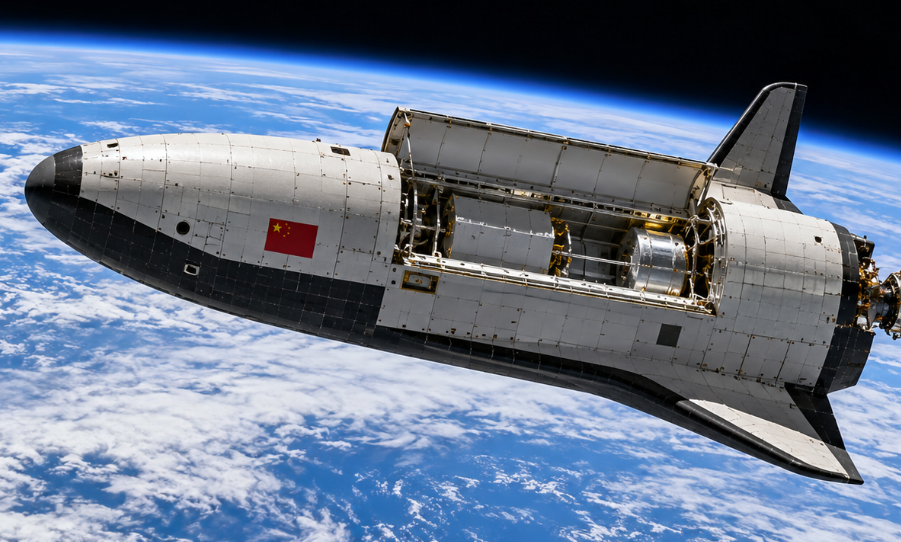
A newly released U.S. intelligence report reveals a rare orbital photograph of China’s mysterious reusable spacecraft, showing its open payload bay and a second satellite attached behind it.
The United States has released a rare photograph of China’s secretive reusable spaceplane, offering the clearest public view yet of a spacecraft whose design and operations have remained largely hidden. The image appears in a Defense Intelligence Agency (DIA) report published October 26, 2026, and shows the Chinese vehicle orbiting Earth with an open payload bay and another spacecraft attached to its rear.
The photograph was captured on May 28, 2024, by the WorldView-3 satellite operated by Maxar Technologies, now known as Vantor. The satellite photographed the Chinese spacecraft from a distance of just under 56 miles (90 kilometers), revealing structural details that had previously been difficult to observe.
The Chinese vehicle is widely believed to be Shenlong, an experimental uncrewed spaceplane that has completed several orbital missions since 2020. Its appearance closely resembles the American X-37B, a reusable military spacecraft operated by the U.S. Space Force.
The image provides new evidence about China’s progress in developing reusable orbital vehicles. However, it does not establish the spacecraft’s classified mission objectives or prove that it carries weapons.
What the Newly Released Photograph Reveals
The image appears on page 53 of the DIA’s 2026 report, Challenges to Security in Space. The agency identifies the vehicle as a Chinese spaceplane but does not publicly confirm its name or provide a detailed description of its technical specifications.
Several features are visible, including a winged body, dark heat-resistant surfaces and a central compartment with its doors open. Another spacecraft is attached near the rear, with solar panels extending outward to collect electricity while in orbit.
Vantor confirmed the photograph’s date and circumstances in information provided to The War Zone. The company identified a separate satellite docked to the spaceplane and confirmed that the spacecraft’s payload bay doors were visibly open.
The image is particularly valuable because China has released very little information about the actual appearance of its experimental orbital vehicle. Previous public observations relied heavily on ground-based telescope images, launch information and measurements collected by satellite-tracking organizations.
The newly released photograph gives researchers a clearer picture of the vehicle’s external structure. Its shape and arrangement suggest a reusable spacecraft designed to conduct extended operations in orbit before returning to Earth.
The attached satellite is another important detail because its purpose remains unknown. The photograph confirms that two objects were connected at the moment of observation, but it does not establish what the smaller spacecraft was intended to accomplish.
China’s Spaceplane Has Completed Several Secretive Missions
China began testing its reusable experimental spacecraft in September 2020, launching the vehicle aboard a Long March 2F rocket from the Jiuquan Satellite Launch Center. The first mission lasted approximately two days before the spacecraft returned to a designated landing site.
The second mission began in August 2022 and lasted 276 days, ending in May 2023. That flight demonstrated that China’s experimental vehicle could remain in orbit for months rather than days.
A third mission launched in December 2023 and ended in September 2024 after roughly nine months in space. Chinese state media described the flight as lasting 268 days, although some independent orbital records put the duration closer to 266 days.
The newly released photograph was taken during that third mission. Its May 2024 capture date places it several months after launch and before the spacecraft returned to Earth.
China launched its fourth known reusable spacecraft mission on February 7, 2026, again using a Long March 2F rocket from Jiuquan. Reuters reported that Chinese state media described the mission as a demonstration of reusable spacecraft technology intended to support peaceful space operations.
China did not disclose the spacecraft’s planned flight duration, operating altitude or specific experiments. As of October 28, the latest flight represented another stage in the country’s continuing development of reusable space systems.
Spaceplane Conducted Unusual Orbital Maneuvers
One of the most closely watched aspects of China’s spaceplane program involves its interactions with smaller objects in orbit. Independent satellite trackers have observed the spacecraft releasing objects and later maneuvering near them during previous missions.
The Center for Strategic and International Studies documented these activities in its 2024 Space Threat Assessment. Its report described observations from LeoLabs indicating that Shenlong had performed formation flying, docking and recapture operations with another object during its second mission.
Such maneuvers require precise control over a spacecraft’s position and speed. Engineers can use these capabilities to test satellite servicing, inspection, docking systems and technologies intended for future reusable missions.
The same capabilities can also have military applications, including approaching or inspecting another country’s satellite. However, the ability to perform proximity operations does not demonstrate that a spacecraft is carrying weapons or preparing to attack other satellites.
During later flights, tracking organizations detected additional objects associated with the Chinese vehicle. Some reportedly transmitted radio signals, but their precise functions and the experiments conducted with them have not been independently established.
The newly released photograph provides visual evidence of an attached spacecraft during the 2024 mission. It does not reveal whether that object was involved in the same types of experiments observed during earlier flights.
How China’s Spaceplane Compares With the American X-37B
China’s experimental vehicle shares several visible characteristics with the X-37B, the uncrewed reusable spacecraft developed by Boeing and operated by the U.S. Space Force. Both are launched vertically aboard conventional rockets and are designed to return through Earth’s atmosphere for runway landings.
The American X-37B has been conducting orbital missions since 2010, often spending hundreds of days in space. Its publicly acknowledged activities include testing spacecraft technologies, evaluating materials and conducting experiments related to navigation and communications.
The X-37B also uses a payload bay to carry experiments into orbit and has operated with solar-powered equipment. Its combination of reusable flight hardware and extended orbital endurance makes it an important comparison for understanding China’s program.
China’s spacecraft appears to use a similar general arrangement, although its exact dimensions, weight and internal systems remain uncertain. The new photograph does not provide enough information to determine whether the two vehicles have identical capabilities.
The American spaceplane program also operates under significant secrecy, particularly regarding certain military experiments. That makes a complete technical comparison difficult because neither government publicly discloses every mission objective.
U.S. Intelligence Warns About Growing Space Threats
The DIA released the photograph as part of a broader assessment examining challenges to American security in space. The report focuses on China, Russia and other countries developing technologies that could threaten satellites and military communications systems.
Modern armed forces rely heavily on satellites for navigation, intelligence gathering, communications and monitoring potential threats. Disrupting those services could affect military operations on Earth as well as other activities that depend on reliable access to space.
The intelligence assessment discusses several categories of potential counterspace technology, including electronic interference, cyberattacks, directed-energy systems and weapons capable of damaging satellites. These threats are separate from the photographed spaceplane, whose specific military capabilities have not been publicly confirmed.
China has expanded its satellite fleet and launch operations while investing in advanced spacecraft and reusable launch technologies. The DIA considers those developments important because they increase China’s ability to operate in an environment where military and civilian infrastructure frequently overlap.
Russia also remains a focus of the assessment because of its anti-satellite capabilities and military space activities. The report addresses the growing difficulty of protecting satellites in an increasingly crowded and strategically important orbital environment.
Photograph Leaves Important Questions Unanswered
Despite offering a clearer view of the Chinese spacecraft, the new photograph leaves major questions unresolved. Researchers still lack verified information about its internal equipment, payload capacity, exact dimensions and the purpose of the satellite attached behind it.
China has described its reusable spacecraft program as an effort to test technology that could make access to space more convenient and affordable. Its authorities have provided few technical details that would allow independent experts to evaluate those claims fully.
The ability to launch, maneuver and recover a spacecraft repeatedly could eventually reduce the costs of certain orbital missions. It may also support future experiments involving satellite maintenance, equipment testing and other activities that require extended operations in space.
The photograph establishes that China’s experimental spaceplane was operating with an open payload bay and an attached satellite in May 2024. Whether those features were part of routine engineering tests, satellite servicing experiments or other operations remains unknown.
China’s fourth known reusable spacecraft mission began in February 2026, while the DIA’s newly published report examines the broader growth of the country’s space capabilities. Further observations, official disclosures or future missions may provide additional information about how China intends to use the vehicle.
IMAGE: Artist’s illustration CNR Art Department