
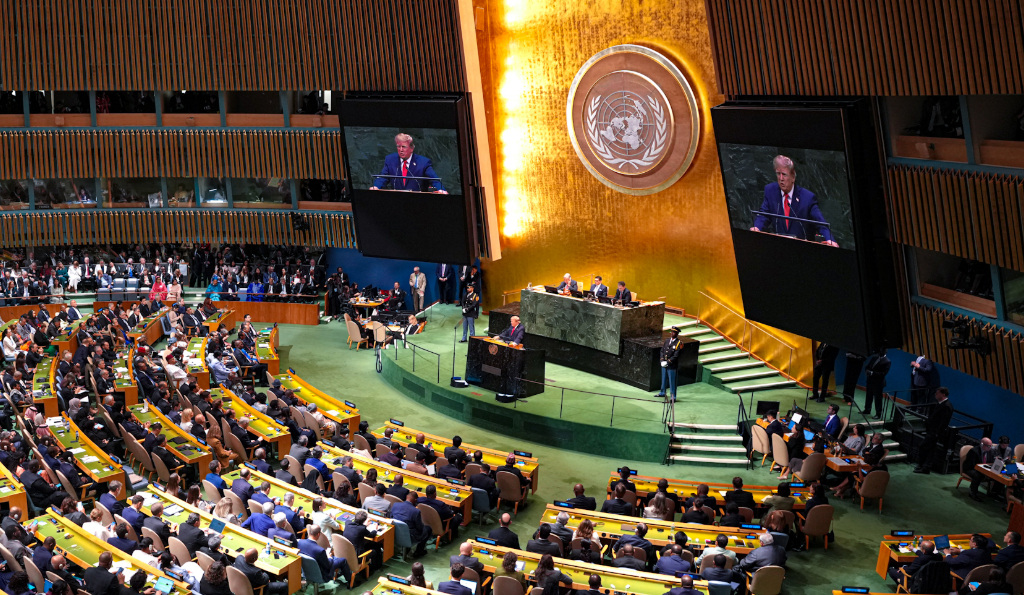
President Donald Trump spoke before the United Nations General Assembly on Tuesday, focusing his remarks on efforts to prevent Iran from developing nuclear weapons. He also addressed his stance on the ongoing conflict with Iran and made mention of his previous attempts to negotiate a deal with the country.
Trump said he had offered full economic cooperation in exchange for Iran giving up its nuclear program, but the nation refused. He claimed that after military operations in the summer of 2025, he again extended an opportunity to negotiate, which Iran also rejected.
The president argued that many past U.S. leaders recognized Iran as a threat but chose not to act on it. He said that after giving Iran every chance for a deal, he took action to prevent it from obtaining a nuclear weapon. These statements reflected Trump’s account of the diplomacy and military campaign.
Trump thanked the United Nations Security Council for condemning attacks on shipping in the region and called on other countries to remain united in applying pressure on Iran. He also called for greater economic isolation of Tehran.
Trump said he believed Iran may be waiting until after the November midterm elections before reaching an agreement with the United States. He predicted that a deal could come after the election. Iranian intentions on the timing of any agreement remain uncertain.
The president used particularly strong language when describing the choice facing him. He asked whether the United States should make a deal that would allow Iran to rebuild or “annihilate” the Islamic Republic if no agreement could be reached.
Trump said that from the first day he entered politics he had remained firm in his opposition to an Iranian nuclear weapon. His remarks came more than seven months into the current U.S.-Iran conflict.
Diplomacy continued despite the threatening language. The Associated Press reported that U.S. and Iranian officials met for about three hours on Tuesday after Trump’s speech. Trump later described the meeting as productive.
The president also referenced his efforts to end the Israel-Hamas war in Gaza and U.S. actions in Venezuela. He said that one year ago the war in Gaza was still raging and hostages remained in Hamas captivity.
Trump credited meetings held during the 2025 General Assembly with helping produce the later Gaza agreement. He said the agreement ended the war and led to the return of the remaining hostages. French President Emmanuel Macron challenged Trump’s description of the situation and argued that continuing humanitarian problems in Gaza showed that peace had not been fully achieved.
Trump also defended U.S. actions in Venezuela. Reuters reported that he used the speech to argue for a stronger U.S. role in the Western Hemisphere and described drug cartels as a major national security threat.
Artificial intelligence was another major subject. Trump said the United States should begin referring to artificial intelligence as “super intelligence.” He argued that the word “artificial” makes the technology sound fake and said the United States should lead its development.
Trump also opposed international efforts to impose broad controls on AI. He said the United States would resist efforts to turn the technology into what he described as a system of global control. His administration said federal authorities could still intervene when necessary under U.S. law.
Secretary-General António Guterres delivered his final General Assembly address before his term ends on December 31. He urged countries to cooperate on peace, climate change, inequality and artificial intelligence.
Guterres warned that the world’s political divisions had grown wider during his tenure. He said wars had expanded, inequality had intensified and trust had weakened. He also called for stronger international safeguards governing artificial intelligence.
The difference between the two speeches was especially clear on international institutions. Guterres defended multilateral cooperation and international rules. Trump praised some recent U.N. changes but continued to criticize what he described as excessive bureaucracy and global control.
Throughout both of his terms, Trump has maintained an “America First” approach when it comes to international organizations like the United Nations. His administrations have withdrawn from or reduced participation in several international organizations and agreements.
Trump also said his administration had helped reduce the U.N. budget and eliminate thousands of positions. The United States recently paid $725 million toward its U.N. dues after falling behind on payments.
Tuesday’s appearance was not Trump’s first General Assembly speech since returning to office. He also addressed the 80th session of the General Assembly on September 23, 2025.
The 2026 event took place during the 81st session of the United Nations General Assembly at U.N. headquarters in New York City. The general debate runs from September 22 through September 28.
Trump’s remarks came as world leaders confronted wars in Iran, Ukraine and other regions along with concerns about economic instability and rapidly developing artificial intelligence.
His Iran comments combined threats of further military action with statements that an agreement remained possible. U.S. and Iranian officials meeting later the same day showed that diplomatic contacts were continuing despite the public confrontation.
IMAGE: United Nations General Assembly Official State Department photo by Freddie Everett CC0