
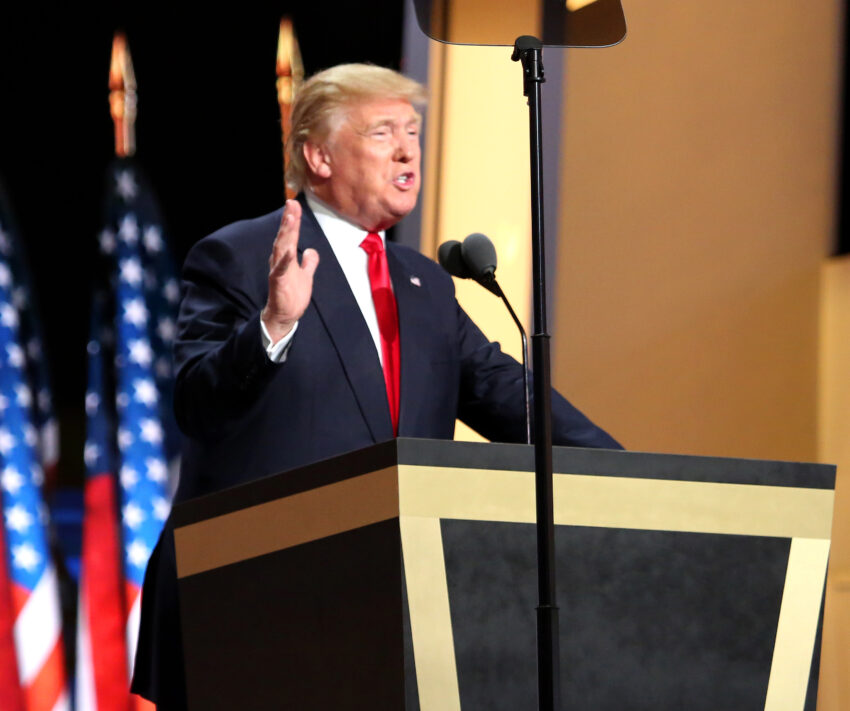
President Donald Trump has redirected his administration’s approach to the Iran conflict, emphasizing economic pressure over military action. The president spoke in the Oval Office on Friday, August 27, 2026, in Washington. His administration has said it will increase economic pressure to weaken Iran’s ability to continue the war. The conflict has not ended as quickly as Trump had suggested, and his earlier talk of a swift resolution now seems to be fading.
In Tehran, pro-government demonstrators gathered and shouted slogans during a public event on Wednesday, according to the South China Morning Post. Trump told reporters that Iran’s military is in serious trouble, saying they are not paying their troops and lack the capacity to continue. He added that the United States does not want to speak with Iran or meet with them in any way.
Trump has posted on social media that the mission is accomplished in Iran, showing a photo of Ayatollah Ali Khamenei alongside AI-generated images, according to a report from CBC News. The war began with airstrikes from Israel and the United States in February, leading to heavy losses on both sides. Tehran and Washington have exchanged few diplomatic gestures in recent weeks, leaving third parties to handle negotiations. Trump has been more preoccupied publicly with his anger over Canada ending trade talks over tariffs.
The war has resulted in significant casualties, including 19 American service members killed and more than 750 wounded. Thousands of civilians have also died across the region due to the conflict. Iran’s top officials, including religious and military leaders, have been targeted by airstrikes. Ayatollah Khamenei’s son, Mojtaba, has not appeared in public and is believed to be seriously injured.
The cost of basic goods has risen sharply in Iran, with rice prices up by 60% and beef prices by 150% since the war began. Iranian citizens have also faced long lines for fuel and other essential supplies. The war has affected global oil markets, leading to higher gas prices in the United States and other countries.
Iran has responded with its own naval actions, including drone attacks and mining in the Strait of Hormuz. These actions have reduced shipping through the strait to about five to fifteen percent of pre-war levels. Iran has also blocked commercial ships from passing through the area, which is a key route for oil and gas transport. The United States has responded with its own naval blockade to limit movement to Iranian ports.
Despite these actions, Trump continues to claim that the Strait of Hormuz remains open. Defense Secretary Pete Hegseth was seen attending military exercises in Panama City on August 13.
The war has cost the U.S. government an estimated $37 billion so far. Lawmakers from both parties have called for more transparency on the war’s financial toll. House Minority Leader Hakeem Jeffries of New York criticized the administration and called for an end to the war.
Few Republicans have openly opposed the war, though some have criticized its tactics. Representative Smith pointed out that the 1973 War Powers Act requires the president to withdraw forces within 90 days unless Congress approves. He said that the administration claimed to end the war and then restarted hostilities after 91 days, which is past the 180-day limit.
IMAGE: Trump promised to bring sweeping political change, to create wealth, and to make America safe again in a speech that excited delegates on the fourth and final day of the convention. (A. Shaker/VOA). Photo: Ali Shaker/VOA / Wikimedia, taken 2016-07-21, Public domain