
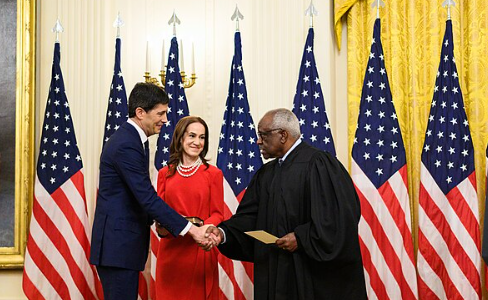
Federal Reserve chair Kevin Warsh led the central bank in raising interest rates on Wednesday. The move marks a shift from earlier policy, after the Fed aggressively raised rates to fight inflation beginning in 2022 and later moved toward lower rates. Investors had expected a slow decline in rates, but inflation rose again this year, prompting the central bank to act. The increase was small, just 0.25 percentage points, but it could signal the beginning of a new tightening cycle.
Kevin Warsh said inflation remains too high and indicated that the Fed needs to see more progress toward its inflation goal, according to Yahoo Finance. The Fed’s statement emphasized that inflation remains elevated and that the rate hike is meant to bring it closer to the bank’s 2% target.
The increase raised the federal funds target range to 3.75% to 4.00%. All 12 voting members of the Federal Open Market Committee supported the move. It was the Fed’s first increase in interest rates since July 2023.
Swaps traders believe that three more rate increases may happen by late 2027, based on current pricing, according to a report from livemint.com. Some experts have pointed out that rate hikes often come in groups, and this pattern is expected to continue. Former Fed officials like Jim Bullard and Richard Clarida have offered similar perspectives, suggesting that the current move is part of a larger plan.
However, not all rate hikes lead to more increases, as was the case in 1997 when Alan Greenspan’s Fed stopped after a single hike. Historically, the stock market often shows weakness in the early months of a tightening cycle, but it usually recovers quickly. The S&P 500 has generally seen positive returns in each 12-month period following a rate-hike cycle, except for one period in 2022. That year saw aggressive and fast rate increases due to unusually high inflation, which made the market reaction more severe.
Some market strategists have viewed early weakness during tightening cycles as a possible buying opportunity rather than the beginning of a long decline. Investors are now watching closely to see how the Fed proceeds in the coming months. The Fed’s latest projections show that 16 of 18 policymakers expect at least one more quarter-point increase before the end of this year. This suggests a slower tightening cycle compared to past periods when the Fed moved quickly.
Those projections also show that most policymakers expect the federal funds rate to end 2026 in a range of 4.00% to 4.25%. The October 27-28 meeting will be the Fed’s next opportunity to change rates. A final scheduled meeting for 2026 will be held December 8-9.
Bloomberg Opinion columnist Jonathan Levin wrote that Warsh has gained what he called “cheap optionality” by acting now while leaving room to respond later. He has built up what the source calls ‘cheap optionality’ in his position.
The Fed’s actions are closely watched by markets and investors who try to predict what comes next in the economy. While some see this as a sign of more rate hikes ahead, others believe the Fed may slow down its pace. The outcome depends on how inflation continues to behave in the months ahead.
Markets remained volatile through Friday. The S&P 500 finished the week nearly unchanged while the Nasdaq gained and the Dow suffered its largest weekly percentage decline since March. The 10-year Treasury yield climbed above 5% during the week while oil prices remained above $100 a barrel.
Investors also pulled a net $31.44 billion from U.S. equity funds during the week ending September 18. Reuters reported that concerns about inflation and additional interest rate increases helped drive the withdrawals. Higher energy costs remain an important concern because they can push transportation and other business costs higher.
For now, investors are adjusting their portfolios in anticipation of a new phase in monetary policy. The Federal Reserve’s decision is part of its ongoing effort to balance economic growth with price stability. This latest move shows that the Fed remains committed to returning inflation to its long-term target of 2%.
Whether this signals a prolonged tightening cycle or just the beginning of a pause remains to be seen.
IMAGE: Kevin Warsh, member of the Board of Governors of the Federal Reserve.. Photo: Federal Reserve / Wikimedia, taken 2006-00-00, Public domain