
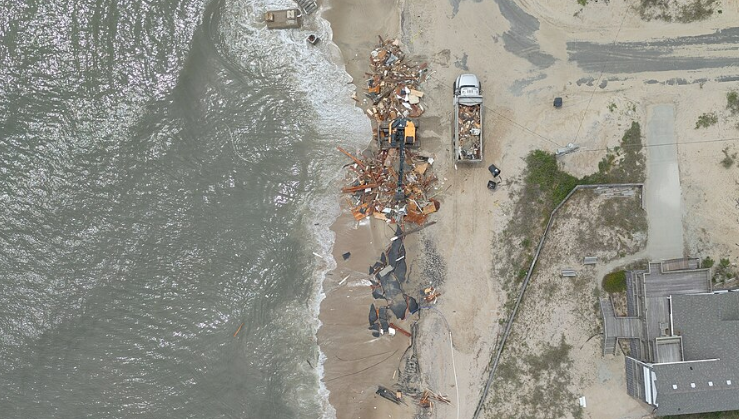
Richard Foreman’s home sits isolated on a stretch of beach in Rodanthe, North Carolina, far from any path to safety. The stairs leading to the house were washed away by waves years ago, leaving no way in or out. The structure stands twenty feet above the ground on stilts meant to protect it from hurricane storm surge.
But recent storms have been small, and it is the slow rise of ocean levels that has caused the real damage, according to NPR. Just six years ago, the house was a popular vacation rental known as Sea ‘n Delight. Now, the house is uninhabitable and has been left to deteriorate.
At low tide, ocean water touches what was once the driveway. At high tide, the ocean flows beneath the entire structure. Homes like Foreman’s are collapsing due to erosion along the coast.
Climate change is making sea levels rise, which worsens erosion in many coastal areas. More than thirty homes have collapsed in Dare County since 2020. The National Park Service currently lists 32 privately owned houses that have collapsed on Cape Hatteras National Seashore beaches since 2020. Foreman knows his house will eventually fall into the ocean.
Four neighboring homes have already fallen into the sea in the past two years. Over a hundred homes on North Carolina’s barrier islands are at risk from erosion and sea level rise in the next ten years. At least half a dozen of those homes are in imminent danger. In June, a high tide and strong waves brought down another house.
But there is no plan to remove most of the threatened homes or clear out their contents. This lack of action stems from how the Federal Emergency Management Agency operates.
FEMA provides most residential flood insurance in the United States. For erosion-threatened homes like Foreman’s, the standard policy generally does not pay simply because a house is in danger of collapsing. NFIP policies cover direct physical loss by or from flood, while gradual erosion by itself is excluded. This creates a financial incentive for owners to wait until their home is gone.
Homeowners may lose tens or hundreds of thousands of dollars if they tear down a house before it falls into the ocean. John Ryan-Henry, a policy analyst at the Coastal States Organization, explained this incentive. He said that homeowners are pushed to wait for collapse and then get a payout.
When homes collapse, they pollute the ocean and leave debris on the shore. Lisa Sharrard, a longtime flood insurance agent in North Carolina, described how this leaves behind hazards on the beach. The National Park Service said it has collected over 480 tons of debris from the area in the last eighteen months. Some of this debris has traveled miles down the coast.
Homeowners, local officials, and even members of Congress are growing alarmed about this situation. Foreman’s house has not been emptied out yet.
He said it looks like the family just left for dinner, with everything still inside. Everything is still inside, including couches, a refrigerator, and beach towels. Foreman said he would have the house torn down tomorrow if FEMA would settle his insurance claim.
As sea levels rise, more coastal areas are facing similar threats. More than thirty homes have fallen into the ocean in North Carolina since 2020. Neighborhoods in Maine, Massachusetts, Michigan, Illinois, Virginia, and California are also facing similar threats.
Just recently, erosion from a storm caused major damage to homes in Southern California. Rep. Chellie Pingree of Maine said people should not have to wait for their homes to collapse. FEMA said it cannot change the rules for threatened properties without new laws from Congress.
A bill to update the National Flood Insurance Program was introduced in 2025 by lawmakers. The bill is H.R. 3161, the Preventing Environmental Hazards Act of 2025, introduced on May 1, 2025. It would extend NFIP coverage to certain shoreline structures condemned or deemed unsafe because of imminent collapse or subsidence from erosion. The proposal also includes payments that could help owners demolish or relocate qualifying structures before collapse. However, the bill is still pending in the House of Representatives. As of September 17, 2026, its latest listed action remains referral to the House Committee on Financial Services.
Congress previously allowed pre-collapse demolition and relocation benefits under the Upton-Jones program, which took effect in 1988. That authority was repealed in 1994 after lawmakers raised concerns about the program’s costs and operation.
FEMA did not respond to questions about how much it costs taxpayers when homes collapse. Federal and county governments estimate they have spent more than half a million dollars cleaning up debris from coastal North Carolina house collapses since 2020.
IMAGE: CapeHatterasNPS 28 May 2024, 16:02:55 CC0