
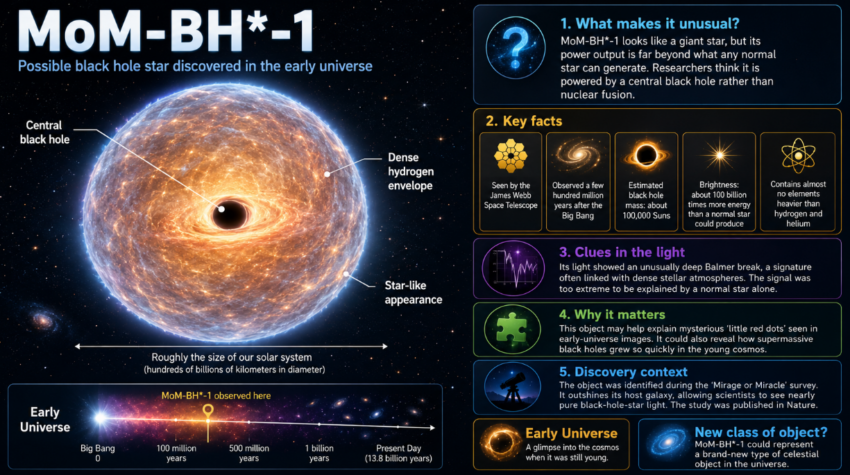
Scientists have identified an unusual astrophysical object that appears to be a new kind of celestial body combining features of both stars and black holes. This object, named MoM-BH*-1, was found by the James Webb Space Telescope in the early universe, just a few hundred million years after the Big Bang. It looks like a large star, about the size of our solar system, but produces energy that is 100 billion times more than any known star can generate.
The object’s brightness is so extreme that it challenges current understanding of how stars and black holes behave, according to Phys.org. Researchers believe the object is powered not by nuclear fusion, but by a central black hole surrounded by a dense cloud of hydrogen gas, according to a report from notebookcheck.net. The lead author of the study, Rohan Naidu from MIT, said the black hole is likely about 100,000 times more massive than our Sun.
Around this black hole, there is a large envelope of gas that gives the object its star-like appearance. The discovery was made during a survey called Mirage or Miracle, which aimed to find the earliest galaxies in the universe. During the survey, researchers noticed a bright red dot that stood out from other sources in the images.
Red objects in space are often thought to be surrounded by dust that changes their light color. However, this object did not match what scientists expect from dust alone. Its light showed a deep Balmer break, which is usually seen in stars with dense atmospheres.
This break was deeper than any previously seen in a celestial object, ruling out normal stars as the source. The object also had almost no signs of elements heavier than hydrogen and helium. To understand what was happening, scientists ran simulations of different scenarios.
These simulations suggested that a dense hydrogen cloud could explain the light patterns. But the energy output still needed a different explanation. Adding a black hole to the model helped solve that issue, as black holes can produce such high energy levels.
The findings suggest that this object is not just a star or black hole, but something entirely new. This discovery could help explain other mysterious red dots seen in early universe images, hothardware.com reported. These little red dots have been common in deep-space images but are rare today.
The researchers think many of these dots are actually black hole stars embedded in early galaxies. MoM-BH*-1 is special because it outshines its host galaxy, allowing scientists to see almost pure black hole-star light. The study was published in the journal Nature.
This discovery may help explain how supermassive black holes grew so quickly in the early universe. It provides new insight into how early black holes developed inside thick clouds of gas. The team includes researchers from MIT, NASA, and multiple other institutions.
This new understanding of black hole stars could change how scientists think about early cosmic evolution.