
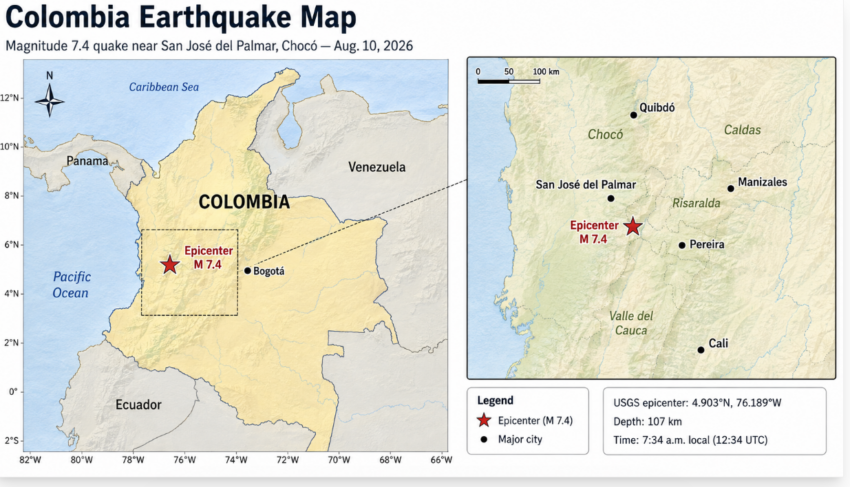
A powerful earthquake struck western Colombia on Monday, killing more than 200 people and triggering widespread search efforts for survivors. The government declared a national disaster in response to the event, and international aid is beginning to arrive. Survivors have shared their experiences of the quake, describing how buildings collapsed around them. CNN reported that rescue workers and volunteers formed a human chain in Pereira to help reach people trapped under rubble. Video footage from Cali showed the rescue of a baby from beneath the remains of an apartment building.
The second day of search and rescue operations was underway as officials worked to assess damage and locate missing people, according to CNN. A young boy from Bahía Solano died after his home collapsed, according to the mayor’s office. Dozens of people attended a candle-lit vigil to mourn the child and pray for his family.
The United States sent a Disaster Assistance Response Team (DART) to support Colombia’s emergency response efforts. The US State Department said the White House and embassy are in constant contact with Colombian President Abelardo de la Espriella. Mexico also offered aid, preparing a group of 255 troops trained in search and rescue along with humanitarian supplies.
One district near the epicenter was dealing with serious structural damage and a lack of water and electricity. A fire broke out at a jail in Buenaventura after the quake, killing at least four people and injuring two others. The jail held about 370 inmates from major criminal groups, according to Valle del Cauca Governor Dilian Francisca Toro.
President de la Espriella announced economic relief measures for those affected during his visit to the coffee region. CNN’s David Culver reported from Pereira where rescue teams were working through rubble with little preparation.
The quake caused serious damage to infrastructure and knocked out essential services in many areas, according to a report from The Hindu. According to the humanitarian office OCHA, as of Monday night, 126 people had died and 1,495 were injured. In Cali, residents gathered in the streets after parts of their homes collapsed. Many families cooked outside and salvaged what they could from the ruins. Pereira was one of the hardest-hit cities, with entire neighborhoods reduced to broken concrete slabs.
Rescuers removed rubble and searched for survivors at collapsed buildings in Pereira. The earthquake also disrupted communications, making it difficult to determine the full extent of the damage.
International aid was starting to arrive as rescue teams worked through the rubble. Rescue crews and civilians searched through debris on Tuesday in hopes of finding survivors, dailypress.com reported. The quake had a magnitude of 7.4 causing widespread destruction across dozens of cities and towns. Authorities reported that around 2,595 people were injured and at least 195 remained missing. Some civilian databases suggest the number of missing could be as high as 3,900.
President de la Espriella said 1,136 homes were destroyed and many more damaged. Most of the deaths occurred in cities like Cali, Pereira, Manizales, and Quibdo, though rural areas had little information available. Aid agencies said the first 48 to 72 hours were critical for finding people alive.
Soldiers, rescue personnel, and family members worked through the rubble by hand. Jairo Vargas drove from Medellin to search for his brother in Pereira after his building collapsed. He said he was certain his brother was still there but feared the worst.
Rescue workers cleared debris in Pereira while heavy machinery rumbled nearby. President de la Espriella’s first major test came with the earthquake as he entered office just days earlier. He visited Quibdo to announce a full military and police response to the disaster.
Choco is one of Colombia’s poorest regions and often faces challenges from armed groups. Access to rural areas in Choco is limited, making it difficult for aid to reach many communities. Sterling Palacios, a leader in the region, said towns were devastated and residents slept in the streets due to aftershocks.
He noted that the government’s response so far has focused mainly on the capital. The biggest challenge remains getting aid to small towns accessible only by boat or plane. Armed groups have complicated access during the pandemic, blocking healthcare workers from reaching remote areas.
Palacios said it could take weeks to understand damage in rural Choco. Citizen-run websites helped families post information about missing loved ones. Dana Carolina Zamora posted a photo of her uncle who was living in a rural area near the epicenter. She said her uncle lived in a traditional house made of sticks and mud.
Zamora expressed fear that her uncle might not have survived the quake. The earthquake left many people shaken, especially after similar quakes hit neighboring Venezuela in June.
Mónica Sánchez, who owns a small company in Pereira, said her factory wall collapsed during the quake. She and her workers escaped just in time.
Sánchez described the moment as shocking, with the city falling down around them. Pereira’s municipal government reported at least 58 buildings had collapsed. Cali Mayor Alejandro Eder said at least 40 buildings collapsed in his city.
Both cities enforced curfews to prevent looting and restricted private vehicle use in Pereira. The city government banned private vehicles from circulating in Pereira to allow emergency services to move freely.