
The ancient human practice of looking up at the stars has always driven scientific discovery and shaped our understanding of the world. At Jodrell Bank, this tradition has evolved into one of Britain’s most important scientific institutions. It began in 1945 with a simple idea from physicist Bernard Lovell who wanted to study cosmic rays in a quiet location.
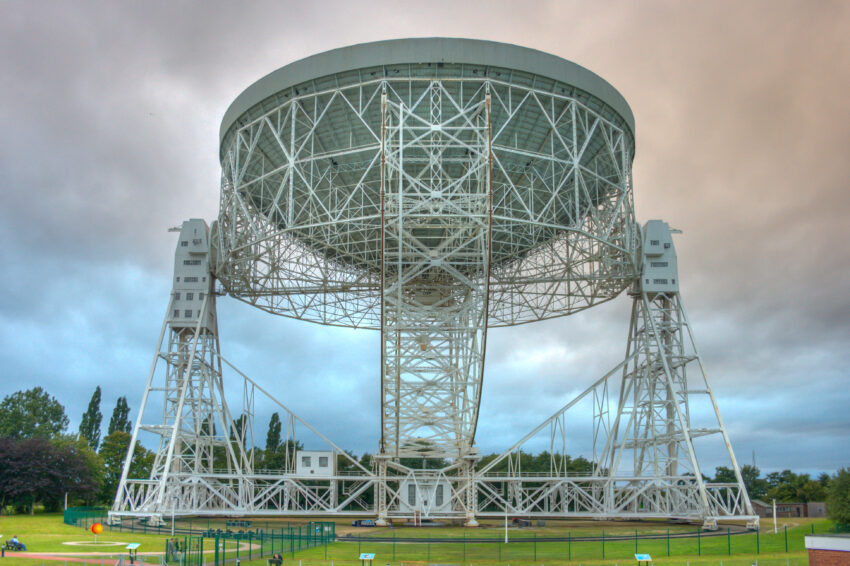
What started as modest radar experiments led to the discovery of meteors and eventually transformed the field of radio astronomy. The development of the Lovell Telescope in 1957 marked a turning point, becoming the largest steerable radio dish in the world at that time. The telescope was ready just in time to track the launch of Sputnik, helping Britain establish its role in early space exploration.
Over the following decades, the observatory became known for tracking galaxies and studying distant cosmic phenomena. It contributed to major discoveries about quasars, pulsars, and supernovae, helping scientists understand how stars form and die. During the Cold War, it also monitored space missions from both superpowers, playing a role in national security efforts.
The impact of its work extends far beyond the stars, influencing modern technologies like medical imaging and global telecommunications. Jodrell Bank has also served as a cultural landmark, attracting thousands of visitors each year. Its visitor center offers young people their first real exposure to science and astronomy.
In 2019, UNESCO recognized the site as a World Heritage Site due to its global importance. Despite this recognition, the observatory now faces financial challenges that threaten its future. Funding for the e-MERLIN network, which operates several radio telescopes including the Lovell Telescope, will end by March 2028.
Without this support, scientific observations at Jodrell Bank will stop permanently. Experts warn that cutting support for the facility is a short-sighted decision with serious consequences. These cuts are part of broader budget reductions affecting physics and astronomy research in the UK.
The loss of e-MERLIN would weaken Britain’s participation in international science projects like the Square Kilometre Array. It would also reduce educational outreach and damage the UK’s scientific reputation. The Lovell Telescope, now approaching its 70th birthday, has played a central role in tracking space missions from both the Soviet Union and the United States.
The telescope’s iconic structure is not just a scientific tool but also a symbol of Britain’s contributions to space science. Scientists and advocates say the potential loss of this landmark is a blow to national pride and scientific progress. The University of Manchester, which manages e-MERLIN, is actively seeking new sources of funding from private donors or other government programs.
Still, time is running out for alternative funding to be secured before the current budget ends in 2028. Jodrell Bank has always been a place where Britain looks outward to understand the universe. It has inspired generations of students and helped shape our understanding of space, technology, and humanity’s place in the cosmos.
Allowing it to decline due to a lack of funding would be an act of scientific vandalism. Astronomy teaches us patience, curiosity, and wonder, reminding us that knowledge is built slowly over time. Cutting support for astronomy is not just a budget decision, but a choice that affects how we see the world.
Preserving Jodrell Bank is not just about science, but also about imagination and the future of British research.
IMAGE: Lovell Telescope, Jodrell Bank. Photo: Mike Peel; Jodrell Bank Centre for Astrophysics, University of Manchester / Wikimedia, taken 2007-08-03, CC BY-SA 4.0