
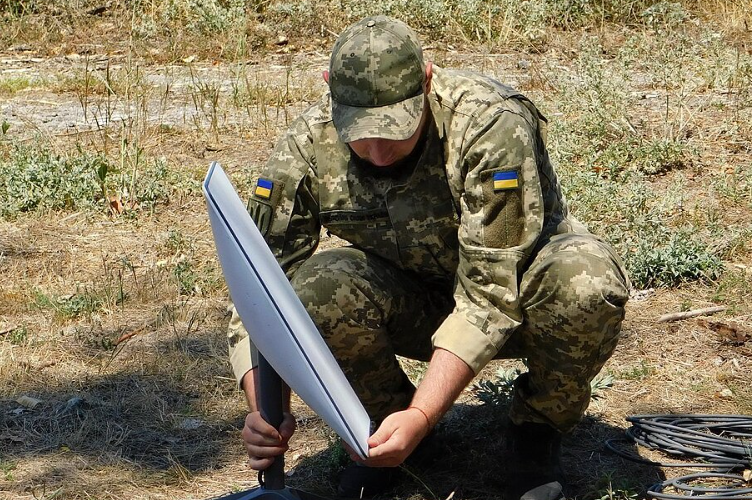
A Reuters investigation traces the order limiting Ukraine’s military satellite communications to the White House. The restrictions disrupted drone missions, prompted a bipartisan congressional investigation request and intensified tensions between Washington and Kyiv.
A White House directive reportedly led to restrictions on Ukraine’s military satellite communications, disrupting drone missions and battlefield operations as tensions between Washington and Kyiv increased. The limitations affected Starshield, a specialized satellite communications service supplied by Elon Musk’s SpaceX.
Reuters reported Thursday, October 15, 2026, that two U.S. officials and a Western official familiar with the matter identified the White House as the source of instructions to limit the service. The officials did not identify who authorized the decision or establish whether President Donald Trump personally approved it.
The restrictions initially interrupted Ukrainian military operations before connectivity was partially restored. However, officials in Kyiv say remaining speed limitations continue to affect drones used for reconnaissance, interception and other battlefield missions.
The developments have prompted bipartisan concern in Congress, with nine U.S. senators requesting a Pentagon investigation into whether government decisions or contractor actions contributed to the disruptions.
White House Reportedly Ordered Satellite Restrictions
The restrictions became apparent overnight on October 13 and 14, when Ukrainian military units began reporting unexpected communication failures.
Serhii Beskrestnov, a Ukrainian presidential adviser specializing in military communications and electronic warfare, said SpaceX had introduced speed restrictions without notifying Ukraine’s armed forces.
The changes affected Starshield terminals operating aboard moving vehicles and aircraft, particularly those traveling faster than approximately 100 miles per hour, or 160 kilometers per hour.
Some Ukrainian units reported losing connectivity at even lower speeds.
Beskrestnov said several military missions were disrupted and suggested that the timing was connected to political developments between Ukraine and the United States.
Initially, it was unclear whether SpaceX independently implemented the restrictions or acted under government instructions.
The Reuters investigation provided new information about their origin. According to the officials cited in its October 15 report, the Department of Defense received instructions from within the White House to reduce Starshield capabilities available to Ukraine.
The officials spoke anonymously because of the sensitivity of the matter.
Their accounts did not establish which White House official issued the instruction, who implemented it or whether the restrictions were intended as pressure on Ukraine.
The White House and Pentagon have not publicly provided a complete explanation of the decision.
Why Starshield Matters to Ukraine’s Military
Starshield is a specialized satellite communications service developed by SpaceX for government and national security customers.
It uses technology associated with the company’s Starlink satellite network but is designed for military and other government applications.
Ukraine relies heavily on satellite communications because conventional communications infrastructure has been damaged or disrupted during Russia’s invasion.
The technology helps military units maintain contact, coordinate movements and operate unmanned aircraft.
Satellite-connected drones are particularly important in a conflict where electronic interference can make traditional radio communications unreliable.
Some Ukrainian interceptor drones travel at high speeds while attempting to destroy incoming Russian attack drones.
Other unmanned aircraft conduct reconnaissance, monitor enemy positions or support operations against military targets.
When satellite connections are interrupted, operators can lose the ability to control aircraft or receive information from onboard systems.
Ukrainian military officials said the sudden restrictions caused missions to fail and complicated frontline logistics.
The limitations also affected communications relay operations, which help military units exchange information across difficult terrain.
Associated Press reported that the disruption demonstrated Ukraine’s dependence on technology whose operational conditions can be changed outside its direct control.
That dependence creates a vulnerability even when the underlying communications system remains technically operational.
Elon Musk Says U.S. Government Controls Starshield
Following criticism of the disruptions, SpaceX founder Elon Musk said decisions about Starshield service restrictions belonged to the U.S. government.
Musk stated that Starshield systems are owned and controlled by the American government and that restrictions on speed or usage are determined by military authorities and ultimately the president.
He distinguished the military-focused Starshield service from commercial Starlink, which operates under different terms and restrictions.
Musk also said commercial Starlink is intended for civilian and defensive purposes rather than unrestricted offensive military operations.
His explanation shifted attention toward Washington and the contractual arrangements governing Ukraine’s access.
However, Musk’s statements did not independently establish who ordered the latest restrictions.
Questions also remain about what instructions SpaceX received and whether the company had discretion over implementation.
Ukraine’s Defense Ministry said it was communicating with SpaceX, U.S. officials and NATO partners to clarify the situation.
The ministry also began examining backup communication options in case additional disruptions occurred.
Partial Restoration Leaves Important Limits
Former Ukrainian Defense Minister Mykhailo Fedorov reported improvements in satellite connectivity on the evening of October 14.
He said service was being restored for equipment moving at speeds of up to approximately 160 kilometers per hour.
That improvement could allow some attack and interceptor drones to resume operations.
However, Fedorov emphasized that Ukraine needed the speed restrictions removed entirely to restore the full capabilities previously available.
Ukrainian defense officials subsequently reported that a limit of approximately 161 kilometers per hour remained in effect.
The situation was therefore a partial recovery rather than a complete restoration of unrestricted service.
The interruption also raised concerns about the reliability of communications during emergencies.
For military planners, advance warning about changes to essential technology can be nearly as important as the equipment itself.
Without such warning, units may launch missions expecting communications to remain available, only to discover that operating conditions have changed.
Restrictions Come Amid Dispute Over Russian Oil Strikes
The satellite controversy developed as Trump increased pressure on Ukraine to stop attacking Russian oil infrastructure.
Ukrainian forces have repeatedly targeted refineries and other energy facilities as part of efforts to disrupt Russia’s economy and reduce resources available for its war.
The Trump administration has argued that attacks on Russian oil facilities can contribute to higher international fuel prices.
However, energy analysts have identified the broader conflict involving Iran and disruptions to global energy supplies as major factors behind recent price increases.
On October 11, Trump announced what he described as an energy ceasefire between Russia and Ukraine.
Ukrainian President Volodymyr Zelenskyy said Kyiv supported reciprocal restrictions on attacks against energy infrastructure but had not received confirmation that Russia would comply.
Russian strikes on Ukrainian energy facilities continued after the announcement, according to Ukrainian officials.
Ukraine subsequently resumed attacks on Russian oil infrastructure, including a refinery in the Ryazan region.
Zelenskyy criticized Washington’s approach and argued that restrictions on Ukrainian military capabilities could weaken the country’s ability to defend itself.
The United States also reached an agreement easing restrictions on Russian diesel exports, drawing objections from some American lawmakers and European officials.
Critics of the agreement argued that additional Russian energy revenue could help finance Moscow’s military operations.
The administration maintained that its energy policy was intended to reduce fuel costs and support diplomatic efforts.
Although the satellite restrictions occurred during these disagreements, their timing alone does not establish that they were imposed to force Ukraine to change its military strategy.
Senators Demand Pentagon Investigation
Congressional concern intensified October 15 when nine senators formally requested an investigation by the Department of Defense inspector general.
The bipartisan group included Democratic Senator Jeanne Shaheen of New Hampshire and Republican Senator Thom Tillis of North Carolina.
Other signatories included Dick Durbin, Susan Collins, Jack Reed, John Cornyn, Chris Coons, Lisa Murkowski and Richard Blumenthal.
Their letter asked investigators to determine whether American officials approved, ordered or knew about the satellite restrictions before they took effect.
The senators also requested an examination of whether the changes complied with existing government contracts.
They expressed particular concern about reports that disruptions to intelligence sharing and early-warning systems may have endangered American personnel during Russian air attacks.
Those reported intelligence problems have not been conclusively linked to the satellite restrictions.
The lawmakers asked investigators to examine whether the incidents resulted from technical failures, contractor decisions or deliberate government policy.
They also requested that relevant communications, technical instructions and contractual records be preserved.
The senators called for an initial briefing by November 1, 2026.
Their request does not establish that misconduct occurred, but it creates a formal demand for answers about the decisions affecting Ukraine’s communications.
Satellite Dispute Raises Broader Security Questions
The controversy has exposed an important challenge for countries that rely on foreign-owned technology during military operations.
Ukraine depends on satellite communications for activities ranging from battlefield coordination to the operation of drones used against Russian attacks.
Although commercial companies develop and maintain much of this infrastructure, government agreements can determine how military customers receive access.
Changes to those arrangements can have immediate consequences during active combat.
Ukraine has been exploring alternative communications technology, but replacing a satellite network with Starlink’s coverage and battlefield integration would be difficult.
The latest disruption also comes during a period of uncertainty about American military assistance and intelligence sharing.
Kyiv continues to seek assurances that essential communications will remain available while Russia conducts missile and drone attacks against Ukrainian targets.
For now, some Starshield connectivity has been restored, but speed restrictions remain unresolved.
The next major development may come from the Pentagon inspector general, which has been asked to establish who authorized the changes, whether proper procedures were followed and how future interruptions can be prevented.
IMAGE: Source https://www.facebook.com/photo/?fbid=201425482213358&set=pcb.201425592213347 Author Support Forces of Ukraine Command CC4