
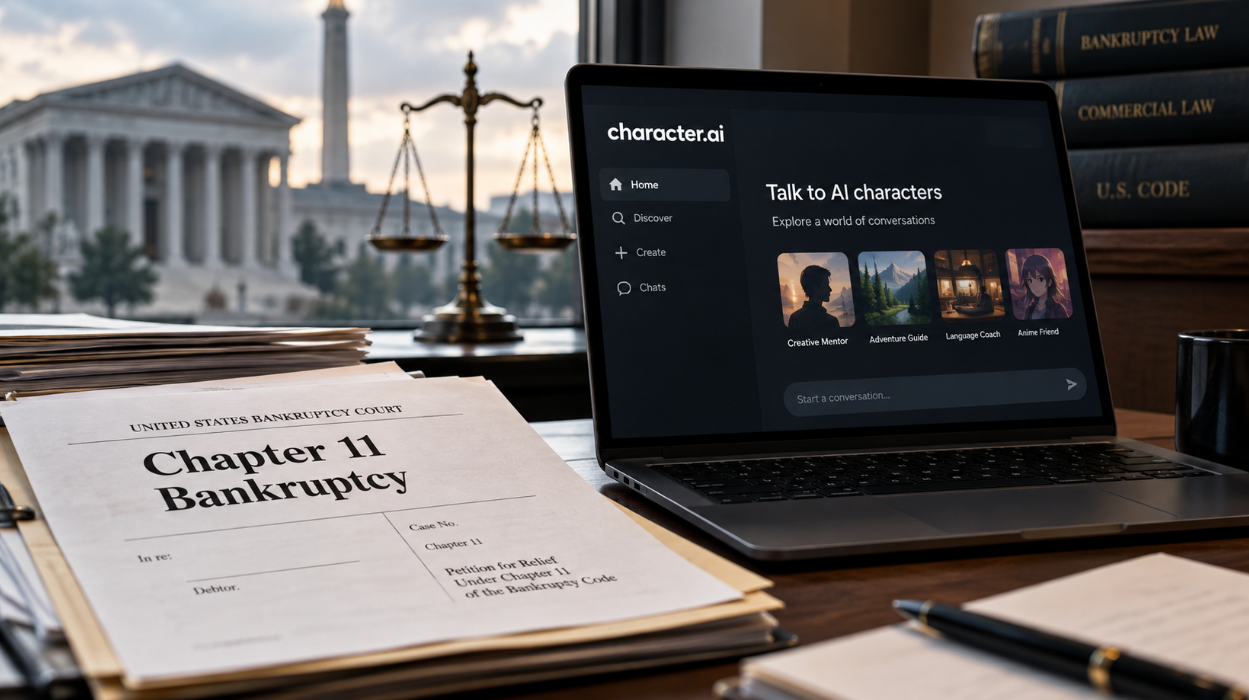
The chatbot company faces mounting legal claims, high operating costs and a possible shutdown as it seeks a buyer through Chapter 11 proceedings.
Character.AI, the artificial intelligence company known for allowing users to create and interact with virtual personalities, filed for Chapter 11 bankruptcy protection on October 12, 2026. The California-based startup is seeking a court-supervised sale as it struggles with mounting legal challenges, heavy operating expenses and concerns about the safety of its chatbots.
The company has already secured a $20 million opening bid from Walt Disney for a license to certain intellectual property and related assets. However, the agreement does not mean Disney has purchased Character.AI or agreed to keep its chatbot platform operating.
The bankruptcy filing was made by Character Technologies Inc., the company behind Character.AI, in the U.S. Bankruptcy Court for the District of Delaware. Court records identify the case as number 26-11603 and estimate both the company’s assets and liabilities at between $50 million and $100 million.
Character.AI plans to continue operating during the bankruptcy proceedings while searching for a buyer. The company expects the sale process to finish by late November or early December 2026.
The company’s future remains uncertain. Character.AI has warned that its platform could shut down if no buyer presents a plan to continue operating the service.
Disney Emerges as First Bidder
Disney has agreed to serve as the initial bidder in Character.AI’s bankruptcy auction. The arrangement gives the entertainment company a starting position in the sale process while allowing other interested parties to submit competing offers.
The proposed agreement would provide Disney with a nonexclusive, perpetual license to certain Character.AI intellectual property. Disney would also receive certain legal claims and provide transition services involving former Character.AI employees.
A nonexclusive license would allow Disney to use the covered technology without necessarily preventing others from using it under separate agreements. The arrangement differs from buying the entire company or acquiring exclusive ownership of its technology.
Disney’s involvement follows its hiring of Karandeep Anand, Character.AI’s former chief executive, as the entertainment company’s first chief technology officer in September 2026. Several other Character.AI employees have also joined Disney.
The relationship between the companies has not always been friendly. Disney previously demanded the removal of unauthorized characters associated with its entertainment properties from Character.AI’s platform.
Despite that earlier dispute, Disney now sees potential value in technology developed by the struggling startup. Its proposed investment represents an opportunity to secure AI capabilities without necessarily taking responsibility for operating the consumer chatbot business.
Legal Challenges Add to Financial Problems
Character.AI’s bankruptcy follows several lawsuits alleging that its conversational chatbots harmed younger users. Some families claim that interactions with AI-generated personalities encouraged emotional dependence or dangerous behavior.
One prominent case involved the death of a 14-year-old Florida boy whose mother alleged that a Character.AI chatbot contributed to his suicide. The lawsuit named Character.AI and Google and raised questions about whether companies had done enough to protect children using conversational AI systems.
The companies reached a settlement in January 2026, according to Reuters. The terms were not publicly disclosed, and a settlement does not establish that the allegations were proven in court.
Other complaints have accused Character.AI of allowing chatbots to engage in harmful conversations with minors. The company has also faced investigations and legal action by state authorities.
In Kentucky, the attorney general alleged that chatbots on the platform encouraged self-harm and other dangerous behavior. The state’s lawsuit raised concerns about safeguards intended to protect young users.
These allegations remain subject to the applicable legal proceedings. They should not be treated as findings that every alleged incident occurred as described.
Character.AI has introduced additional safety measures, including age restrictions and changes to how younger users interact with its chatbots. The company previously announced that it was removing open-ended character chats for users under 18.
Such protections can be expensive to develop, monitor and maintain. They can also change how customers experience a platform that originally attracted users through highly personalized conversations.
The company’s legal expenses have added further pressure at a time when its underlying technology remains costly to operate.
High Operating Costs Strain the Business
Character.AI attracted considerable attention after its launch in 2021. Founded by former Google researchers Noam Shazeer and Daniel De Freitas, the company built a platform where users could interact with artificial personalities inspired by fictional characters, historical figures and original creations.
The startup became especially popular among people interested in entertainment, role-playing and digital companionship. Its technology allowed users to create their own chatbot personalities and share them with others.
In March 2023, Character.AI raised $150 million in a funding round led by Andreessen Horowitz. The investment valued the company at approximately $1 billion, reflecting strong investor interest in conversational AI.
However, attracting users did not guarantee that the company could turn its popularity into a profitable business.
Character.AI has approximately 12 million users but has reportedly been losing between $8 million and $9 million per month, according to Reuters. Computing expenses and staffing costs have been major contributors to those losses.
Conversational AI systems require substantial computing resources to generate responses and support millions of interactions. The expense can rise as platforms introduce more sophisticated models and additional features.
Court records also reveal significant unpaid obligations. Business Insider reported that Character.AI owes more than $10.6 million to its 20 largest unsecured creditors.
Those creditors include Google and several major law firms. Google alone is owed more than $4 million, according to the reported court documents.
Character.AI selected Google Cloud as its preferred infrastructure provider in 2023. The companies later expanded their relationship through a 2024 agreement that included technology licensing and the return of Character.AI’s founders to Google.
That arrangement did not result in Google acquiring the Character.AI consumer platform. The startup continued operating separately, leaving it responsible for its own products, expenses and legal obligations.
What Bankruptcy Means for Character.AI Users
Chapter 11 bankruptcy allows a business to operate under court supervision while attempting to restructure its debts or sell its assets. Filing for protection does not automatically mean a company must close.
Character.AI has told users that its website and mobile services remain available during the bankruptcy process.
The company also confirmed that paid subscriptions remain active and billing will continue under existing arrangements for now. Subscribers are expected to receive advance notice if changes affect their paid services.
Users have also been told that the company’s existing data privacy and security practices remain unchanged. Character.AI says people can export their information or delete their accounts through the application or website.
For customers who regularly use the service, the biggest uncertainty is whether a buyer will agree to preserve the platform.
Disney’s proposed licensing agreement does not provide that assurance. Its interest centers on selected intellectual property rather than a commitment to maintain Character.AI as a consumer service.
A competing bidder could offer a different arrangement, including a proposal to purchase the business and continue operating it.
If no acceptable buyer emerges, Character.AI says the platform will be wound down.
The bankruptcy also shows how rapidly fortunes can change in the artificial intelligence industry. Character.AI reached a billion-dollar valuation during an investment boom but later faced significant costs associated with infrastructure, safety and litigation.
Its financial difficulties do not establish that other AI startups will face the same outcome. However, they demonstrate that strong user interest and substantial investment are not always enough to support a business with high operating expenses.
Character.AI’s immediate priority is finding a buyer through the court-supervised process. The company expects that process to end by late November or early December, when users and creditors should have a clearer picture of whether the platform can continue operating.
IMAGE: DNR Art Department