
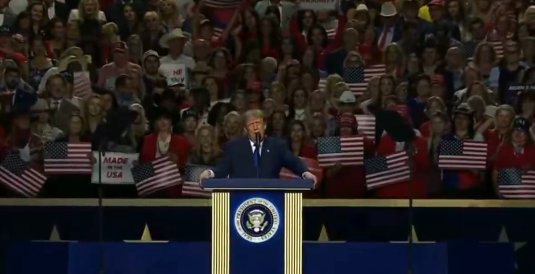
Republicans gathered in Dallas for an unusual two-day national convention aimed at energizing voters before the November midterm elections. The event placed President Donald Trump at the center of the party’s campaign to keep control of Congress.
The Republican National Midterm Convention was held September 9 and 10 at the American Airlines Center. It was the first time the Republican Party had organized a national convention specifically for a midterm election. Traditional party conventions are normally held during presidential election years to nominate candidates and adopt a party platform. This gathering had no nomination process. It was designed mainly as a campaign event.
Trump spoke on both nights and repeatedly urged Republican voters to treat the November election as though his own name were on the ballot. Republicans are trying to protect narrow majorities in Congress during an election that could determine how much of Trump’s agenda can pass during the final two years of his term.
One of Trump’s biggest announcements came when he proposed a $5,000 payment to every American adult if Republicans retain control of the House and Senate. Trump called the proposed payment a dividend. He did not provide a detailed plan showing how Congress would pay for it or when the money would be distributed.
The president also promoted tax cuts and his administration’s immigration policies. He defended his handling of the economy at a time when high prices remain an important issue for voters. Republicans used the convention to promote the tax and spending law Trump signed during his second term. The law includes tax breaks on tips and overtime while also making major changes to Medicaid and food assistance programs.
Foreign policy was another issue hanging over the gathering. The continuing war with Iran has contributed to concerns about fuel prices and the economy. Trump told convention attendees that the conflict would end after the midterm election. The war has also created some divisions within the Republican coalition.
Vice President JD Vance was one of the most prominent speakers on the second night. His appearance also drew attention to the Republican Party’s future beyond Trump. Supporters in the arena chanted phrases suggesting Vance should run for president in 2028. Trump praised his vice president but did not endorse a successor.
Vance focused much of his speech on attacking Democratic policies and encouraging Republicans to remain united. His role at the convention showed how he has become one of the most visible figures in the MAGA movement. Other prominent Republicans also spoke during the two-day gathering.
Republican speakers repeatedly portrayed the November election as a major choice between the two parties. They accused Democrats of moving too far to the left on immigration and economic issues. Democrats responded that Republicans were trying to distract voters from concerns about prices and the administration’s foreign policy.
The convention also honored conservative activist Charlie Kirk on the first anniversary of his assassination. His death was mentioned repeatedly as speakers discussed political violence and the conservative movement.
A separate controversy emerged after audience members shouted violent comments during remarks by Republican Sen. Ted Cruz. The comments came as Cruz mentioned several Democratic politicians. Cruz continued his speech without directly addressing the outbursts. Democratic Senate candidate Abdul El-Sayed later criticized the comments. A spokesperson for El-Sayed’s Republican opponent Mike Rogers also condemned violent political rhetoric.
Attendance also became part of the story. Photographs and reports from inside the American Airlines Center showed large sections of empty seats during parts of the convention. Several Republican lawmakers and candidates in competitive races chose not to attend. Some stayed in their home districts to campaign instead. Republican leaders said those absences should not be seen as candidates distancing themselves from Trump.
The convention reportedly cost more than $40 million. Republicans argued that the expense was worthwhile if it increased turnout among voters who strongly support Trump but do not always participate in midterm elections. That group could be important in close House and Senate races.
The location also carried political importance. Texas remains strongly Republican at the statewide level but several races in the state have become more competitive. The Senate contest between Republican Ken Paxton and Democrat James Talarico has attracted national attention and major spending from both sides.
Trump ended the convention by asking those in attendance to pledge that they would vote in November. The event closed with the party making clear that its midterm strategy will remain closely tied to Trump and his record.
That strategy carries both opportunity and risk. Trump continues to have strong support among the Republican base. His ability to bring occasional voters to the polls helped Republicans in previous elections. At the same time his approval numbers and concerns about the economy could make the association more difficult for Republican candidates in competitive districts.
The November 3 elections will determine control of Congress. Republicans hope the Dallas convention will help turn Trump supporters into midterm voters. Democrats are betting that dissatisfaction with the administration will instead produce a backlash at the polls.