
U.S. stocks fell Monday as rising oil prices and a sharp increase in Treasury yields added new pressure to financial markets. Investors were also watching renewed uncertainty over the war with Iran and the future of the Strait of Hormuz, a critical route for global oil shipments. The combination pushed major stock indexes lower after a strong finish last week.
Wall Street fell Monday as Treasury yields reached levels not seen since 2007 and volatile oil prices added to inflation concerns.
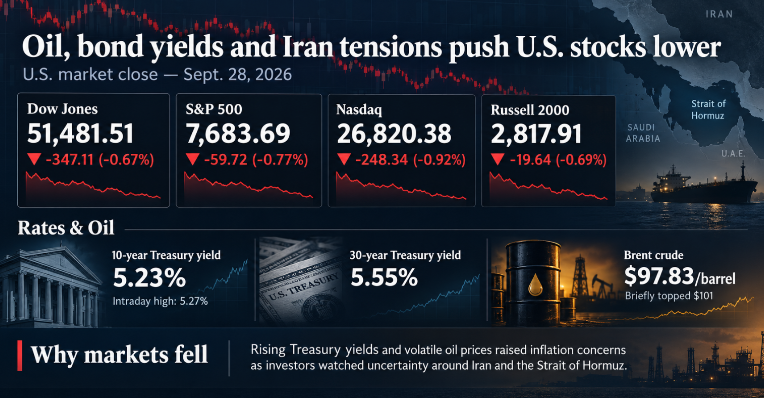
The Dow Jones Industrial Average fell 347.11 points, or 0.67%, to close at 51,481.51. The S&P 500 dropped 59.72 points, or 0.77%, to 7,683.69. The Nasdaq Composite lost 248.34 points, or 0.92%, ending at 26,820.38. The decline moved the S&P 500 farther away from its recent record levels.
A major source of pressure came from the bond market. The yield on the 10-year U.S. Treasury briefly climbed above 5.27% before ending near 5.23%. That was up from about 5.17% late Friday and put the benchmark yield near levels last seen in 2007.
The 30-year Treasury yield also rose, reaching about 5.55%. Higher Treasury yields can weigh on stocks because government bonds become more attractive compared with riskier investments. They can also raise borrowing costs for consumers, businesses and the federal government.
According to Reuters, investors were balancing higher oil prices, rising yields and uncertainty about whether the United States and Iran can reach an agreement that reduces fighting and restores more normal oil shipments through the Strait of Hormuz. The market has reacted sharply to nearly every change in the diplomatic outlook. Oil prices have repeatedly moved higher or lower as expectations for an agreement changed.
President Donald Trump said over the weekend that he had rejected an Iranian proposal connected to reopening the Strait of Hormuz and restarting talks over Iran’s nuclear program. However, U.S. officials also indicated that diplomatic efforts had not completely ended. Qatari mediators were expected to remain involved in discussions between the two sides. That uncertainty produced another volatile session in the oil market.
Brent crude briefly moved above $101 a barrel during Monday trading before giving back much of its increase. The Associated Press reported that Brent settled at $97.83 a barrel, up about 0.4% for the day. Oil remains far above the roughly $72-a-barrel level seen before the United States and Israel attacked Iran in late February.
Higher oil prices matter far beyond energy markets. More expensive crude can push up gasoline, diesel, transportation and manufacturing costs. Those increases can eventually show up in the prices consumers pay for a wide range of goods and services.
That is especially important now because investors are closely watching inflation and the Federal Reserve.
The Federal Reserve raised interest rates by a quarter percentage point earlier in September. Several officials have since indicated that additional increases could be considered if inflation remains too high. Reuters reported that financial markets were pricing in about a 70% chance of another increase of at least a quarter point at the Fed’s October meeting.
Higher oil prices could make the Fed’s job more difficult. If fuel and transportation costs continue rising, inflation could remain stronger than policymakers want. That could keep interest rates higher for longer or lead to additional rate increases.
MarketWatch reported that the 10-year Treasury yield climbed about seven basis points early Monday as oil prices rose and U.S.-Iran talks showed little progress. The 10-year yield is important because it influences borrowing costs across the economy. Mortgage rates, business loans and other forms of credit often move in response to changes in longer-term Treasury yields.
Some of Monday’s stock losses were concentrated in companies that are especially sensitive to fuel costs and interest rates. American Airlines shares fell about 2.5%, while United Airlines lost about 2.2%. Airlines can be hurt quickly by higher jet fuel prices because fuel is one of their largest operating expenses.
Boeing shares fell 6.9%, making the aircraft maker one of the biggest drags on the Dow. The Federal Aviation Administration said certification of Boeing’s long-delayed 737 MAX 10 would be delayed until a newly disclosed software issue is resolved. That company-specific news added to the broader pressure on the market.
Tesla also had a difficult session. Its shares fell 3.9% after J.P. Morgan lowered its price target for the electric vehicle maker, citing concerns about third-quarter deliveries. MongoDB dropped 18.5% after the database company announced that CEO Chirantan Desai was leaving immediately for a senior position at Meta Platforms.
Nvidia moved in the opposite direction.
The chipmaker gained about 1.6% after announcing a new $150 billion share repurchase authorization. The move increased the amount remaining under Nvidia’s buyback program to about $235 billion through 2028. The gain helped limit some of the Nasdaq’s losses, but it was not enough to reverse the broader decline.
Gold also fell sharply Monday. The price of gold dropped about 3.5% as bond yields increased. Gold does not pay interest, so higher yields can make bonds more appealing to some investors.
The weakness was broad across the market. Declining stocks outnumbered advancing stocks by more than three to one on the New York Stock Exchange. On the Nasdaq, declining stocks also outnumbered gainers by more than two to one.
Investors now face several important economic reports later this week. Inflation data and labor market figures could influence expectations for the Federal Reserve’s next decision. Friday’s government employment report will be watched closely for signs that the economy is either slowing or continuing to grow at a strong pace.
For Wall Street, oil prices and Treasury yields have become closely linked to the Iran conflict. A diplomatic breakthrough that improves the flow of oil through the Strait of Hormuz could reduce some inflation pressure. Continued fighting or new restrictions on shipping could have the opposite effect.
Monday’s trading showed how quickly geopolitical developments can move financial markets.
Stocks remain significantly higher for the year despite Monday’s decline. The S&P 500 is still up more than 12% in 2026, while the Nasdaq has gained more than 15%. The Dow is up more than 7%.
Investors will now be watching whether higher oil prices and Treasury yields persist or ease in the days ahead. New economic data and any developments between the United States and Iran could provide the next major direction for markets.
IMAGE: U.S. stocks, stock market, Dow Jones, S&P 500, Nasdaq, Russell 2000, Treasury yields, oil prices, Brent crude, Iran DNR Art Department