
A new study has used the collision of two neutron stars to test whether one of nature’s most important constants changes with time. Researchers found no evidence that Newton’s gravitational constant, known as G, varied during the event. The result gives scientists a new way to test gravity under some of the most extreme conditions in the universe.
The study was published September 24 in Communications Physics. It used data from GW170817, the famous neutron star merger detected in 2017 by the LIGO and Virgo gravitational-wave observatories.
Newton’s gravitational constant appears in equations that describe the strength of gravity. In simple terms, it helps determine how strongly two masses pull on each other. Modern physics normally treats G as constant everywhere and at all times.
That assumption is also important to Einstein’s general theory of relativity.
Scientists have tested gravity for more than a century, but some alternative theories allow the strength of gravity to change very slowly over time. Finding such a change would be a major sign that general relativity is incomplete or that another physical field affects gravity.
The researchers behind the new study developed a gravitational-wave model that allowed G to vary slowly. They then tested that model against observations from GW170817 and the burst of light that accompanied it.
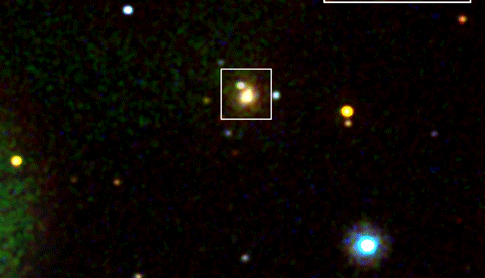
GW170817 was unusually useful because astronomers detected the event in several different ways. LIGO and Virgo measured gravitational waves from two neutron stars spiraling together. A gamma-ray burst was detected less than two seconds later, and telescopes around the world found light from the explosion.
According to the LIGO Scientific Collaboration, the event occurred on August 17, 2017, in the galaxy NGC 4993, about 130 million light-years from Earth. It became the first cosmic event observed in both gravitational waves and electromagnetic radiation.
This combination is called multimessenger astronomy. Instead of studying an event using only visible light, radio waves, X-rays, or gravitational waves, researchers combine several types of signals from the same source.
That extra information was important for the new test.
A gravitational-wave signal from two neutron stars contains information about their masses, motion, distance, and the way the orbit changes as the stars spiral toward each other. If G were slowly changing, it could slightly alter both the motion of the stars and the gravitational waves traveling toward Earth.
The difficulty is that other unknown properties of the system can produce similar changes in the signal. Distance, viewing angle, and other factors can overlap with the effects researchers are trying to measure.
The new study used electromagnetic observations to reduce some of those uncertainties. The researchers included independent information about the source’s distance, location in the sky, and the angle at which the neutron star system was viewed.
They then performed a Bayesian analysis, a statistical method that compares different possible values while taking uncertainties into account.
The team found no evidence that G changed.
The researchers placed the fractional rate of change of G between about minus 3.36 billionths and plus 0.534 billionths per year. Written scientifically, the range is from -3.36 × 10^-9 to 5.34 × 10^-10 per year.
That does not mean scientists have proved that G can never change. It means the GW170817 observations were consistent with a constant value within the sensitivity and assumptions of the analysis.
The authors describe the result as the tightest limit so far obtained from real gravitational-wave observations.
That distinction is important. Scientists have also tested the stability of G using other methods, including observations within the solar system, pulsars, stars, and cosmological measurements. Different experiments test gravity under different conditions and over different periods of time.
Gravitational waves offer something unusual because they come from objects where gravity is extremely strong and rapidly changing.
Neutron stars are among the densest known objects in the universe. They form when massive stars collapse, leaving behind objects roughly the size of a city but containing more mass than the Sun.
When two neutron stars orbit each other, they lose energy through gravitational waves. Their orbit becomes faster and tighter until the stars finally collide.
NASA reported that GW170817 produced a gamma-ray burst and was followed by ultraviolet, visible, infrared, X-ray, and radio observations. That made the event one of the most thoroughly studied astronomical explosions ever detected.
The gravitational-wave signal itself lasted much longer than the black hole merger signals LIGO had detected earlier. This gave researchers a long record of the neutron stars accelerating toward their final collision.
Scientists have repeatedly returned to the GW170817 data to test different parts of fundamental physics.
The event has helped researchers study the speed of gravitational waves, the properties of neutron stars, the production of heavy elements, and the behavior of matter at enormous densities. The new study shows that the same event can also be used to test whether the basic strength of gravity remains constant.
The idea is connected to the strong equivalence principle. In general relativity, the laws of gravity should behave consistently even when objects contain large amounts of gravitational binding energy.
A changing value of G could signal a violation of that principle. Some alternative theories of gravity include additional fields or interactions that could create such an effect.
The new analysis did not find that evidence.
Future gravitational-wave detections could make the test much stronger. GW170817 remains the best-known example of a neutron star collision observed with both gravitational waves and light, but future observatories are expected to detect many more mergers.
A larger collection of events would allow researchers to compare systems at different distances and from different periods in cosmic history. Better detectors could also measure gravitational-wave signals with greater precision.
The study demonstrates why multimessenger astronomy is becoming important for fundamental physics. Light can tell astronomers where an event occurred and provide information that gravitational waves alone may not reveal. Gravitational waves can measure parts of the collision that ordinary telescopes cannot see directly.
Combining the two gives scientists a more complete picture.
For now, the results agree with the standard assumption used in general relativity: Newton’s gravitational constant behaved as a constant during GW170817. But the method gives researchers another way to look for extremely small departures from Einstein’s theory as gravitational-wave astronomy continues to improve.
IMAGE: Credits: NASA/Swift