
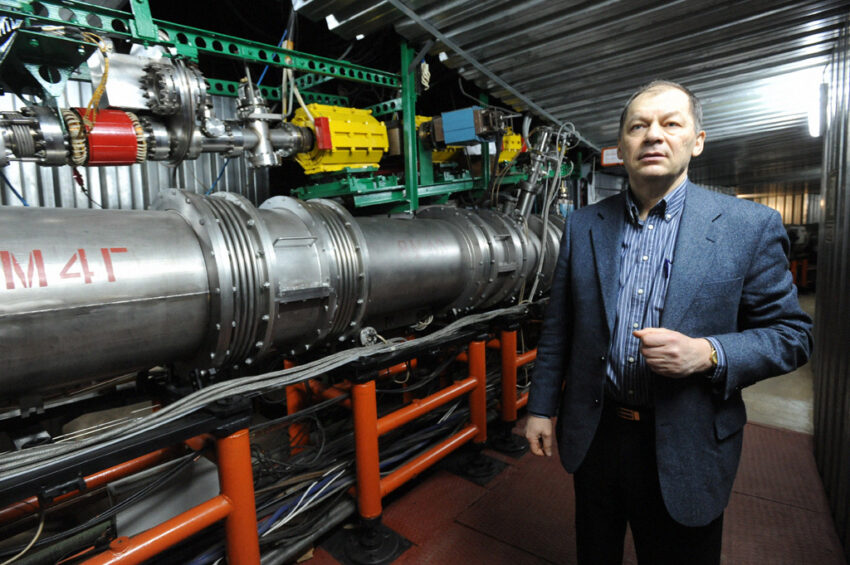
The Large Hadron Collider at CERN has been operating for more than 16 year. Its role in confirming the Higgs boson discovery earned it recognition as a key instrument in modern physics research. Despite its impressive capabilities, the LHC has not yet revealed new physics beyond the Standard Model.
As a result, the machine is entering a long shutdown period known as Long Shutdown 3, which will allow for major upgrades, according to Gizmodo. When it resumes operations in 2030, the LHC will be called the High-Luminosity Large Hadron Collider. This upgrade aims to increase collision rates and data collection, offering physicists a better chance to detect anomalies or new phenomena.
Experts are hopeful that this new version will allow for more precise tests of the Standard Model and possibly reveal unexpected findings. Daniel Tapia Takaki, a high-energy nuclear physicist at the University of Kansas, highlighted the potential for AI-driven data analysis to uncover hidden patterns. He also emphasized the importance of developing model-independent methods like quantum tomography to reconstruct more complete quantum systems from collisions.
Nedaa Alexandra Asbah from the ATLAS experiment at CERN explained that the HL-LHC will collect about six times more data than before. This increase in data volume will allow for better studies of Higgs boson properties and rare events such as two-Higgs production. The ATLAS detector is also being upgraded with new components to manage the higher collision rate and improve tracking accuracy. These improvements include a new Inner Tracker and High-Granularity Timing Detector, which will help separate simultaneous proton collisions. The HL-LHC is expected to record around 180 million Higgs bosons, giving scientists a clearer picture of how it interacts with other particles.
Handling such large datasets will require advanced computing techniques, especially machine learning and artificial intelligence. John Jowett, an accelerator physicist involved in the ALICE experiment, pointed out that the goal is to probe deeper into physics beyond the Standard Model. He noted that while the LHC has already tested the model very precisely, surprises can still emerge in unexpected areas of research. In heavy-ion collisions, for example, researchers have observed collective behavior in quark-gluon plasma that was not anticipated.
These findings show how the LHC continues to offer insights into fundamental physics even within the current model. In addition to the LHC upgrades, there are plans for other major particle accelerators that could complement its work, according to a report from Wikinews. One such project is the proposed International Linear Collider, which would collide electrons and positrons at different energy levels. This machine could help resolve some issues left open by Einstein’s theories of relativity.
Although the LHC is currently the most powerful tool for exploring particle interactions, future projects may offer more detailed views of fundamental processes. The HL-LHC upgrade represents a major step forward in humanity’s quest to understand the universe at its most basic level. It will allow scientists to test theoretical predictions with greater precision and potentially find hints of new physics beyond what we currently know.
IMAGE: “Joint Institute for Nuclear Research in Dubna hosts seminar on Physics on Large Hadron Collider”. Vladimir Kekelidze, head of the high-energy physics laboratory, at elements of a superconductive nuclear and heavy ion accelerator.. Photo: Sergey Pyatakov / Сергей Пятаков / Wikimedia, CC BY-SA 3.0