
Iran has issued a list of six conditions that the United States must meet before it will allow traffic to resume in the Strait of Hormuz. The demands come as tensions rise in the region following attacks on commercial vessels and ongoing disputes over the blockade of Iranian ports. Mohammad Bagher Zolghadr, who serves as both a security council secretary and commander in the Revolutionary Guard, laid out the terms. He said that Iran will not reopen the strait unless Washington corrects its behavior and ends threats against Iran.
The U.S. must also permanently end any war with Iran’s allies in the region and withdraw its military forces from the area. In addition, Iran insists on lifting the naval blockade of its ports and completely compensating for war damage caused by U.S. actions. Another key demand is that the United States lift all sanctions and unconditionally release Iranian frozen assets.
The U.S. has previously stated that a deal on the strait must be reached before ending the blockade of Iranian ports, according to fox6now.com. A June interim agreement had already outlined how sanctions and compensation would be addressed in a final deal, according to a report from Fortune. Negotiations are set to conclude within a week, though they may be extended. Iran claims it is close to finalizing an agreement with Oman to manage the strait, which is vital for global oil and gas supplies. Oman has said that talks are continuing in a constructive way and condemned attacks on ships passing through the strait.
The UAE has accused Iran of attacking a vessel owned by its state oil company ADNOC while it was passing through the strait. ADNOC reported no injuries from the attack and said over a dozen of its ships have been targeted since the war started. The United Kingdom Maritime Trade Operations Center later confirmed that a vessel near Khasab, Oman, had been struck by a projectile. It was unclear if this was the same incident involving ADNOC.
Iran has maintained control over traffic in the strait since U.S. and Israeli forces launched an attack in February, AOL reported. The situation remains tense as both sides continue to make demands and respond to attacks on commercial shipping.
Iran’s Supreme National Security Council has emphasized that the strait will not open until all conditions are met. The U.S. has not yet responded directly to the new list of demands issued by Iran.
Meanwhile, regional developments include Yemen’s military attacking Houthi rebels and Turkey approving a peace bill with Kurdish groups. Turkey’s foreign minister stated that a defense agreement between Saudi Arabia, Pakistan, and Turkey is not directed against any third party. The pact includes mutual support in case of an attack on one of the three countries. The agreement also calls for a secretariat to be based in Saudi Arabia.
These developments highlight the complex and evolving nature of Middle Eastern geopolitics amid ongoing regional conflicts.
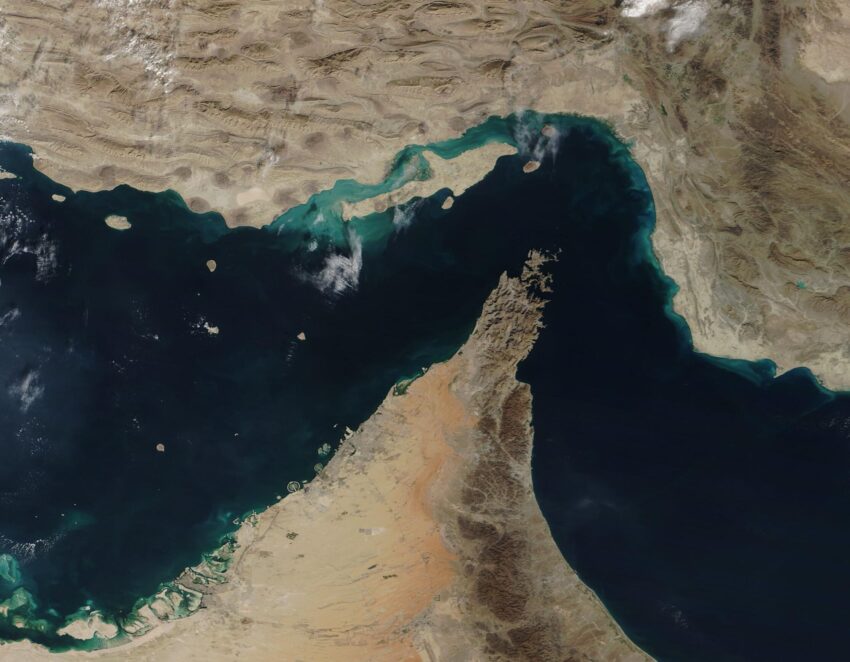
IMAGE: The narrow Strait of Hormuz lies between the Persian Gulf and the Gulf of Oman, separating Iran (north) from the Arabian Peninsula (south). Only about 21 miles (34 km) wide at the narrowest point and roughly 96 miles (155 km) long, about thirty percent of the world’s seaborne oil and nearly one-quarter of the liquified natural gas (LNG) supply passes through this strait — all on shipping lanes that measure only two-mile wide. It has been estimated that 21 million barrels of oil, with a value of 1.2 billion US dollars (USD), pass through the strait every day.
On December 2, 2020, the Moderate Resolution Imaging Spectroradiometer (MODIS) on board NASA’s Terra satellite acquired a true-color image of the Strait of Hormuz.
The arid landscape of Iran sits in the north, with Qeshm Island, the largest in the Persian Gulf, just off the Iranian coast. The tiny Strait of Khuran separates the island and the mainland and bounds a wetland of international importance, recognized by Ramsar. These wetlands provide critical habitat to two globally threatened species: the Dalmatian Pelican and the Green sea turtle. In the south, the rocky and rugged Musandam Peninsula juts into the Strait of Hormuz. The tip of the peninsula is filled by the Musandam Governate, an exclave of Oman. To the south, the land on the peninsula belongs to the United Arab Emirates.. Photo: MODIS Land Rapid Response Team, NASA GSFC / Wikimedia, Public domain