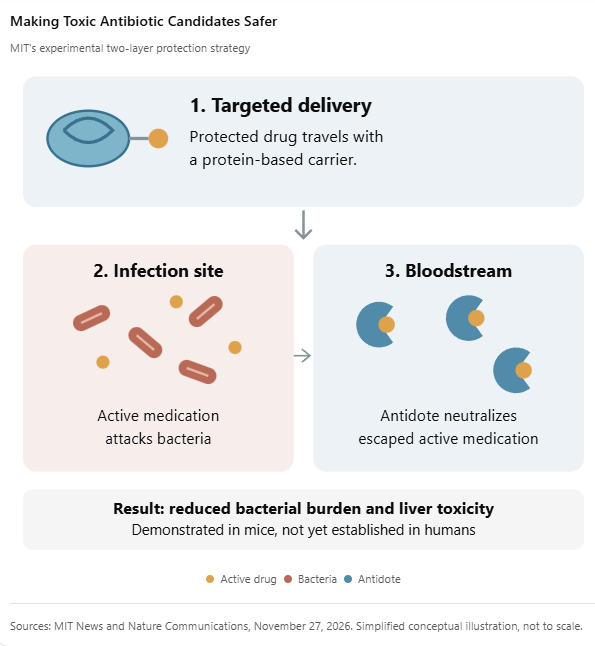
A new drug delivery system combines targeted treatment with a circulating antidote, successfully fighting bacterial pneumonia in mice while protecting their livers from toxic side effects.
Researchers at the Massachusetts Institute of Technology have developed a method that could allow previously rejected drug compounds to become effective antibiotics. The approach combines targeted drug delivery with an antidote that neutralizes potentially harmful medication circulating outside infected tissues. In experiments involving mice with bacterial pneumonia, the treatment reduced infections while protecting the animals against liver damage. The findings could expand the range of compounds available for developing antibiotics as bacterial resistance continues to threaten public health.
The study was published in Nature Communications on November 27, 2026, with Tahoura Samad as its lead author and MIT professor Sangeeta Bhatia as its senior author. Rather than discovering entirely new antimicrobial compounds, the researchers investigated whether existing compounds could be modified to reduce their harmful effects. Their approach addresses one of the biggest obstacles in antibiotic development: finding substances that kill bacteria without damaging healthy human cells.
Recovering Previously Rejected Drug Candidates
Developing antibiotics requires researchers to balance antibacterial effectiveness with patient safety. Some compounds demonstrate considerable effectiveness against bacteria during laboratory experiments but are subsequently rejected because they damage healthy tissues. Even small amounts of certain substances can cause serious complications involving the liver, kidneys, or other organs.
The MIT researchers selected calicheamicin, a naturally occurring compound produced by the bacterium Micromonospora echinospora. The compound damages DNA, making it effective at killing cells but also potentially dangerous to healthy tissues. Although its toxicity has prevented its use as a conventional antibiotic, calicheamicin derivatives are already used in certain cancer treatments.
One medication containing a calicheamicin derivative is Mylotarg, also known as gemtuzumab ozogamicin. The U.S. Food and Drug Administration initially approved the leukemia treatment in 2000, but it was withdrawn from the American market in 2010 following concerns about safety and clinical benefits. The FDA approved the medication again in 2017 following further research involving revised treatment regimens.
This regulatory history demonstrates both the medical potential of calicheamicin and the challenges associated with controlling its toxicity.
Delivering Medication to Infected Tissues
The first part of MIT’s approach involves modifying the drug so that it becomes active primarily in areas affected by bacterial infection. The researchers attached calicheamicin to a protein designed to associate with albumin, a naturally occurring protein found in blood. Albumin helps transport various substances throughout the body and can accumulate in inflamed tissues.
The drug delivery system also takes advantage of neutrophils, a type of white blood cell that responds to bacterial infections. These immune cells release enzymes as part of their response to invading microorganisms. The researchers designed the connection between calicheamicin and its carrier to respond to conditions associated with this immune activity, allowing the drug to become active near infected tissues.
Initial experiments demonstrated that targeted delivery could reduce bacterial infections while causing less liver damage than unmodified calicheamicin. However, the approach did not entirely eliminate toxicity. Some active medication could still reach other parts of the body, prompting researchers to investigate an additional protective mechanism.
An Antidote Inspired by Bacteria
To address the remaining toxicity, the researchers examined how the bacterium that naturally produces calicheamicin protects itself from the compound. Microorganisms that produce harmful substances often possess biological defense mechanisms that prevent those substances from damaging their own cells.
The researchers identified a protective enzyme called CalU19 that neutralizes active calicheamicin. They adapted the enzyme into an antidote designed to remain in the bloodstream for longer periods. Its purpose is to intercept active medication that escapes the intended treatment area before it causes significant damage elsewhere in the body.
An important feature of the antidote is its ability to distinguish between free calicheamicin and the inactive drug attached to its delivery system. Laboratory experiments demonstrated that the antidote could neutralize the free drug without prematurely disabling the protected medication.
The combined strategy therefore provides two layers of protection. Targeted delivery helps concentrate the drug’s activity near infected tissues, while the circulating antidote provides protection against unintended exposure.
Promising Results in Mouse Experiments
The researchers evaluated their approach using mice with pneumonia caused by Pseudomonas aeruginosa and Staphylococcus aureus. Both bacteria can cause serious infections in humans, particularly among hospitalized patients and people with weakened immune systems. Drug-resistant forms of these bacteria can make infections especially difficult to treat.
The combination treatment substantially reduced bacterial levels in the animals’ lungs while limiting liver toxicity. Researchers assessed liver health through blood tests measuring enzymes associated with liver injury and through microscopic examination of tissue samples. Animals receiving the protective antidote showed considerably less evidence of liver damage than those exposed to unprotected calicheamicin.
Laboratory testing also demonstrated antibacterial activity against other medically important organisms, including methicillin-resistant Staphylococcus aureus, commonly known as MRSA, Escherichia coli, and Klebsiella pneumoniae. However, these laboratory findings should not be interpreted as proof that the treatment can safely cure infections caused by all these organisms in humans.
Addressing the Growing Threat of Antibiotic Resistance
Antimicrobial resistance occurs when bacteria and other microorganisms develop the ability to survive medications intended to eliminate them. Resistant infections can require longer hospital stays, more expensive treatments, and medications that carry greater risks of side effects.
A major international analysis published in The Lancet estimated that bacterial antimicrobial resistance directly contributed to approximately 1.27 million deaths worldwide in 2019. The findings illustrate the importance of developing additional treatment options, particularly for infections that no longer respond to commonly prescribed antibiotics.
MIT’s approach could provide researchers with another way to investigate compounds previously rejected during drug development. Rather than requiring every candidate to be inherently safe, scientists could explore whether targeted delivery and protective antidotes can reduce unacceptable side effects.
Potential Applications Beyond Antibiotics
The research team is investigating whether similar protective strategies could be developed for medications associated with kidney damage and other forms of organ toxicity. The concept could also have applications in cancer treatment, where powerful drugs sometimes damage healthy tissues while attacking tumors.
However, different medications have different mechanisms of toxicity, and suitable antidotes may not exist for every compound. Researchers must also determine whether protective proteins remain effective in humans, whether they trigger unwanted immune responses, and whether the combined treatments can be administered safely over extended periods.
The MIT experiments establish a promising proof of concept rather than an approved treatment. Further laboratory research, safety evaluations, and eventual human clinical trials will be necessary before the drug-antidote strategy can become available to patients.
IMAGE: Photograph of biological engineer Sangeeta N. Bhatia, recipient of the Othmer Gold Medal, Heritage Day, May 8, 2019, at the Science History Institute, Philadelphia, PA.. Photo:
Conrad Erb, Staff photographer / Wikimedia, CC BY-SA 4.0