
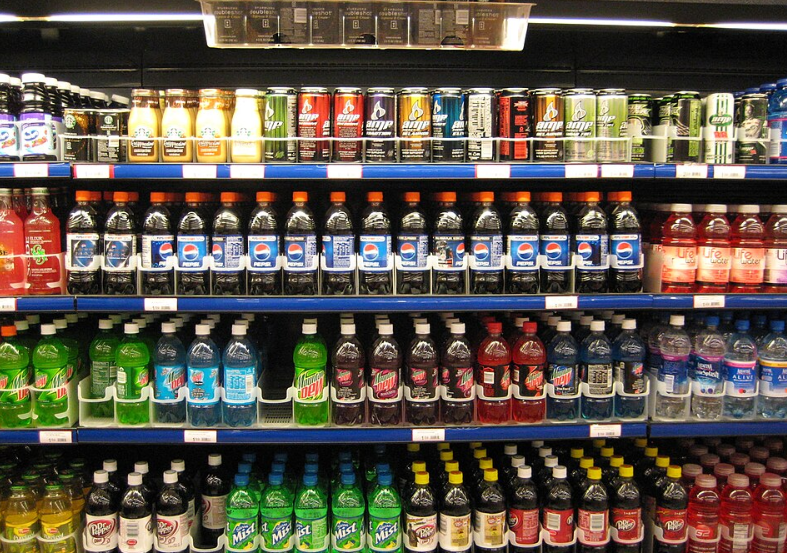
A study covering 96 countries found that improvements in food security were associated with modest increases in sugary beverage sales in higher-income economies, suggesting that better food access alone may not improve dietary choices.
Improvements in national food security may not automatically lead to healthier beverage choices, according to a new international study. Researchers examining data from 96 countries between 2015 and 2023 found that greater food security was associated with increased sales of sugar-sweetened beverages in wealthier economies.
The study, published on November 24, 2026, in the journal BMC Nutrition, was conducted by Anusha Ramesh, Mary R. L’Abbe, and Daniel A. Zaltz, researchers affiliated with Canadian universities, including the University of Toronto.
The findings suggest that efforts to improve access to food may need to be accompanied by policies that encourage healthier dietary choices. However, the observational research does not establish that improving food security directly causes people to purchase more sugary drinks.
Examining Food Security Across 96 Countries
Food security involves reliable access to sufficient, safe, and nutritious food. People experiencing food insecurity may struggle to afford balanced meals or obtain enough food to meet their nutritional needs.
Previous research has associated individual food insecurity with greater consumption of sugary beverages. Much of that research has concentrated on populations within wealthier countries.
The new study examined national trends rather than individual dietary habits. Researchers wanted to determine whether the relationship between food security and beverage purchases differed across economic settings.
The investigation covered nine years of national food security measurements and retail beverage sales. Researchers also considered demographic and economic differences that might influence the relationship.
How Researchers Measured Beverage Sales
The research team obtained food security estimates from the World Bank and commercial beverage sales information from Euromonitor International.
The analysis included regular soft drinks, energy drinks, and sports drinks containing added sugar. Fruit juice categories were excluded.
Researchers divided annual beverage sales by population size to make comparisons between countries of different sizes.
These figures provided an indirect measure of beverage consumption. They did not establish exactly how much each person drank or account for every possible source of sugary beverages.
The researchers also grouped countries according to World Bank income classifications. The higher-income group included both high-income and upper-middle-income economies. Lower-middle-income and low-income economies formed the second group.
Sugary Drink Sales Higher in Wealthier Economies
Across the countries and years examined, approximately 79 percent of the population was classified as food secure.
The average was 87 percent in higher-income economies, compared with 60 percent in lower-income countries.
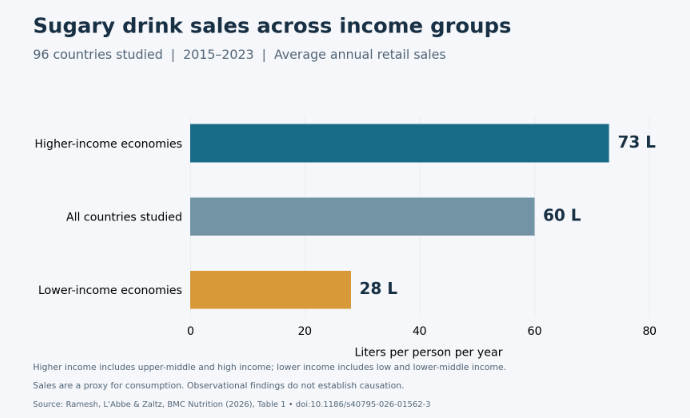
Retail beverage sales also differed considerably between the two economic groups. Across the entire study, annual sugary drink sales averaged approximately 60 liters per person.
Higher-income countries recorded average annual sales of 73 liters per person. Lower-income countries recorded approximately 28 liters.
These figures represent national sales averages rather than measurements of how much individual residents consumed.
The researchers also examined whether improving food security within a country coincided with changes in beverage sales. This approach helped distinguish changes occurring over time from longstanding differences between countries.
A Modest but Measurable Association
After accounting for economic and demographic factors, the researchers found that a one-percentage-point increase in food security was associated with approximately 0.17 additional liters of sugary beverage sales per person annually across the study population.
In higher-income economies, the corresponding estimated increase was approximately 0.30 liters per person.
The relationship was not statistically significant in lower-income economies. This means the available data did not provide sufficient evidence of a consistent association in those countries.
The researchers characterized their findings as exploratory. The estimated increases were modest, and the study could not determine whether changes in food security directly caused changes in beverage purchases.
Why Food Access and Dietary Quality May Differ
Being able to afford sufficient food does not necessarily mean that every available food or beverage is nutritious.
The researchers considered several possible explanations for the observed patterns, including greater purchasing power and the availability of commercially produced beverages.
As food markets develop, consumers may gain access to a wider selection of products. This can include nutritious foods alongside inexpensive beverages containing substantial amounts of added sugar.
However, the study did not directly measure the affordability of sugary drinks. It also could not establish how advertising, local retail conditions, or individual preferences influenced the results.
These factors require further investigation before researchers can determine why the association appeared more clearly in wealthier economies.
Important Limitations of the Research
One limitation is that the study examined national statistics rather than following individual participants.
A country could experience improving food security while sugary beverage purchases increase among a completely different segment of its population. National averages cannot establish which individuals are responsible for either change.
The findings therefore do not contradict earlier research showing that some people experiencing food insecurity consume more sugary beverages.
Retail sales also provide an incomplete picture of consumption. Some purchased beverages may never be consumed, while drinks obtained outside recorded commercial markets may not appear in the data.
Implications for Public Health
The World Health Organization has identified taxation of sugar-sweetened beverages as one policy option for encouraging healthier diets. Its 2024 guidance also examines subsidies that can make selected nutritious foods more affordable.
The organization maintains that food prices influence purchasing decisions and that appropriate financial policies can help improve dietary patterns.
The new research suggests that food security and diet quality deserve attention as related but distinct public health objectives. Improving access to sufficient food remains essential, particularly in communities experiencing hunger and economic hardship.
Future investigations could examine how beverage prices, household incomes, marketing practices, and local food availability influence individual purchasing decisions. Such research would help determine which policies can improve food security while also supporting healthier beverage choices.
FEATURE IMAGE: Source Own work Author Marlith CC3