
A three-generation study involving more than 14,000 grandchildren found associations between grandfathers’ tobacco and alcohol use and autism diagnoses in later generations. Researchers caution that the findings do not establish causation.
Researchers studying three generations of California families have identified an association between grandfathers’ smoking and heavy alcohol consumption and autism diagnoses in their grandchildren. The investigation examined health records dating back more than six decades and included information on 14,059 grandchildren.
The findings, published in the journal Autism Research, suggest that environmental exposures in one generation could be associated with developmental differences in subsequent generations.
However, the researchers emphasized that their observational study does not establish that smoking or drinking by grandparents causes autism.
Examining Three Generations of Families
The research involved scientists from the California Department of Public Health, the Public Health Institute, and other research institutions.
They obtained historical information from the Child Health and Development Studies, a long-running investigation involving California families.
Between 1959 and 1967, more than 15,000 pregnant women enrolled in the research program participated in interviews. They answered questions about their own habits and those of their partners, including tobacco use and the consumption of alcoholic beverages, coffee, and tea.
Researchers later connected these records with California birth records for grandchildren born between 1989 and 2014. They used information from the California Department of Developmental Services to identify documented cases of autism spectrum disorder (ASD).
The original linked population included 18,053 grandchildren. After accounting for missing exposure information, the analysis included 14,059 grandchildren, of whom 86 had documented autism diagnoses.
Among those diagnosed, 72 were male and 14 were female.
Higher Estimated Risk Associated With Smoking
The researchers identified several associations between grandfathers’ tobacco use during their partners’ pregnancies and subsequent autism diagnoses.
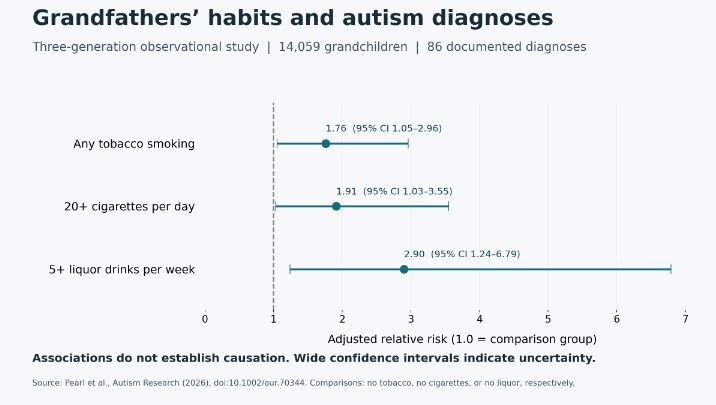
After statistical adjustments, grandchildren of men who smoked cigarettes, cigars, or pipes had an estimated relative risk approximately 76 percent higher than grandchildren of men who did not smoke.
The association was stronger among men who smoked at least 20 cigarettes daily. Their grandchildren had an estimated relative risk approximately 91 percent higher than those whose grandfathers did not smoke cigarettes.
These estimates describe differences between groups rather than the probability that any particular grandchild will be autistic.
The researchers accounted for several demographic characteristics, including grandparents’ ages and education. However, other unmeasured factors could have contributed to the observed associations.
Heavy Liquor Consumption Shows an Association
Researchers also examined whether the amount and type of alcohol consumed by grandparents were related to autism diagnoses.
Grandchildren of men who reported consuming at least five servings of hard liquor weekly had an estimated relative risk 2.9 times that of grandchildren whose grandfathers did not consume liquor.
However, this estimate was based on only 10 autism cases within the relevant exposure group. Consequently, considerable uncertainty surrounds the actual magnitude of the association.
An analysis of overall alcohol consumption produced less definitive results. Men who consumed at least nine alcoholic drinks weekly had a higher estimated risk of having an autistic grandchild compared with those who drank fewer than nine.
However, the difference was not statistically significant when these men were compared specifically with those who abstained from alcohol.
The study did not establish a clear association involving moderate alcohol consumption or the consumption of beer and wine alone.
Coffee and Tea Show No Clear Association
The investigation also considered whether grandparents’ consumption of coffee and tea was related to autism diagnoses in their grandchildren.
Researchers found no convincing evidence of an association involving coffee consumption or combined coffee and tea consumption by either grandparent.
The historical records did not provide detailed information about the caffeine content of beverages. Other potential sources of caffeine were also not documented.
Consequently, the findings cannot establish whether particular amounts of caffeine consumed by grandparents influence developmental outcomes in subsequent generations.
Exploring Possible Biological Mechanisms
Scientists have increasingly investigated whether environmental exposures can influence biological processes across multiple generations.
One area of interest is epigenetics, which examines changes in the regulation of gene activity without necessarily altering the underlying DNA sequence.
Tobacco smoke and alcohol can affect biological processes, including those involving reproductive cells. Researchers are investigating whether some of these effects could persist across generations.
Previous animal experiments have identified behavioral and biological differences in descendants of animals exposed to nicotine or alcohol. However, animal findings cannot automatically be applied to humans or treated as evidence of autism causation.
The California study did not demonstrate that epigenetic changes were responsible for the observed associations.
Autism is a complex neurodevelopmental condition influenced by genetic and environmental factors. No single explanation accounts for every autism diagnosis.
Important Limitations of the Study
The relatively small number of documented autism diagnoses limits the strength and precision of the findings.
Approximately 6.1 of every 1,000 grandchildren in the study had a recorded diagnosis. This historical figure should not be interpreted as a current estimate of autism prevalence.
California’s developmental services records primarily identify individuals who qualify for substantial disability support. Some autistic individuals, particularly those with lower support needs, may not have been represented.
Another limitation is that pregnant women reported their partners’ smoking and drinking habits. The researchers did not independently measure these exposures.
Inherited genetic characteristics, family environments, and similarities in behavior between generations could also help explain the statistical relationships.
Although recording exposures decades before the grandchildren received their diagnoses reduced some forms of reporting bias, it did not eliminate every possible source of error.
Further Research Is Needed
The findings provide researchers with additional questions about how reproductive health and environmental exposures might relate to development across generations.
Avoiding tobacco and excessive alcohol consumption already has established health benefits. However, this study does not establish that changing those behaviors will prevent autism in future generations.
The findings also cannot determine why any individual person is autistic and should not be used to assign responsibility to parents or grandparents.
Larger studies involving additional populations, more detailed exposure records, and biological measurements will be necessary to establish whether the reported associations are reproducible and identify any underlying mechanisms.
FEATURE IMAGE: Source Own work Author Kiwiev CC1