
Researchers develop a mathematical model showing how quantum uncertainty could give way to a single cosmic geometry, offering a possible approach to a longstanding problem in physics.
A theoretical physics study offers a possible explanation for how the universe developed the definite large-scale structure observed today, despite the uncertainty allowed by quantum mechanics. Researchers found that modifying the mathematical rules governing quantum states could cause a simplified universe to settle into one well-defined geometry.
The study, published in the Journal of High Energy Physics on February 23, 2024, has attracted renewed attention following coverage in November 2026. Its findings address a major question in modern physics: how a universe governed by quantum uncertainty can appear stable and predictable on large scales.
Researchers José Luis Gaona-Reyes, Lucía Menéndez-Pidal, Mir Faizal and Matteo Carlesso examined whether spontaneous changes to a quantum state could explain this transformation. Their calculations suggest that a quantum universe initially described by several possible geometries could eventually settle into a single arrangement.
The findings are theoretical and do not demonstrate that quantum mechanics and Einstein’s theory of gravity have been unified. Instead, the research identifies a possible mechanism within a simplified mathematical description of the universe.
Why Quantum Physics Creates a Problem for Cosmology
Quantum mechanics describes the behavior of matter and energy at extremely small scales. One of its central principles is superposition, which allows a quantum system to exist in a combination of different possible states.
These states are not simply ordinary possibilities caused by a lack of information. They can interfere with one another, producing measurable effects that distinguish quantum physics from classical probability.
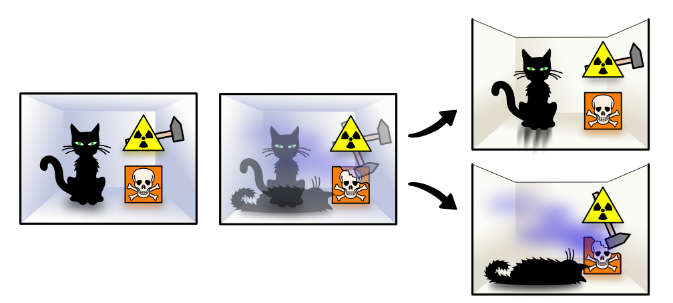
The familiar thought experiment involving Schrödinger’s cat illustrates this unusual behavior. A cat is imagined inside a sealed box containing equipment connected to a radioactive atom. Depending on whether the atom decays, a mechanism could release poison and kill the animal.
The example was designed to challenge how quantum theory should apply to large objects. It does not establish that real cats remain physically alive and dead until someone opens a box.
In everyday life, objects appear to occupy definite positions and follow predictable paths. Planets move through space, stars maintain recognizable structures and the universe has an observable geometry.
The difficulty comes when physicists attempt to describe these large-scale features using quantum principles. If the entire universe follows quantum mechanics, its mathematical description could include several possible arrangements of space and time.
Understanding why observations reveal one definite geometry remains an important problem in quantum cosmology.
Researchers Introduce Spontaneous Quantum Collapse
The research team investigated a proposal known as spontaneous wavefunction collapse. In these models, a quantum state can change randomly and continuously through a physical mechanism rather than requiring an external measurement.
Standard quantum mechanics describes how isolated quantum states evolve while preserving their superpositions. Collapse models introduce additional mathematical terms that can gradually reduce those superpositions.
The researchers applied this approach to a simplified universe described by general relativity and an idealized form of matter called a perfect fluid. Their model assumed that space was flat, homogeneous and isotropic.
These conditions mean the universe has no preferred location or direction when viewed on sufficiently large scales. Such assumptions allow researchers to examine complex physical questions without modeling every galaxy, star or particle.
The calculations used the Wheeler–DeWitt equation, an important mathematical framework in quantum cosmology. This equation helps describe quantum states involving gravity and the geometry of space.
One challenge with the Wheeler–DeWitt framework is that time does not appear in the same straightforward way it does in ordinary quantum mechanics. The researchers addressed this issue by selecting an internal variable to act as a clock.
They then introduced a continuous and random collapse mechanism connected to the system’s Hamiltonian, the mathematical quantity governing its evolution.
Under the model’s assumptions, the modified dynamics caused the quantum state to become concentrated around a single geometry. This provides a possible explanation for how a definite cosmic structure might emerge from multiple quantum possibilities.
The result depends on the particular collapse mechanism chosen by the researchers. No experiment has established that the universe actually follows these modified equations.
What the Model Suggests About Dark Energy
The researchers also examined a related framework known as parametrized unimodular gravity. This alternative mathematical description of gravity allowed them to investigate the cosmological constant.
The cosmological constant is associated with the accelerated expansion of the universe. It appears in Einstein’s equations and is closely connected to the scientific discussion surrounding dark energy.
A longstanding problem in theoretical physics concerns why the observed cosmological constant is so small compared with some estimates derived from quantum field theory.
In the researchers’ model, the collapse mechanism could narrow a range of possible cosmological constant values until one definite value remained.
This result suggests a possible way to explain why the universe has a single cosmological constant rather than a quantum combination of different values.
However, the calculations do not predict the particular value measured by astronomers. Demonstrating that one value can emerge is not the same as explaining why nature selected the value associated with our universe.
The model therefore offers a potential approach to one part of the cosmological constant problem rather than a complete solution.
Decoherence and the Quantum Measurement Problem
The study also addresses a limitation often discussed in explanations of the transition from quantum behavior to the familiar classical world.
A process called decoherence occurs when a quantum system interacts with its surroundings. These interactions spread quantum information into the environment and make interference between different possibilities increasingly difficult to observe.
Decoherence helps explain why large objects generally do not display the same easily detectable quantum effects as isolated particles.
However, scientists continue to debate whether decoherence alone explains why an individual measurement produces one definite outcome. Different interpretations of quantum mechanics approach that question in different ways.
Cosmology presents an additional challenge because there is no physical environment outside the entire universe. Individual regions can still interact with other regions, but the universe as a whole cannot exchange information with something beyond itself.
Spontaneous collapse models offer another possibility by introducing a physical process that does not depend on an outside observer.
Such theories remain alternatives to standard quantum mechanics rather than established descriptions of nature. Experiments capable of detecting or restricting spontaneous collapse effects are important for determining whether these modifications are realistic.
Separate Space Experiment Demonstrates Extreme Quantum Control
While cosmologists investigate quantum behavior through mathematical models, another group of scientists has achieved a major experimental result aboard China’s Tiangong space station.
Researchers reported producing a cloud of ultracold rubidium atoms with an equivalent temperature of 9.7 picokelvins, or 9.7 trillionths of a kelvin above absolute zero.
The findings appeared in the journal Science on November 5, 2026. The achievement involved approximately 20,000 atoms forming a Bose–Einstein condensate, a special state of matter in which atoms exhibit collective quantum behavior.
The experiment took place inside the Mengtian laboratory module. Scientists used laser-based optical traps and cooling techniques to reduce the atoms’ energy to extraordinarily low levels.
After releasing the atoms from their trap, the researchers observed the expanding cloud for seven seconds. Measuring how slowly the atoms spread allowed them to calculate the extremely low equivalent temperature.
This figure does not mean the entire space station, its equipment or the surrounding environment reached that temperature. It describes the energy associated with the atomic cloud’s expansion.
The reported value was lower than previous equivalent temperatures achieved in comparable microgravity experiments. Scientists have identified potential applications in precision measurement, quantum simulation and tests of fundamental physical laws.
Space provides an important advantage because microgravity allows researchers to observe slowly expanding atomic clouds for longer periods than many Earth-based experiments permit.
Different Approaches to Fundamental Quantum Questions
The cosmic geometry model and the Tiangong experiment investigate different aspects of quantum physics. One explores a possible modification to the mathematical description of the universe, while the other demonstrates improved experimental control over quantum matter.
The space experiment does not verify the spontaneous collapse model. Nor does the theoretical study predict the specific cooling result achieved aboard Tiangong.
Together, the research efforts illustrate the range of problems that scientists are investigating, from the behavior of carefully controlled atoms to the structure of space and time.
For the cosmological proposal, the central challenge is determining whether spontaneous collapse is a genuine physical process or simply a useful mathematical possibility. That requires connecting the theory to observations or experiments that could distinguish it from standard quantum mechanics.
The researchers have demonstrated how one definite cosmic geometry can emerge within their chosen model. Whether the same mechanism operates in the actual universe remains an open scientific question.
IMAGE: Source Own work Author Christian Schirm CC1