
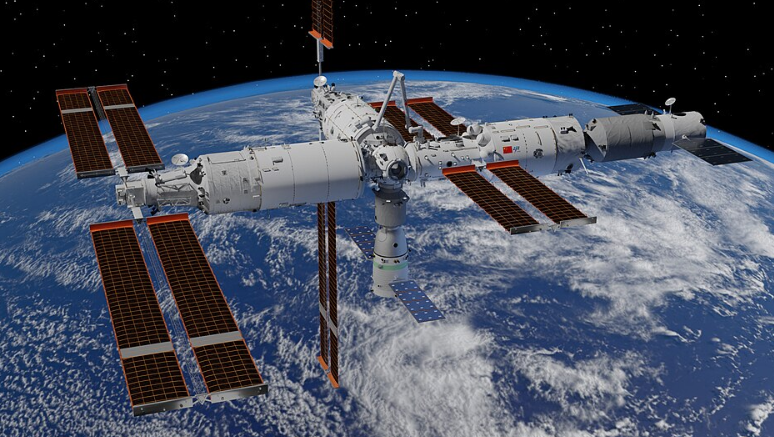
Researchers on China’s space station created an ultracold atomic gas just trillionths of a degree above absolute zero, opening new possibilities for quantum experiments and precision measurements of gravity.
Chinese scientists have achieved a record-low equivalent temperature of 9.7 picokelvins aboard the Tiangong space station, bringing a cloud of atoms extraordinarily close to absolute zero. The achievement, reported November 5, 2026, in the journal Science, establishes a new benchmark for ultracold quantum gases and could help researchers develop more sensitive instruments for studying gravity.
The experiment took place inside the Mengtian laboratory module, where researchers used lasers to cool approximately 20,000 rubidium-87 atoms. The resulting gas formed a Bose-Einstein condensate, an unusual state of matter in which atoms behave collectively according to quantum mechanical rules.
The researchers measured the equivalent temperature by observing how slowly the atomic cloud expanded after being released from its laser trap. In the space station’s microgravity environment, the cloud could expand freely for seven seconds, providing an unusually long observation period.
The result is nearly four times lower than the previously reported benchmark of 38 picokelvins. That earlier achievement used a magnetic atom-chip trap during a microgravity experiment in a terrestrial drop tower.
The new measurement represents a major technical achievement, although the temperature applies specifically to the atomic gas. It does not mean the surrounding laboratory, spacecraft or equipment reached anything close to absolute zero.
Why 9.7 Picokelvins Is Remarkable
Absolute zero is the lowest possible temperature on the Kelvin scale, corresponding to minus 273.15 degrees Celsius. At such extremely low temperatures, the thermal motion of atoms becomes exceptionally small.
One picokelvin equals one trillionth of a kelvin. The newly reported 9.7-picokelvin equivalent temperature therefore represents less than ten trillionths of a degree above absolute zero.
Producing such low temperatures allows physicists to investigate quantum effects that are normally difficult to observe. When atoms are sufficiently cold, their quantum behavior becomes easier to study collectively rather than only at the level of individual particles.
A Bose-Einstein condensate forms when certain atoms are cooled until they occupy the same quantum state. The resulting gas can exhibit wave-like behavior on a scale large enough for scientists to examine directly.
The researchers used rubidium-87, an isotope commonly employed in ultracold atom experiments. Its properties make it suitable for precise laser manipulation and the formation of Bose-Einstein condensates.
The previous benchmark of 38 picokelvins allowed researchers to observe an atomic cloud expanding for approximately two seconds. The new experiment extended that period to seven seconds while achieving an even lower equivalent temperature.
These improvements are important because slower atomic motion and longer observation times can increase the sensitivity of certain quantum measurements. They may also allow scientists to study interactions that would otherwise be obscured by thermal movement.
How Scientists Cooled the Atomic Cloud
The research team combined several established atomic cooling techniques with a specially designed optical trapping system.
The process began with laser cooling, which reduces atomic motion through carefully controlled interactions between atoms and light. Researchers then confined the atoms using optical dipole traps formed by focused laser beams.
An optical dipole trap uses light to create forces that hold atoms in a small region of space. Unlike some magnetic trapping methods, it can also accommodate atoms with different magnetic properties.
After the atoms were confined, the researchers used evaporative cooling to reduce their temperature further. They gradually lowered the trap’s strength, allowing more energetic atoms to escape while the remaining population became colder.
The basic principle resembles evaporative cooling in everyday life, although the equipment and physical conditions are very different. Removing atoms with higher energies reduces the average energy of the particles that remain.
The team developed a two-stage approach involving crossed laser beams with different widths and trapping depths. This arrangement helped the researchers achieve extremely low atomic energies while controlling the cloud’s behavior.
The optical system also provided useful access for observing the gas. According to the published study, the experiment demonstrates that optical dipole traps can produce quantum-degenerate gases under microgravity conditions.
Why the Experiment Was Conducted in Space
Gravity makes it difficult to observe slowly moving atomic clouds for extended periods in laboratories on Earth. Once released from confinement, the atoms fall, limiting the time available to measure their motion.
Scientists can simulate microgravity using drop towers, where experiments briefly experience free fall. However, these facilities provide only short observation windows.
The International Space Station also operates an ultracold atom laboratory. NASA’s Cold Atom Lab has demonstrated the value of conducting quantum experiments in orbit, where atomic gases can be studied without the same gravitational limitations found on Earth.
China’s Tiangong experiment builds on this approach by using a different trapping method and achieving an exceptionally low equivalent expansion temperature.
The seven-second measurement window allowed researchers to track the cloud’s movement in three dimensions. Because its expansion was extremely slow, small differences in atomic motion could be measured more effectively.
The temperature was inferred from that expansion rather than measured with an ordinary thermometer. Scientists calculated the equivalent temperature from the behavior of the freely expanding atoms.
This distinction is important when comparing different experiments. Temperatures inferred from atomic expansion are not always directly equivalent to measurements made using other techniques or physical systems.
The reported measurement also contains uncertainty. The team estimated an equivalent temperature of 9.7 picokelvins, with an uncertainty of approximately 3 picokelvins in either direction.
Despite that uncertainty, the result represents a substantial improvement over the previously published 38-picokelvin benchmark.
Building a Laboratory for Extreme Conditions
The experiment required scientists to build a compact, automated ultracold atom laboratory capable of operating aboard a space station.
Researchers from Peking University and the Shanghai Institute of Optics and Fine Mechanics began developing the equipment years before its launch. The experimental system reached Tiangong aboard the Mengtian module in October 2022.
The facility includes an ultra-high-vacuum chamber, stabilized laser systems, optical components and equipment designed to control and observe the atomic cloud.
Such systems are sensitive to vibration, fluctuations in laser frequency and changes in optical power. Even small disturbances can interfere with cooling or alter the movement of the atoms.
Engineers therefore needed to control the equipment precisely while meeting the spacecraft’s limits on space, mass and electrical power. The experiment also had to operate reliably without constant hands-on adjustments.
The research was led by scientists associated with Peking University, the Chinese Academy of Sciences and the Shanghai Institute of Optics and Fine Mechanics. The collaboration combined expertise in atomic physics, laser technology and space engineering.
Peking University identified Xuzong Chen and Xiaoji Zhou among the principal scientific leaders. The study’s authors also included researchers responsible for developing the experimental hardware and conducting the analysis.
What the Discovery Could Mean for Future Physics
One important application involves atom interferometry, a technique that uses the wave-like properties of atoms to measure extremely small changes in acceleration or gravitational fields.
An atom interferometer manipulates atomic matter waves along different paths and then brings them together. The resulting interference pattern can reveal subtle changes in motion or the surrounding gravitational environment.
Longer observation times can improve the sensitivity of such measurements, provided the atoms remain sufficiently coherent and other sources of experimental noise are controlled.
This capability could eventually support more precise measurements of Earth’s gravity field from orbit. Such measurements may help scientists study changes in underground mass distributions and the movement of water or other materials.
Researchers are also interested in testing Einstein’s equivalence principle, a central idea underlying general relativity. The principle predicts that objects fall at the same rate in a gravitational field when other forces can be neglected.
Extremely sensitive atom interferometers could compare the motion of different atomic species and search for tiny deviations from that prediction. Detecting such deviations would have important implications for fundamental physics.
However, the Tiangong experiment was not itself a new test of the equivalence principle. It demonstrated cooling and observation capabilities that may contribute to future experiments.
Ultracold gases can also be used to simulate complex quantum systems. By carefully controlling interactions between atoms, physicists can investigate behavior that is difficult to reproduce in conventional materials.
More Work Is Needed Before Practical Applications
The reported achievement does not mean that fully developed space-based gravity sensors are ready for routine operation. Researchers still need to improve instrument stability, measurement sensitivity and the ability to repeat experiments reliably.
Increasing the number of atoms could also improve some measurements. The Tiangong experiment involved approximately 20,000 atoms, enough to demonstrate the technique but smaller than the populations desirable for certain future applications.
Another challenge is preserving quantum coherence for extended periods. An atomic cloud can remain observable without necessarily retaining all the properties needed for high-precision interferometry.
Different instruments also introduce different sources of noise. Temperature improvements alone cannot guarantee proportionate gains in measurement accuracy.
Nevertheless, the research establishes an important foundation for future investigations. By producing an exceptionally cold atomic gas and observing its expansion for seven seconds, the Tiangong team demonstrated capabilities that had not previously been combined in this form.
The findings provide researchers with a new method for studying quantum matter in orbit. Future experiments will determine how effectively the technology can be adapted for gravity measurements, fundamental physics tests and more complex quantum simulations.
IMAGE: Tiangong Space Station Rendering 2022.11.01 Source Own work Author Shujianyang CC4