
Wall Street ended a volatile week with gains in AMD, Nvidia and other chip stocks, while investors weighed AI spending, election fallout and new scrutiny of SpaceX.
Wall Street ended a turbulent week with a partial rebound on Friday, November 6, as investors returned to some of the technology and semiconductor stocks hit hardest by the previous day’s selloff. The recovery did not erase the week’s losses, but it showed that investors are still willing to buy into the artificial intelligence trade even as concerns grow over valuations, data-center spending and political scrutiny.
The Nasdaq Composite rose 1.1% on Friday, while the S&P 500 gained about 0.3%. The Philadelphia Semiconductor Index climbed 4.2% after suffering its largest one-day drop since April 2025, according to Reuters. Even after Friday’s recovery, the Nasdaq finished the week down 3.4% and posted its fourth straight weekly decline.
Advanced Micro Devices was one of the strongest performers during the rebound, rising 11% on Friday. The move followed a volatile week in which investors weighed strong company results against broader doubts about whether the enormous sums being spent on AI infrastructure will generate returns quickly enough.
AMD reported record third-quarter revenue of $13.4 billion, up 45% from a year earlier. Its data-center business generated a record $8.5 billion in revenue, a 97% year-over-year increase driven by demand for EPYC processors and Instinct graphics processors.
Chief Executive Lisa Su said demand for the company’s newest data-center products continued to strengthen and that AMD expects growth to accelerate in the fourth quarter. The company projected roughly $17 billion in fourth-quarter revenue, plus or minus 3%, making its outlook one of the strongest signals this week that spending on AI hardware remains substantial.
The strong results did not prevent AMD from being swept into the broader technology selloff. Investors have become more sensitive to the cost of building data centers, the use of debt to finance AI infrastructure and the possibility that new political pressure could slow construction or regulation approvals.
Those concerns intensified after Democrats won control of both chambers of Congress in the November 3 midterm elections. Reuters reported that the election results contributed to fears of tighter oversight of the AI industry and more scrutiny of data-center development, although questions about the economics of the AI boom had already been building before the vote.
Nvidia, Intel and Micron Technology also rebounded on Friday after heavy losses earlier in the week. Nvidia gained nearly 3%, while Intel and Micron were among chipmakers that rose between 5% and 11%, showing how quickly sentiment shifted after Thursday’s sharp decline.
Intel entered the week already under pressure after a difficult October. Reuters reported that the company’s shares fell nearly 30% during the month, part of a broader retreat that pushed the Nasdaq to its worst monthly performance since March 2025.
Tesla also participated in Friday’s recovery, rising about 4% after falling earlier in the week. The company remains closely tied to investor expectations surrounding Elon Musk’s broader technology ambitions, including autonomous driving, robotics and artificial intelligence.
Musk’s other major company, SpaceX, also drew investor attention after the election. Reuters reported that SpaceX shares fell following the Democratic sweep as investors anticipated greater congressional scrutiny of Musk’s businesses and their federal relationships, then rebounded by nearly 9% on Friday.
SpaceX has also become part of the debate over the financing required to support the next stage of AI infrastructure. The company announced in October that an Apollo Global Management affiliate would purchase AI chips and server equipment and lease them to SpaceX under an arrangement involving about $40 billion in principal payments.
Goldman Sachs and Apollo are now seeking investors to take portions of that financing, according to a Bloomberg report cited by Reuters. The structure is designed to keep the debt off SpaceX’s balance sheet, and the equipment is expected to be delivered during the first half of 2027.
The scale of that transaction reflects a much broader shift in the technology industry. S&P Global has warned that large technology companies may have more AI-linked financial obligations than investors can easily see because some data-center and equipment deals are structured outside traditional corporate borrowing.
Political scrutiny of SpaceX is also increasing for reasons beyond AI spending. Senator Richard Blumenthal opened an inquiry in October into restrictions on Ukraine’s access to Starshield, SpaceX’s military communications service used under U.S. government arrangements.
Blumenthal asked the Defense Department and SpaceX to explain who had the authority to restrict service after Ukrainian forces reported that communications capabilities were degraded during Russian attacks. Ukrainian officials said the changes interfered with some drone and air-defense operations, while public accounts have differed over who authorized the restrictions.
Berkshire Hathaway offered investors a different kind of technology-adjacent story this week. The conglomerate reported $22.11 billion in third-quarter net income, down 28% from a year earlier, while operating earnings fell 6% to $12.71 billion.
Insurance was one of the weaker areas. Geico’s pretax profit fell 45% as the insurer lowered premiums to win back customers while claims costs increased, and Berkshire’s overall insurance underwriting profit also declined.
Other Berkshire businesses performed better. BNSF railroad profit rose 19%, Berkshire Hathaway Energy profit increased 8%, and Precision Castparts posted a 30% increase in pretax profit, helping demonstrate why some investors moved toward diversified companies during the technology selloff.
Berkshire also accelerated its own share repurchases, buying back $9.6 billion of stock during the third quarter and about $2 billion more in October. The company ended September with $356.9 billion in cash and equivalents, leaving it with enormous financial flexibility even after the repurchases.
For investors, the week showed two competing forces shaping the market. AI-related companies continue to report strong demand and attract massive amounts of capital, but investors are becoming less willing to ignore financing risks, political pressure and questions about the eventual returns on that spending.
Friday’s rebound suggested that confidence in the AI trade has not disappeared. The Nasdaq and major chip stocks still ended the week with substantial losses, leaving the market highly sensitive to earnings, interest rates, data-center spending and new developments in Washington.
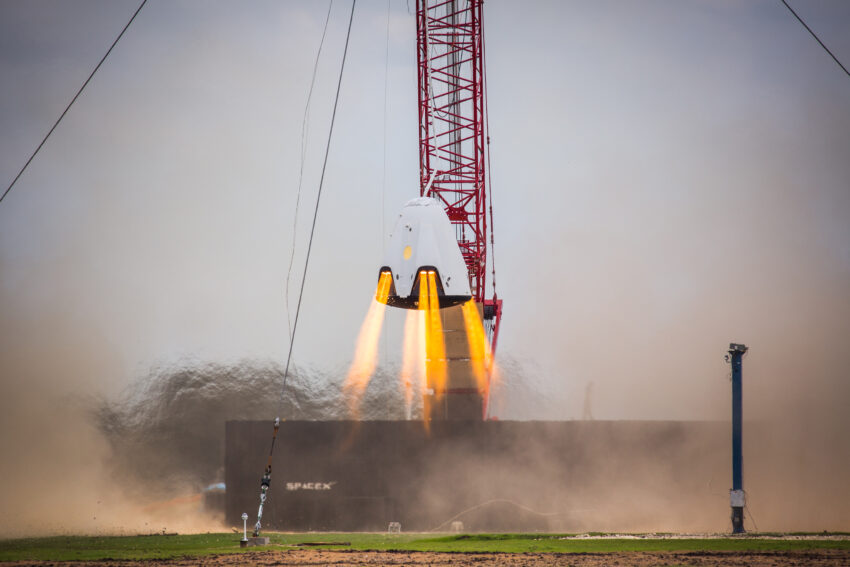
IMAGE: A full-size test article of the SpaceX Crew Dragon named DragonFly fires its eight SuperDraco engines in a development test of its ability to land with the accuracy of a helicopter using only the thrusters. The company conducted two tethered tests vehicle attached to a crane so engineers could refine the landing software and systems on the spacecraft. SpaceX envisioned returning people to Earth from space on the power of thrust instead of beneath parachutes. SpaceX, in partnership with NASA’s Commercial Crew Program, is developing the Crew Dragon and Falcon 9 integrated system to launch astronauts to the International Space Station from the United States.. Photo: SpaceX Photos / Wikimedia, CC0