
The longtime immigration adviser will take over on November 9 as President Donald Trump reshapes his White House leadership following Republican losses in the 2026 midterm elections.
President Donald Trump has appointed Stephen Miller as his new White House chief of staff, replacing Susie Wiles in a major leadership change following Republican defeats in the November 3 midterm elections. The announcement came Friday, November 6, with Miller scheduled to assume his new responsibilities on Monday, November 9.
Miller, 41, has been one of Trump’s closest advisers for more than a decade and a leading figure in the administration’s immigration policies. His promotion places an outspoken supporter of expanded presidential authority in charge of coordinating White House operations during the final two years of Trump’s second term.
The appointment also follows a political setback for Republicans, who lost control of both chambers of Congress in the midterm elections. The changes will give Democrats greater authority over legislation, congressional investigations and oversight of the administration.
Trump Announces Major White House Leadership Change
Trump announced Miller’s appointment on Truth Social, praising his longtime adviser and thanking Wiles for her service. He described Miller as one of his most trusted advisers and said he understood both the administration’s priorities and the political challenges ahead.
Speaking with reporters Friday, Trump acknowledged that the change marked a significant personnel decision. However, he said it was not a direct response to the Republican Party’s election losses.
The White House subsequently issued an official statement identifying Miller as the 33rd White House chief of staff. The announcement highlighted his experience in government and his involvement in developing major administration policies.
Miller had previously served as deputy chief of staff for policy and homeland security adviser. Those responsibilities gave him substantial influence over immigration enforcement, domestic policy and coordination between federal agencies.
As chief of staff, Miller will have a broader management role. He will be responsible for coordinating senior officials, overseeing policy implementation and helping determine which issues receive the president’s attention.
The position is one of the most influential jobs in the federal government, although it does not require Senate confirmation. The chief of staff traditionally serves as a central link between the president, executive departments and congressional leaders.
Miller’s appointment received immediate support from several senior administration officials. Vice President JD Vance, Secretary of State Marco Rubio and other Trump allies publicly congratulated him while praising Wiles for her work.
Susie Wiles Leaves After Historic Tenure
Wiles, 69, became the first woman to serve as White House chief of staff when Trump returned to office in January 2025. She had previously played an important role in organizing his successful 2024 presidential campaign.
Her leadership was widely associated with efforts to bring greater discipline to Trump’s political operation. She worked closely with senior advisers and cabinet members while managing the demands of a second administration.
According to the Associated Press, Wiles submitted her resignation Thursday, November 5. Friday was her final day in the White House, rather than November 9, as some earlier accounts suggested.
Wiles described the position as the honor of a lifetime and expressed pride in the administration’s accomplishments. She highlighted work on border security, economic policy and other priorities supported by the president.
Trump said Wiles would continue working with his political organization outside the White House. That arrangement will allow her to remain involved in his broader political activities without managing daily government operations.
Wiles underwent treatment for breast cancer earlier in 2026 and subsequently announced that she was cancer-free. Reporting about her departure has also described discussions about leaving the position that began before the midterm elections.
The exact combination of factors behind the leadership change has not been publicly established. Trump has characterized it as a personnel decision rather than a direct consequence of Tuesday’s voting.
Miller’s Immigration Policies Shape His Political Career
Miller has been closely associated with Trump’s immigration agenda since the 2016 presidential campaign. He served as a senior policy adviser and speechwriter during Trump’s first term, helping develop policies intended to reduce unauthorized immigration.
Before joining Trump’s political operation, Miller worked for Republican lawmakers, including former Senator Jeff Sessions of Alabama. He developed a reputation for promoting restrictive immigration policies and supporting stronger border enforcement.
During Trump’s first administration, Miller was involved in policies that led to the separation of migrant children from their parents at the U.S.-Mexico border. The family separation crisis became especially prominent in 2018 under the administration’s zero-tolerance prosecution policy.
The policy generated widespread criticism from humanitarian organizations, medical professionals and lawmakers. Supporters of the administration argued that stronger enforcement was necessary to discourage unlawful border crossings.
Miller remained an important immigration policy advocate after Trump left office in 2021. He returned to a senior White House position when Trump began his second term in January 2025.
Since then, Miller has helped coordinate an expanded immigration enforcement strategy involving federal agencies, deportation operations and efforts to increase cooperation between law enforcement organizations.
His influence has extended beyond immigration. Reporting from Reuters and other major news organizations has described his involvement in domestic security initiatives and efforts to expand the administration’s use of executive authority.
Birthright Citizenship and Executive Power
One of the administration’s most controversial immigration initiatives has involved an executive order seeking to restrict birthright citizenship.
Trump signed the order shortly after returning to office in January 2025. It sought to deny automatic citizenship to certain children born in the United States based on their parents’ immigration status.
The measure encountered legal challenges because the Fourteenth Amendment establishes citizenship protections for people born or naturalized in the United States and subject to its jurisdiction.
Miller has supported the administration’s position that existing interpretations of birthright citizenship should be reconsidered. Opponents argue that the executive branch cannot unilaterally change constitutional citizenship guarantees.
The dispute illustrates the broader legal questions surrounding some of the policies Miller has helped advance. Courts have examined the limits of presidential authority as the administration attempts to implement its immigration priorities.
As chief of staff, Miller will have an expanded role in coordinating the president’s agenda. However, the position does not give him independent authority to override federal law or judicial decisions.
His influence will depend on the president’s decisions, the cooperation of federal agencies and the legal limits applying to government actions.
Minnesota Immigration Operations Draw Scrutiny
The administration’s immigration enforcement strategy has also faced criticism following deaths involving federal agents in Minnesota earlier in 2026.
Federal immigration operations in Minneapolis became the subject of public demonstrations and demands for investigations after two U.S. citizens were fatally shot by federal agents.
The incidents prompted questions about enforcement practices, operational oversight and the use of force. They also increased political pressure on administration officials responsible for immigration policy.
Miller has defended aggressive federal enforcement and criticized local officials who oppose the administration’s approach. Critics argue that his influence has contributed to policies that place communities and civil liberties at risk.
The deaths should not be described as people being killed merely while intervening in immigration proceedings. The circumstances involved separate law enforcement encounters, and responsibility for those deaths must be assessed through the available evidence and investigations.
The administration has maintained that its enforcement operations are intended to uphold immigration law and improve public safety. Opponents have challenged the scope and methods of those operations.
Those disagreements are expected to become more prominent as Democrats prepare to exercise additional congressional oversight.
Democrats Prepare for Greater Congressional Influence
Miller’s appointment comes at a difficult political moment for Trump. Republican defeats in the midterm elections have changed the balance of power in Washington and increased scrutiny of the administration’s domestic and foreign policies.
Democratic leaders immediately criticized the decision. Senate Democratic leader Chuck Schumer argued that Miller’s record made him an inappropriate choice for the position.
House Democratic leader Hakeem Jeffries also condemned the appointment, citing Miller’s role in immigration enforcement and other administration initiatives.
Republican supporters offered a sharply different assessment. They praised Miller’s loyalty to Trump, understanding of federal government operations and willingness to defend the administration’s priorities.
The competing responses reflect the political significance of the appointment. Miller will be expected to help advance Trump’s agenda while working within a government in which Democrats control both chambers of Congress.
That division could make legislation more difficult and increase the importance of negotiations over spending, federal appointments and other government decisions.
The administration may also continue relying on executive orders and agency actions where it believes existing law provides the necessary authority. Those measures remain subject to constitutional limits and judicial review.
A New Role for One of Trump’s Longest-Serving Advisers
Born in California in August 1985, Miller attended Duke University before beginning his political career in Washington. His work on Capitol Hill established his interest in immigration and national security policy.
He joined Trump’s presidential campaign in 2015 and became one of the relatively small number of advisers who remained closely connected to the president through both administrations.
Miller married Katie Waldman, a former White House and Department of Homeland Security official, in 2020. The couple have four children.
His promotion represents the highest-ranking White House position of his career. It also creates new responsibilities that extend beyond policy development into staffing, scheduling, administration and relations with Congress.
The White House has not announced a broader restructuring of senior positions following Wiles’s departure. Additional personnel decisions may follow as Miller establishes his management team.
Miller is scheduled to begin work as chief of staff on Monday, November 9. His first responsibilities will include coordinating White House operations as the administration prepares to work with a newly elected Congress and respond to the political consequences of the midterm elections.
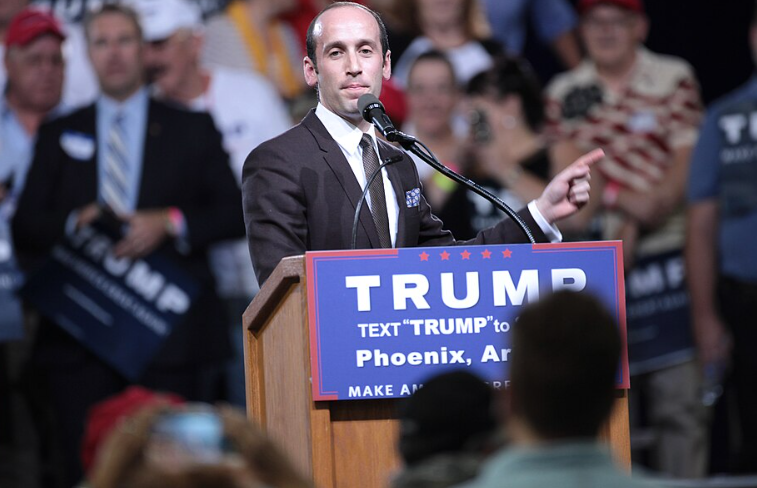
IMAGE: Source Stephen Miller Author Gage Skidmore from Peoria, AZ, United States of America CC2