
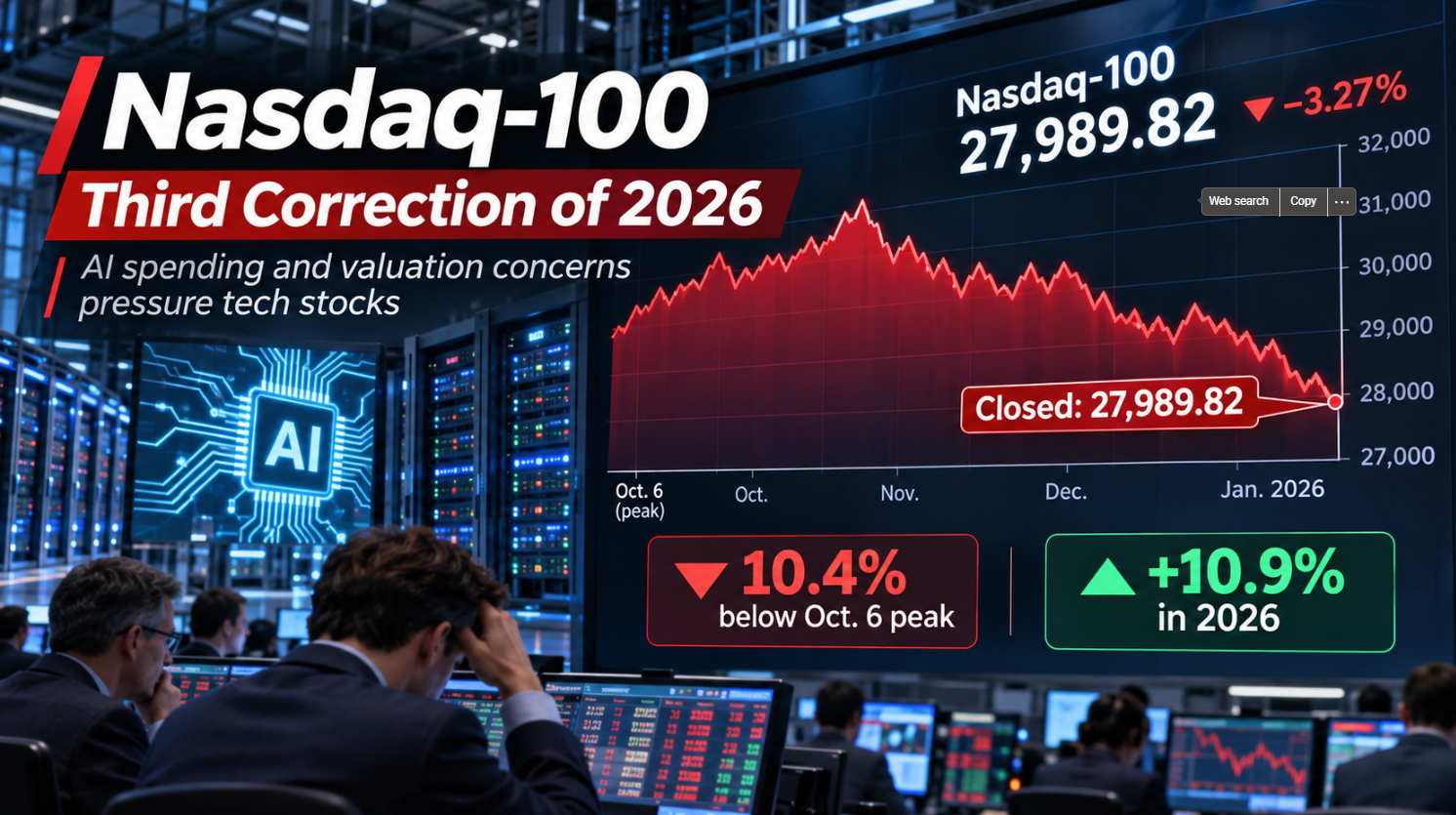
The technology-heavy index fell more than 10% from its October record on November 2, as disappointing earnings and rising AI infrastructure costs unsettled investors.
The Nasdaq-100 entered correction territory on Monday, November 2, 2026, after another decline in major technology stocks pushed the index more than 10% below its October peak. The selloff marked its third correction of the year as investors questioned whether massive spending on artificial intelligence would generate enough earnings to support elevated stock valuations.
The technology-focused benchmark fell 1.4% Monday to close at 27,989.82. That left it approximately 10.4% below its October 6 record closing level of 31,224.47, meeting the widely accepted definition of a market correction.
Despite the setback, the Nasdaq-100 remained approximately 10.9% higher for 2026. Its performance reflected both the strength of the earlier technology rally and the sharp changes in investor expectations throughout the year.
The index previously experienced corrections in March and July before recovering to reach new highs. Its latest decline followed a difficult October marked by disappointing corporate earnings, falling semiconductor shares and concerns about the financial returns from AI investments.
AI Spending Raises Questions About Technology Valuations
Artificial intelligence has been one of the strongest influences on stock market performance in recent years. Companies developing AI chips, cloud infrastructure and related software attracted investors expecting rapid growth in demand for the technology.
That optimism has supported substantial increases in the market values of several major technology companies. Investors have been willing to pay higher prices for shares based partly on expectations of future earnings growth.
However, those expectations are now facing closer examination. Companies have committed enormous sums to data centers, advanced processors, electrical infrastructure and other equipment needed to operate increasingly powerful AI systems.
Bloomberg reported that technology investors have entered a more demanding phase as they assess whether those expenditures will deliver sufficient financial returns. The concern is not necessarily that AI adoption will stop growing, but that profits may take longer to materialize than stock prices previously suggested.
Businesses developing AI infrastructure must pay for expensive equipment and facilities before they can fully benefit from increased demand. If revenue growth fails to match investment expectations, companies could face weaker profit margins and greater pressure on their balance sheets.
Such concerns can affect stock valuations even when companies continue reporting higher revenue. Investors may become less willing to pay large premiums for anticipated earnings that remain years away.
Intel, Amazon and Alphabet Add to Selling Pressure
Several prominent technology companies contributed to the recent decline following earnings announcements that disappointed investors.
Intel suffered one of the most severe setbacks during the final trading sessions of October. Its shares plunged approximately 28.6% on October 30 after the company issued a disappointing fourth-quarter revenue forecast.
The semiconductor manufacturer’s outlook raised concerns about its competitive position and ability to meet market expectations. The decline also contributed to broader selling across the chip industry.
Amazon faced pressure after reporting higher-than-expected capital spending and slower growth in its core e-commerce business. Investors examined whether the company’s expanding AI infrastructure commitments could weigh on profitability.
Alphabet also experienced a sharp market decline following its financial results. Concerns about rising investment costs and future earnings helped reverse some of the enthusiasm that had previously supported its shares.
These developments affected companies with different business models, demonstrating how closely major technology valuations have become connected to expectations for AI-related spending and growth.
The Philadelphia Semiconductor Index declined 7.2% on October 30, adding to concerns about the health of the broader chip market. Semiconductor companies are especially sensitive to changes in expectations for AI infrastructure because their products support data centers and advanced computing systems.
What the Third Market Correction Means
A stock market correction occurs when a major index falls at least 10% from a recent high. The term describes the size of a decline rather than establishing why it happened or predicting what will follow.
Corrections are generally considered less severe than bear markets, which are commonly defined by declines of at least 20%. A correction can develop during a longer-term market advance without necessarily leading to a prolonged downturn.
The Nasdaq-100 experienced a similar episode on October 30 when it briefly crossed the correction threshold during trading. However, the index recovered enough to finish that session approximately 9.1% below its October record.
Monday’s decline pushed it below the threshold on a closing basis. That confirmed the third correction of 2026 following earlier declines in March and July.
MarketWatch reported that the latest correction occurred while investors were becoming increasingly concerned about extensive borrowing and spending on AI data centers. The question facing shareholders is whether future revenue and earnings will justify the financial commitments already being made.
The index’s continued positive return for the year also provides important perspective. Although the recent decline has been substantial, earlier gains have prevented the Nasdaq-100 from turning negative for 2026.
Weakness Spreads Beyond Individual AI Stocks
Monday’s trading showed how weakness in large technology companies can influence broader stock market performance.
The Nasdaq Composite fell approximately 1.1%, while the S&P 500 declined 0.5%. The technology-heavy Nasdaq-100 experienced a larger drop because of its concentration in major growth companies.
Other areas of the market performed differently. Several S&P 500 sectors recorded gains despite the decline in the broader index, indicating that selling pressure was not distributed evenly across all industries.
Investors sometimes respond to falling technology valuations by shifting money into companies with different earnings characteristics. Businesses in energy, healthcare, utilities and other industries may attract interest when investors become cautious about highly valued growth stocks.
This process, often described as sector rotation, does not necessarily mean investors are abandoning equities. Instead, it can reflect changing expectations about which industries offer attractive returns relative to their risks.
The distinction matters because a concentrated decline in major technology companies can pull down market indexes even when many individual stocks remain relatively stable.
High Valuations Leave Little Room for Disappointment
One concern surrounding AI-related shares is the relationship between current valuations and future earnings.
Investors often value rapidly growing technology companies using estimates of profits several years ahead. Higher expectations can support larger stock prices, but they also increase the potential effect of disappointing financial results.
When companies fail to meet those expectations, their shares may fall even if revenue and earnings continue growing. The market can respond negatively because the actual performance does not justify the premium investors previously paid.
Rising borrowing costs can create another difficulty. Companies financing major infrastructure projects may face pressure if interest expenses increase or expected returns take longer to arrive.
The rapid expansion of AI data centers also requires electricity, cooling systems, real estate and specialized equipment. These costs make investment decisions increasingly important for technology companies attempting to expand capacity.
The longer-term commercial opportunity remains significant, but growth in AI usage does not automatically translate into equally rapid profit growth for every company involved.
Investors Await Earnings and Economic Signals
The correction arrives during a period of economic and political uncertainty. Investors are following the November 3 U.S. midterm elections while preparing for employment data and additional corporate earnings announcements.
The October U.S. jobs report, scheduled for November 6, could influence expectations for interest rates and the broader economy. Changes in those expectations can affect technology valuations because investors use interest rates when assessing future corporate earnings.
Upcoming results from major technology companies will provide further evidence about demand for AI equipment and services. Investors will be examining revenue, profit margins, capital expenditures and management forecasts.
Nvidia is among the companies whose financial performance receives particularly close attention because of its role in supplying advanced processors for AI computing.
For now, the Nasdaq-100’s November correction reflects a change in how investors are weighing the opportunities and costs associated with artificial intelligence. The index remains higher for the year, but its third correction demonstrates how quickly expectations can change when corporate results fall short of market forecasts.
The next important signals will come from company earnings reports, AI spending plans and economic data. Those developments will help determine whether the technology sector can regain investor confidence after its difficult October.
IMAGE: DNR News Department