
Six decades after the Enterprise first appeared on television, Star Trek fans continue to shape a global culture of conventions, creativity, friendship and shared optimism.
For 60 years, Star Trek has been more than a television franchise. It has also been a meeting place for fans who saw possibility in its stories about exploration, science, cooperation and a future built around people from different backgrounds working together.
The original series premiered in the United States on Sept. 8, 1966. Six decades later, the franchise has expanded across television, film, animation, publishing, games, podcasts and live experiences. Paramount says the Star Trek universe now includes 11 television series, 14 films and more than 900 episodes, with programming available in more than 190 countries.
That long life was never guaranteed. Star Trek: The Original Series lasted three seasons and 79 episodes, but viewers continued supporting it through letters, fanzines, fan clubs and gatherings. Those communities helped keep interest alive after the original network run ended and created habits that would later become familiar across modern fandom.
John Champion, producer and co-host of Mission Log: A Roddenberry Star Trek Podcast, told ScreenRant that fans have helped define what Star Trek means through fan fiction, fan films, meetups, conventions, blogs, books and podcasts. The relationship between the franchise and its audience has become part of Star Trek’s identity.
Long before social media made instant communication possible, fans relied on newsletters and fanzines to find one another. One of the earliest important gatherings took place on March 1, 1969, at Newark Public Library in New Jersey. The free Star Trek Con, organized by Sherna Comerford Burley and Devra Langsam, attracted about 300 people and included panels, presentations and a fan-produced skit.
A much larger event followed from Jan. 21 to 23, 1972, at the Statler Hilton Hotel in Manhattan. Organizers expected only a few hundred people, but more than 3,000 attended. StarTrek.com has described that convention as the first major convention devoted to Star Trek and an event that helped establish the model for the large Trek gatherings that followed.
San Diego Comic-Con provides another measure of that change. David Glanzer, the convention’s chief communications and strategy officer, told ScreenRant that Star Trek programming remains a regular part of the event even as Comic-Con has expanded far beyond its early focus. Current conventions can combine panels, exhibits, branded experiences and online discussion that reaches people who never enter the convention hall.
The fan network also preserves its own history. Podcasts, archives, convention panels and longtime collectors document stories that might otherwise disappear, including the contributions of early organizers who built communities before studios treated fandom as a major part of entertainment culture.
The scale of fan events has changed dramatically since then. In August 2026, Creation Entertainment’s STLV: Trek to Vegas marked the 60th anniversary with a five-day convention at the Rio in Las Vegas. The organizer listed nearly 200 guests and reported that admission packages sold out.
The Star Trek Cruise has also become part of the modern fan calendar. The 2026 sailing ran from Feb. 20 to 27 and was promoted as part of the franchise’s anniversary year, with veteran performers and actors from across different Star Trek series joining fans at sea.
For many attendees, however, celebrity appearances are only part of the attraction. Conventions offer a place to meet people who may have first connected through online groups, podcasts or local clubs. The gatherings can turn relationships built at a distance into lasting friendships.
Los Angeles has its own example in the LA Away Team. Group leader Yez Ze Masc described it as a casual social community for people interested in Trek, space and related science fiction. The group does not require formal meetings or costumes, an approach intended to make participation easier for people who simply want to spend time with other fans.
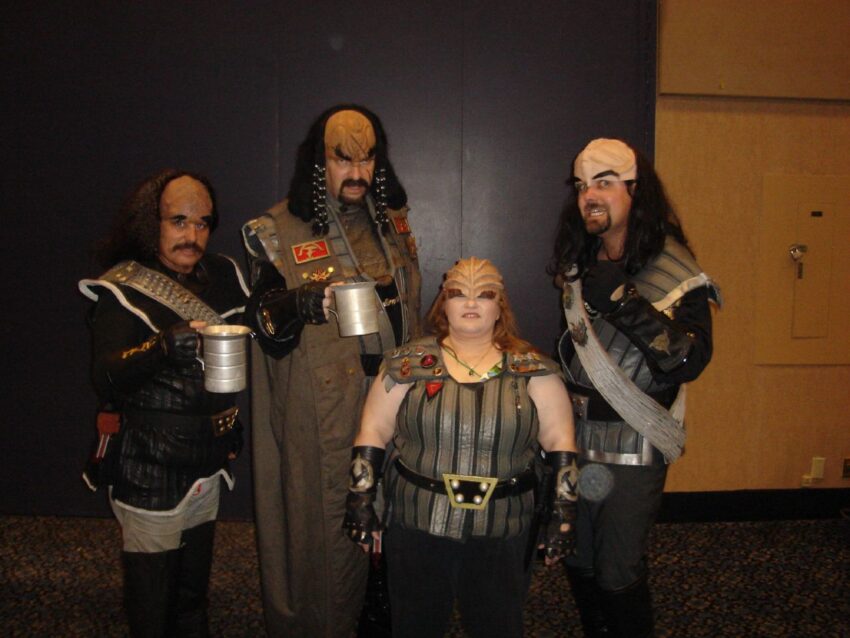
Cosplay remains one of the most visible parts of convention culture. Fans appear as Starfleet officers, Klingons, Vulcans and characters from multiple generations of the franchise. Others build props, create artwork, write stories, record podcasts or produce fan films, extending the fictional universe through their own work.
That creativity has always existed alongside debate about what Star Trek represents. Gene Roddenberry’s future was built around the idea that humanity could move beyond many of its divisions. The Vulcan phrase “Infinite Diversity in Infinite Combinations,” commonly shortened to IDIC, became one of the franchise’s best-known expressions of that philosophy.
The official Star Trek site describes IDIC as a celebration of differences and of the value created when different perspectives come together. That idea has helped make the franchise meaningful to fans across generations, cultures and nationalities, even when individual viewers disagree about particular series, characters or creative choices.
Star Trek has also inspired people beyond entertainment. Fans and cast members have often spoken about its influence on interests in science, engineering, medicine and space exploration. The franchise’s hopeful view of the future has given audiences a fictional example of discovery driven by curiosity rather than conquest alone.
The 60th anniversary has emphasized that relationship between the stories and the people who kept returning to them. Paramount launched a yearlong celebration built around the theme “Space for Everybody,” while official events highlighted participation by fans as much as the franchise’s television and film history.
That history now stretches from mimeographed fanzines and library gatherings to global conventions, streaming communities and cruise ships filled with people wearing Starfleet uniforms. Technology changed how fans find one another, but the basic reason for gathering has remained recognizable.
Star Trek fandom grew because viewers did not want the experience to end when an episode was over. They wrote, organized, dressed up, debated, created and formed communities around a shared vision of the future.
Sixty years after the Enterprise first appeared on television, that fan culture remains one of Star Trek’s strongest links between its past and whatever comes next.
IMAGE: Fans dressed as Klingons in a Star Trek Convention.Star Trek Convention 106. Photo: Eric / Wikimedia, taken 2007-08-12, CC BY 2.0