
Google’s newest frontier model is initially restricted to trusted cybersecurity defenders while the company separately tests AI computing hardware in orbit through Project Suncatcher.
Google announced its latest frontier artificial intelligence model called Gemini 4 Argon on September 30 2026. The model has drawn attention for both its advanced capabilities and its limited release. Google chose to roll out Argon first to trusted cybersecurity defenders through its Fairwind Program rather than opening it broadly.
This approach has led to wider discussion about how much caution is appropriate when introducing powerful new AI systems into public use.
Gemini 4 Argon is designed for complex long-running tasks in areas such as software engineering and cybersecurity. Google also says the model performs advanced knowledge work in fields such as finance and law. The company has given Argon a one-million-token output limit.
Google says the restricted rollout is intended to help strengthen safeguards before wider availability. The company is testing protections against misuse involving cyberattacks and dangerous biological or chemical applications. It is also working to improve resistance to prompt injection attacks that could manipulate an AI system’s behavior.
Google is participating in a voluntary U.S. government process for pre-release access to frontier models. The company plans to gather feedback from early testers before offering Argon to developers and other customers. Google says paid API customers and Google AI Ultra subscribers will be among the first broader groups to receive access.
The situation highlights a larger issue in the tech industry about balancing innovation with responsibility. As AI systems grow more capable companies must grapple with how to deploy them safely without stifling progress.
In another development Google launched a satellite carrying its own advanced computing chips into space on a SpaceX rocket according to TechCrunch. The satellite was sent aboard the Transporter-18 rideshare mission on October 1 and is meant to test how Google’s Tensor Processing Units perform in orbit. Google confirmed that it had contacted the satellite after launch and that it was operating as expected.
This effort is part of a larger project called Project Suncatcher which aims to explore large-scale computing clusters in orbit around Earth. The satellite will run its TPU in 15-minute bursts to avoid placing too much strain on its power and cooling systems. Google and Planet plan a 2027 test involving two more specialized satellites linked through laser communications.
Google envisions a network of satellites flying in formation to process data in parallel which could help with large-scale AI workloads. One research design uses an 81-satellite cluster as an example of how such a system could operate.
According to Google’s research launch prices could fall to about $200 per kilogram by the mid-2030s under an aggressive cost-reduction scenario. That model would require roughly 1,800 Starship launches over about 10 years rather than 1,800 launches per year. The estimate works out to roughly 180 launches annually if each mission carried about 200 metric tons.
Despite the challenges Google believes its chips can handle the radiation in space and maintain performance for a five-year satellite mission. The company had to redo tests after realizing earlier results were overly optimistic about the chip’s resilience. Even with some errors Google remains confident that its chips can support large inference workloads in space.
The research behind Project Suncatcher has been published in a peer-reviewed paper in Joule.
In addition to Google’s work tech leaders are also exploring how consciousness might factor into future AI systems according to Fast Company. Anthropic co-founder Christopher Olah has been studying what it could mean if AI systems were conscious. Anthropic describes this area of research as model welfare.
To explore the issue Anthropic consulted theologians and religious thinkers from several traditions including Jewish and Sikh communities. The discussions also involved Mormon and Ubuntu perspectives as well as Vatican officials. The work reflects how ethical and philosophical questions are becoming more central as AI systems become more capable.
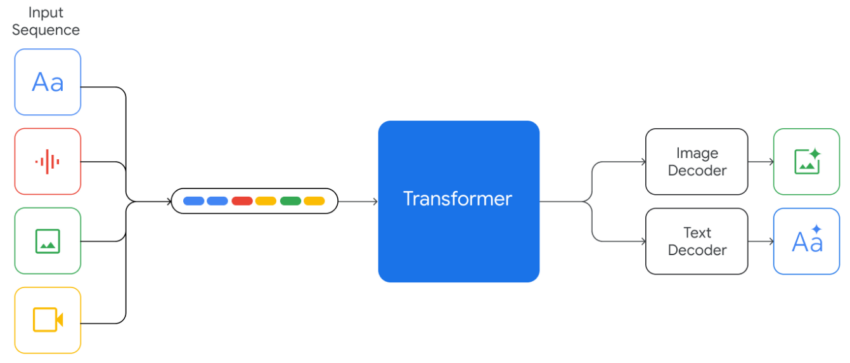
IMAGE: “Gemini supports interleaved sequences of text, image, audio, and video as inputs (illustrated by tokens of different colors in the input sequence). It can output responses with interleaved image
and text.”. Photo: Authors of the preprint: Gemini Team Google: Rohan Anil, Sebastian Borgeaud, Yonghui Wu, Jean-Baptiste Alayrac, Jiahui Yu, Radu Soricut, et al. / Wikimedia, taken 2023-12-19, CC BY 4.0