
Registered voters are more likely to support a Democratic candidate for Congress than a Republican, according to the latest NPR/PBS News/Marist poll. The survey found 53% supporting the Democratic candidate in their district and 41% supporting the Republican candidate. Democrats also held advantages when voters were asked which party would better handle gas prices, the economy, and foreign policy.
A majority of respondents also think it is more important to vote for candidates with new ideas rather than those with experience. The poll found 56% preferred candidates with new ideas while 38% preferred candidates with a proven record.
President Trump’s job approval rating stands at 39% among registered voters. Another 59% disapprove of his job performance, including 53% who strongly disapprove. In June, Trump’s approval rating was 38%.
Democrats also have substantial support from independent voters in the congressional ballot question. Independents favored Democratic candidates by 57% to 32% in the Marist poll. A plurality of all registered voters, 45%, say their decision to vote for Congress is mainly a vote against President Trump.
Among Democrats, four in five say they are voting against Trump, while about half of independents do the same. About a quarter of voters, including most Republicans and Trump 2024 supporters, say their vote is to back the president. Marist found that 59% of Republicans described their congressional vote as mostly a vote for Trump.
Recent state polling also shows competitive Senate contests in states that backed Trump in 2024. In Iowa, a Marist poll found Democrat Josh Turek at 50% and Republican Ashley Hinson at 42% among registered voters. In Texas, Democrat James Talarico received 50% while Republican Ken Paxton received 44%. Each state poll had a margin of error of plus or minus 4.4 percentage points.
Trump’s favorability has declined since his return to office, dropping from 44% in early 2025 to 37% in the latest Marist survey. That figure measures whether voters have a favorable opinion of Trump and is separate from his 39% job approval rating.
The Republican Party trails Democrats on several issues in the poll. On the economy, voters favored Democrats 42% to 34%. Democrats also led on foreign policy by 42% to 36% and gas prices by 40% to 27%.
In immigration, for example, 41% of voters say Democrats would do better than Republicans, compared to 38% who say the opposite. Voters also believe Democrats are more capable of managing gas prices and foreign policy. The immigration numbers represent a major change from 2024, when Marist found Republicans held a 42% to 30% advantage on the issue.
Economic concerns and the Iran war have also affected some Republican campaigns. This week, Iowa Representative Ashley Hinson and former Michigan Representative Mike Rogers changed their positions after previously supporting Trump’s authority to conduct military strikes against Iran. They now support ending the Iran war and suspending gas taxes to help with rising prices.
Reuters reported that Hinson had voted six times against House measures seeking to limit Trump’s authority to continue the war. Rogers had also previously supported Trump’s strikes and opposed efforts to curb his authority while negotiations were underway. Both candidates have now called for the war to end quickly and for gasoline taxes to be suspended.
Gas prices have risen sharply in Michigan and Florida. Michigan’s statewide average reached $4.93 per gallon on September 21, the highest level in the state so far in 2026. AAA said that was 62 cents higher than a week earlier and $1.75 higher than a year earlier.
Florida’s average for regular gasoline was about $4.29 on September 23. That was not a record for regular gasoline. Florida’s record average for regular remains about $4.89 from June 2022. However, the state’s diesel average recently reached a record above $6.34 per gallon.
Most registered voters say they are paying attention to the midterm elections. About 75% told Marist they are following the election either closely or very closely. Nearly nine in ten said they care at least quite a bit about which party controls Congress.
A separate survey commissioned by Bipartisan Policy Center Action and American Policy Ventures found that 60.5% of likely voters believe the country is mostly or definitely on the wrong track. The poll also showed that a majority of voters would prefer to vote for a Democratic candidate over a Republican candidate in the 2026 midterms.
Respondents identified healthcare costs, grocery prices, and housing expenses as their biggest sources of stress. The poll was conducted among 1,500 likely voters between September 1 and 2, 2026. It found that 50.7% of respondents would vote for a Democratic candidate, while only 42.1% said they would vote for a Republican.
The poll also revealed that two-thirds of voters believe the federal government is doing too little to help families. Liam deClive-Lowe, president of American Policy Ventures, said policies supporting families are backed across party lines. The survey found 67% said the federal government was doing too little for families, including majorities of Democrats, independents and Republicans.
The survey was commissioned by the Bipartisan Policy Center Action and American Policy Ventures. It was conducted by Cygnal and Impact Research.
The two national surveys were conducted at different times and among different populations. The NPR/PBS News/Marist survey questioned 1,280 registered voters on September 14 and 15 and had a margin of error of plus or minus 3.8 percentage points. The BPC Action and American Policy Ventures survey questioned 1,500 likely voters on September 1 and 2.
Polls provide a snapshot of voter opinion when they are conducted and do not determine the outcome of the November election.
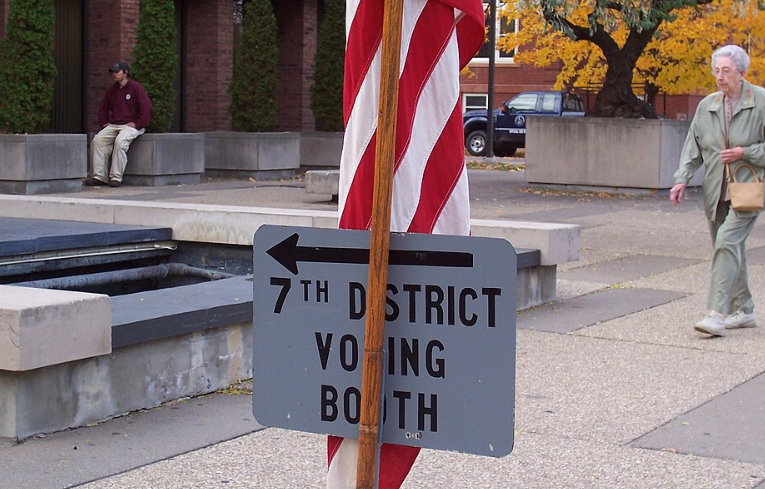
IMAGE: Source “7th district voting booth” Author rochelle hartman CC2