
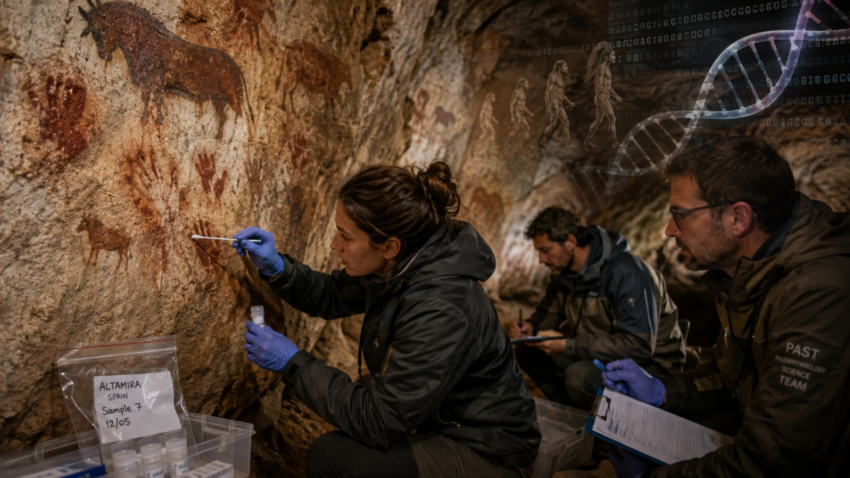
Scientists have found genetic material from ancient humans directly on the walls of caves in Spain and Portugal, marking a breakthrough in understanding how our ancestors lived and created art. These findings come from a new method that extracts DNA not only from bones or teeth but also from the surfaces of painted cave walls. The samples were taken from caves across Spain and Portugal, where researchers identified ancient DNA that belonged to populations who lived in Europe during the Late Palaeolithic and Mesolithic times. One of the most significant samples came from a pigmented part of a cave wall in Escoural Cave, Portugal, which contained DNA that could be traced to ancient western hunter-gatherers.
However, the technique is not yet advanced enough to definitively identify a specific artist behind any particular painting, according to The Conversation. Still, this development opens up new possibilities for studying the communities that made cave art and how they relate to other ancient human populations. The discovery also raises questions about who actually created some of the oldest known cave paintings, such as a hand stencil found in Maltravieso Cave in Spain. That stencil is dated to around 66,700 years ago, which is earlier than when modern humans are thought to have entered Europe. Some researchers believe Neanderthals may have made the art, but finding DNA from either species in that location could help settle the debate.
But even if DNA is found, it does not automatically prove who made the paintings, as genetic material can be transferred through simple actions like breathing. In addition to cave art studies, scientists are also using new methods to explore the genetic legacy of ancient human populations in modern DNA, according to a report from Smithsonian Magazine. A recent study revealed that modern humans carry genetic material from two previously unknown hominin species, one of which interbred with early Homo sapiens more than 50,000 years ago. Another ancient lineage contributed genetic material indirectly through Denisovans more than 200,000 years ago, suggesting a complex pattern of interbreeding among early human relatives. These findings show that the evolutionary tree of Homo sapiens is more intertwined than previously believed, with multiple branches representing extinct human species.
The research team used a new approach that analyzes current-day human genomes rather than relying on ancient DNA from fossils. This method allowed them to trace genealogical relationships across different parts of the human genome and identify genetic segments that came from these ancient populations. One of the mysterious ancestors may have been Homo heidelbergensis, a species that lived between 200,000 and 700,000 years ago in Europe, parts of Africa and potentially Asia. Another ancient lineage seems to have contributed genetic material to Denisovans, who then passed it on to modern humans, particularly in populations from Oceania.
This research shows that early humans did not evolve in isolation and that their genetic history is far more complex than earlier theories suggested. In a related field, scientists are also using artificial intelligence to design new proteins by understanding how amino acid sequences fold into structures, Phys.org reported. They have developed a machine-learning model called PottsMPNN that improves protein design by better modeling the relationship between sequence and structure. This new framework allows researchers to generate sequences for novel proteins that do not resemble any naturally occurring ones. By incorporating physical principles and evolutionary information, the model helps predict how mutations affect protein stability.
The development of such tools could lead to advances in medicine and biotechnology by enabling the creation of proteins that target specific diseases.
IMAGE: Ancient Human DNA Found on Cave Walls in Spain and Portugal DNR Art Department