
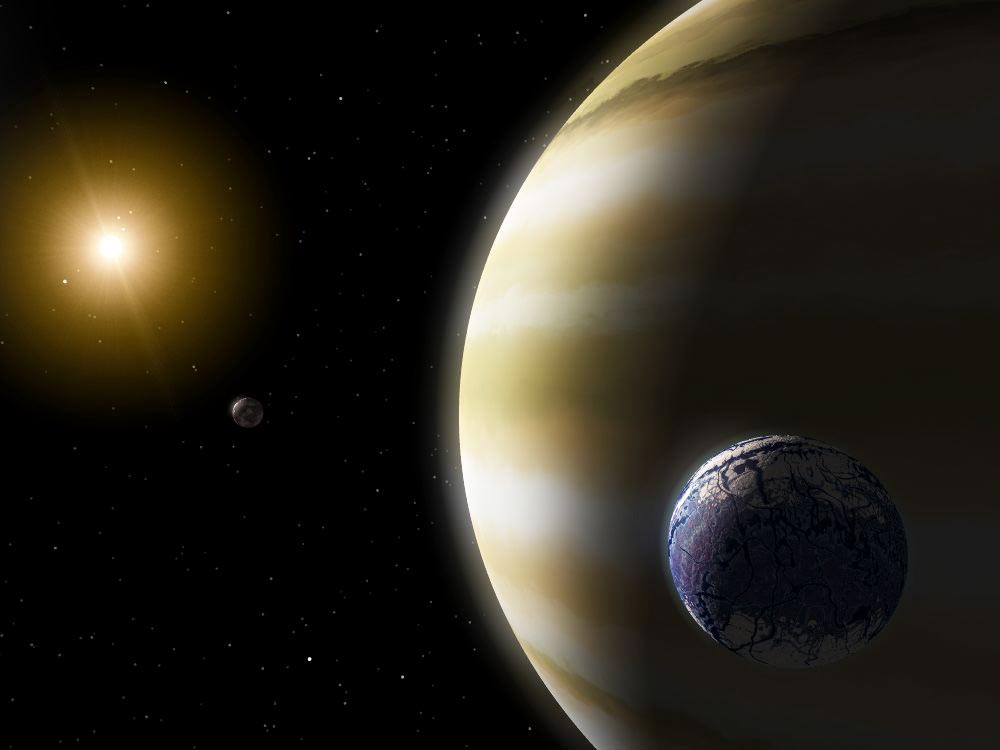
Astronomers have identified an unusual celestial body that may change how scientists think about moons and planets. The object orbits a brown dwarf, which itself circles a star. This three-tiered arrangement is unlike anything found in our own solar system. The newly discovered world is about the size of Jupiter and moves around its host brown dwarf in a way that makes it difficult to categorize using traditional terms.
The discovery was made using data from a powerful telescope located in Chile. Scientists tracked tiny changes in light coming from the brown dwarf as it moved under the pull of the orbiting object. These movements were subtle but detectable, allowing researchers to calculate the mass of the satellite. The object has at least 90% of Jupiter’s mass and orbits its host at a distance that takes about 170 days to complete one full revolution.
This system is different from previous discoveries because it involves a brown dwarf rather than a planet. Brown dwarfs are objects that form like stars but do not have enough mass to start nuclear fusion. They fall between the largest planets and smallest stars in size. The new satellite orbits a brown dwarf that is about 37 times heavier than Jupiter, making it a significant gravitational partner.
The challenge for scientists lies in how to label this object. It is massive enough to be considered a planet, but it does not orbit a star directly. Instead, it circles a brown dwarf that orbits a star. Because of this unusual setup, researchers are hesitant to call it either a moon or a planet. Some prefer the term exosatellite, which describes any satellite orbiting a world outside our solar system without requiring a strict definition.
The object’s mass and orbital pattern suggest it might have formed differently than typical moons in our solar system. Moons usually form from leftover material around their parent planets. But this satellite is too large to have formed that way. Scientists believe it may have come into existence like a star does, collapsing directly from a gas cloud. If true, this would make the formation process very different from what we see with moons orbiting planets.
This finding adds to growing evidence that the universe contains many strange and unexpected systems. Our solar system offers simple categories for celestial bodies, but other parts of space do not always fit neatly into those boxes. The discovery raises questions about how scientific terms are used when describing distant worlds.
Researchers note that this is only the beginning. Future telescopes will likely find more examples of these unusual arrangements. Some believe that systems like this one could be more common than previously thought. As tools improve, scientists expect to learn more about how such objects form and what role they play in their respective systems.
The debate over naming continues among experts. Some argue that the object should be called a planet because of its mass and behavior. Others insist it is better described as an exosatellite or even a failed star. There is no official definition for what makes a moon, which adds to the confusion. As more discoveries come in, scientists may need to update their vocabulary to reflect new realities.
This discovery also opens up possibilities for habitable worlds far from stars. If a satellite orbits close enough to its host brown dwarf, it might receive heat through tidal forces instead of sunlight. This could allow life to exist in regions where traditional habitable zones do not reach.
The system is located about 72 light-years away from Earth. It includes a red dwarf star and a brown dwarf that orbits it. The satellite moves around the brown dwarf at a distance that makes its orbit relatively tight. Its path is not perfectly circular, which adds complexity to understanding how it formed and evolved.
Scientists have spent years studying similar systems, but this one stands out due to its mass ratio and orbital characteristics. Previous attempts to find exomoons have mostly failed because they are too small and faint to detect clearly. The new method used here shows promise for uncovering more of these hidden worlds.
The data collected over multiple nights helped confirm the satellite’s presence. Measurements were taken with high precision, allowing researchers to rule out other explanations. Computer simulations supported the idea that a single large object is most likely responsible for the observed motion.
While this discovery does not definitively answer all questions, it provides a new example of how complex and diverse space systems can be. It shows that our understanding of celestial mechanics must evolve as we learn more about distant worlds. The implications extend beyond just naming conventions, touching on theories of formation and potential for life in unexpected places.
As more powerful instruments come online, researchers expect to find many more examples of these nested orbits. These findings will help shape future discussions about how to classify objects in space. For now, the system around CD-35 2722 remains a unique case that challenges current scientific thinking.
IMAGE:
The original uploader was Latitude0116 at English Wikipedia. / Wikimedia Commons (Public domain) Source: http://www.nasa.gov/lb/centers/jpl/news/planetquest-080205.html
This article passed automated originality and source-verification checks before publishing.