
The Cassini spacecraft observed unusual features in the seas of Titan that appeared and disappeared over time. These changes were not permanent structures but rather transient phenomena. Scientists named them “magic islands” due to their shifting nature. The bright patches did not look like solid land, but instead showed up as radar echoes that changed in size, shape, and visibility across multiple flybys.
These features were first seen in Ligeia Mare during a close pass in 2013. They did not appear in earlier images taken before the event. The same area was checked again in 2014 and showed the feature returning, though with different dimensions. By January 2015, it had vanished completely. Similar behavior was noted in Kraken Mare, the largest sea on Titan.
Cassini used synthetic-aperture radar to map the surface of Titan. This method sends microwave signals through the thick atmosphere and measures how much energy returns from land or liquid. A calm sea reflects little energy and appears dark in the images. Rough surfaces, floating objects, or suspended particles can reflect more back, making those areas appear bright.
The first clear case happened in Ligeia Mare during T92 flyby. The feature was not present in earlier high-resolution data. It reappeared later with a different shape and size, then disappeared again. A second such patch appeared in the same sea in 2014 but also vanished by January 2015. These events were repeated across multiple observations, ruling out image artifacts or fixed geological features.
Scientists studied what could cause such changes. One idea involved waves, which are common in liquid environments. Another suggested floating or suspended solids like organic rafts that might appear and sink over time. A third theory proposed nitrogen bubbles forming within the sea.
Nitrogen dissolves easily in cold methane-rich liquids on Titan. When conditions change—such as warming, pressure drop, or mixing with ethane-rich fluids—nitrogen can be released from solution. This process is called exsolution. It’s similar to how carbon dioxide escapes from a soda when opened.
Laboratory experiments tested how nitrogen behaves in methane-ethane mixtures under Titan-like conditions. These tests confirmed that significant quantities of gas can be released quickly. Mixing different types of liquids, such as fresh methane runoff entering an ethane-rich sea, could trigger this exsolution.
The idea of bubbles explains why radar signals would return strongly from certain areas. If a field of centimeter-sized nitrogen bubbles rises through the liquid, they scatter the microwave signal. This can make a large area appear bright even though no solid land exists there.
Models suggest that nitrogen exsolution could occur in deep layers of Titan’s seas. As liquid moves upward or changes composition, gas may separate and rise to the surface. The process can start, continue, and stop depending on changing conditions. This matches the pattern seen by Cassini—features appearing, disappearing, then returning.
The term “island” is useful for visualizing what was seen but does not describe the actual physical state. What Cassini detected may have been roughness or scattering within a liquid rather than floating objects. The radar response could reflect changing surface conditions without real land.
Other explanations remain possible. Waves and porous organic materials could also create similar radar returns. Organic compounds settle from Titan’s atmosphere and can form deposits in the seas. Some of these might float temporarily if they are large enough and have internal void spaces. These rafts could behave like icebergs, staying at the surface until liquid seeps into their pores.
The key point is that Cassini proved Titan’s seas are active. The radar data shows that changes happen over time in ways that do not match fixed features or measurement errors. However, scientists cannot say exactly what caused each event. The spacecraft did not observe continuously and multiple physical processes can produce similar results.
Cassini completed its final close flyby of Titan in April 2017 before ending its mission at Saturn in September. No current mission is designed to explore the seas directly or stay long enough to track these changes over time. Future missions may include instruments capable of measuring sea conditions or sending probes that can land on the surface.
The most supported explanation for the bright features remains nitrogen exsolution. This idea connects directly to known chemical behavior under Titan’s cold and unique environment. While it does not explain every detail, it provides a physical mechanism that matches what was observed. Whether these changes are caused by bubbles, floating rafts, or waves, they confirm that Titan’s seas are not static.
The ongoing mystery of the magic islands highlights how much more there is to learn about Titan. The moon’s complex chemistry and climate system continue to surprise scientists. Future missions may finally resolve whether these features are truly bubbles, floating solids, or something else entirely.
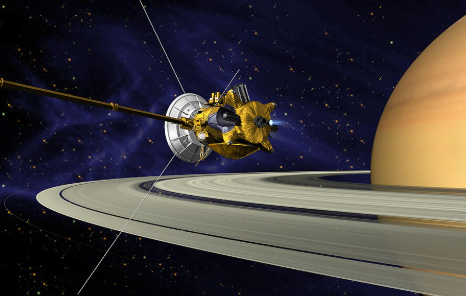
IMAGE: Orbit Insertion (SOI) maneuver, just after the main engine has begun firing. Taken on 11 December 2002 JPL Photojournal
This article passed automated originality and source-verification checks before publishing.